
Search News
Industry Portal
Hot Articles
BLDC Motor Technology in Power Tools: Efficiency Gains That Matter
Time
Click Count
BLDC motor technology is reshaping modern power tools by delivering higher efficiency, stronger torque density, lower maintenance, and longer runtime in demanding industrial environments. For researchers evaluating tool performance, procurement trends, or future-ready hardware strategy, understanding these efficiency gains is essential to judging real-world productivity, lifecycle cost, and competitive value across construction, manufacturing, and smart infrastructure applications.
Why BLDC Motor Technology Matters More in Today’s Power Tool Market
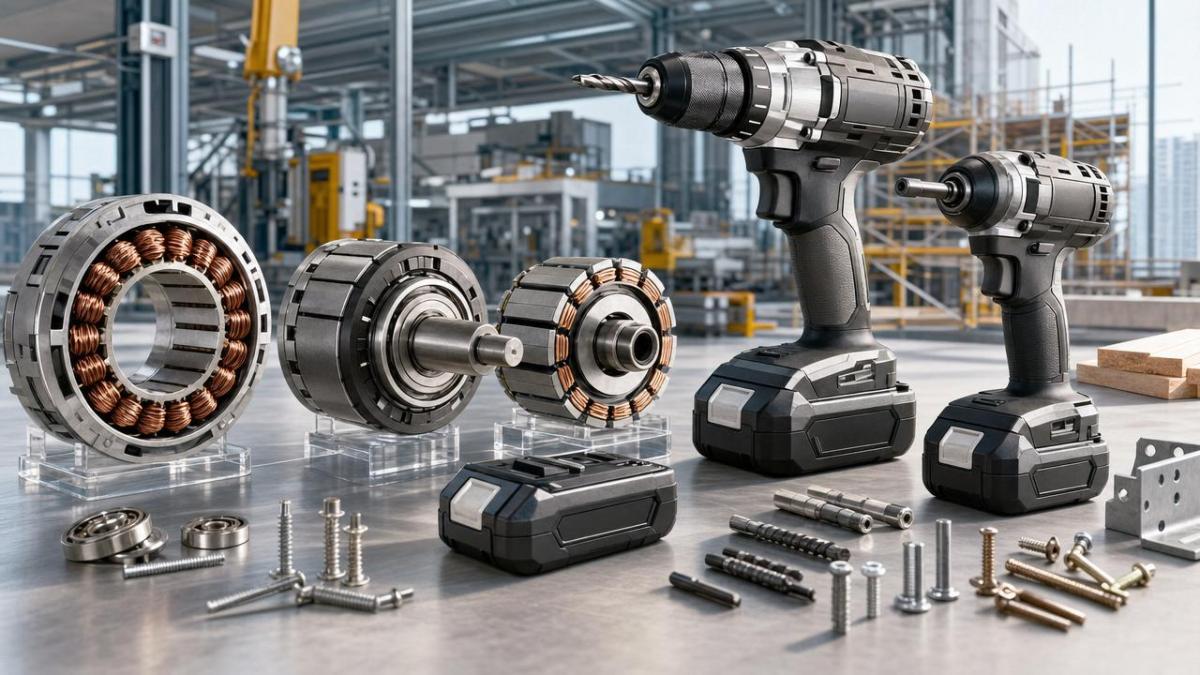
In industrial tools, efficiency is not a marketing phrase. It directly affects drilling speed, fastening consistency, thermal stability, battery runtime, downtime, and operator fatigue. That is why BLDC motor technology has moved from a premium feature into a strategic baseline for many professional-grade power tools.
Unlike brushed motors, brushless DC systems use electronic commutation rather than physical brushes. This reduces friction, lowers sparking, and improves energy conversion. In practice, the result is a tool that wastes less power as heat and converts more of it into usable output.
For information researchers, the key point is this: BLDC motor technology should not be assessed only by top speed or maximum torque on a brochure. It should be evaluated by how it changes productivity across full duty cycles, harsh jobsite conditions, and mixed workloads.
- Higher electrical efficiency can extend runtime per battery pack and reduce charging interruptions.
- Better torque control can improve fastening precision in structural, manufacturing, and maintenance tasks.
- Lower wear components can reduce service frequency and total ownership cost.
- Smarter electronics can support overload protection, thermal management, and application-specific modes.
What Efficiency Gains Does BLDC Motor Technology Actually Deliver?
From Input Power to Useful Work
The main advantage of BLDC motor technology is improved conversion efficiency. With fewer friction losses and more precise electronic control, more battery energy becomes rotation and torque at the spindle, chuck, or drive anvil. This matters most when tools run repeatedly under medium to heavy loads.
The gain is not only visible in laboratory measurements. It shows up as less speed drop during sustained drilling, fewer stalls during hard fastening, and more stable output when battery voltage begins to fall. For professional users, that means fewer interruptions and better task consistency.
Thermal Control and Duty Cycle Stability
Heat is one of the hidden costs in power tools. A motor that runs hotter can trigger derating, stress electronics, shorten battery life, and reduce operator comfort. BLDC motor technology generally produces less internal heat under equivalent workloads, especially when paired with competent controller design.
This is particularly relevant in enclosed housings, elevated ambient temperatures, or repetitive fastening lines. Lower heat load can support longer duty cycles without frequent pauses, which is often more important than peak specification claims.
The table below summarizes the most decision-relevant performance differences between brushed and brushless tool motor platforms in professional applications.
The value of BLDC motor technology becomes strongest when runtime, thermal behavior, and consistency are measured together. A faster tool that overheats or drains packs quickly may be less productive across a full shift than a more balanced brushless platform.
Which Application Scenarios Benefit Most from BLDC Motor Technology?
Construction and Structural Fastening
On construction sites, tools face concrete dust, irregular load spikes, overhead work, and tight schedules. BLDC motor technology supports better torque delivery in compact housings, which helps with anchor installation, repetitive screwdriving, and metal-to-metal fastening where stall resistance matters.
Manufacturing and Assembly Lines
In assembly settings, repeatability often matters more than peak output. Brushless tools can support controlled speed ramps, more stable torque profiles, and better integration with digital controls. This makes them attractive for mixed production lines and quality-sensitive fastening tasks.
Smart Infrastructure Maintenance
Municipal maintenance teams, smart lighting installers, and access system integrators increasingly work across distributed sites. They benefit from lighter tool platforms, longer runtime, and lower maintenance frequency. For these teams, portability and field reliability are as important as raw power.
For cross-sector research, the application fit of BLDC motor technology can be mapped as follows.
This comparison shows that BLDC motor technology is not only for heavy industrial users. It also creates value in mobile service environments where uptime, ergonomics, and lower maintenance logistics are important procurement drivers.
How Should Buyers Evaluate Brushless Power Tools Beyond Marketing Claims?
Focus on System-Level Performance
A power tool is a system, not just a motor. The benefits of BLDC motor technology depend on controller quality, battery chemistry, thermal design, gearing, trigger logic, and application matching. A strong motor paired with weak electronics may underperform in real use.
Researchers and procurement teams should request application-based data wherever possible. Runtime in softwood alone says little about steel fastening, masonry drilling, or repetitive maintenance work in hot conditions.
Practical Evaluation Checklist
- Compare rated output and delivered output under realistic load, not only no-load speed figures.
- Review thermal protection behavior to understand how the tool reacts during extended duty cycles.
- Check battery ecosystem compatibility, charge times, and pack availability for multi-shift operations.
- Assess ergonomics, weight distribution, and vibration because productivity falls if operators tire early.
- Verify spare parts, after-sales service, and technical documentation for regional deployment.
The table below helps information researchers connect BLDC motor technology with procurement criteria that influence lifecycle value, not just purchase price.
A disciplined evaluation framework prevents a common mistake: assuming every brushless tool delivers the same gain. In reality, implementation quality varies, and the surrounding tool architecture often determines whether BLDC motor technology produces measurable efficiency gains.
Cost, Alternatives, and the Real Total Ownership Question
BLDC motor technology usually increases initial tool cost, but that does not automatically make it expensive. For many industrial users, the better question is whether the higher purchase price is offset by runtime efficiency, lower maintenance, and longer usable service intervals.
In low-frequency or light-duty tasks, brushed tools may still be a practical choice. Small contractors, temporary field teams, or price-sensitive buyers may accept shorter lifespan and lower efficiency if utilization is limited. But where tools are used daily, the economics often shift toward brushless systems.
- Choose brushed alternatives when usage intensity is low and replacement cycles are acceptable.
- Choose BLDC motor technology when labor cost, uptime, battery logistics, and maintenance interruptions are material cost factors.
- Model total ownership using tool fleet size, charge cycles, labor hours, service frequency, and productivity impact per shift.
For distributors, EPC contractors, and industrial buyers, this lifecycle view is essential. SHSS consistently tracks how hardware decisions connect with field performance, capital efficiency, and long-term operational resilience across construction, industry, and smart infrastructure environments.
Standards, Safety, and Integration Risks Researchers Should Not Ignore
BLDC motor technology exists inside broader compliance and safety contexts. Depending on the tool type and sales region, buyers may need to review electrical safety, EMC considerations, battery transport rules, and workplace safety requirements. Compliance is especially important when tools are procured at scale or deployed in regulated projects.
Another issue is interoperability. A high-performance motor platform can be limited by poor battery management or mismatched accessories. Researchers should also examine environmental sealing, dust resistance, and control software behavior because harsh sites can quickly expose weak system integration.
Common Risk Areas
- Assuming brushless automatically means industrial-grade durability without reviewing housing, gearbox, and controller protection.
- Comparing only voltage platforms without studying actual output, battery discharge capability, and thermal control.
- Ignoring charger availability and fleet management when planning multi-team deployment.
- Overlooking operator training for mode selection, overload limits, and safe high-torque handling.
FAQ: What Do Information Researchers Most Often Ask About BLDC Motor Technology?
Is BLDC motor technology always better than brushed motors?
Not always in every budget case, but often in demanding or repetitive work. The main advantage appears when tools are used frequently, under load, or in environments where downtime and battery swaps affect labor efficiency. For light, occasional use, brushed tools may still be commercially reasonable.
Which metrics should I compare first when researching brushless tools?
Start with task-based runtime, torque stability under load, thermal behavior, and service support. These indicators reveal more about real performance than no-load speed or headline voltage alone. If possible, compare output consistency at partial battery charge, not only at full charge.
Does BLDC motor technology reduce maintenance significantly?
It usually reduces brush-related maintenance because there are no brushes to replace. However, buyers still need to evaluate bearings, gearing, electronics protection, and battery health. Lower maintenance does not mean zero service requirement; it means fewer wear points in the motor system itself.
What sectors gain the most from adopting BLDC motor technology?
Construction, industrial assembly, infrastructure maintenance, field service, and smart city installation teams often see the strongest benefit. These sectors depend on mobility, uptime, compact power, and repeatable output, all of which align well with well-designed brushless systems.
Why Choose Us for BLDC Motor Technology Research and Sourcing Insight?
SHSS approaches BLDC motor technology as part of a wider smart hardware ecosystem, not as an isolated product claim. Our perspective connects industrial power tools with procurement economics, fastener performance, field safety, infrastructure deployment, and long-term operational requirements across global construction and manufacturing contexts.
If you are comparing brushless tool platforms, planning a sourcing strategy, or evaluating where efficiency gains truly matter, you can consult us on specific decision points rather than generic marketing language.
- Parameter confirmation for torque, runtime, heat behavior, and intended duty cycle.
- Product selection guidance based on construction, manufacturing, MRO, or smart infrastructure scenarios.
- Delivery cycle discussion for bulk procurement, regional deployment, and replacement planning.
- Custom solution evaluation when tool fleets must align with battery ecosystems or application-specific attachments.
- Certification and compliance review for target markets and regulated project environments.
- Sample support and quotation communication for comparative testing and sourcing decisions.
For organizations that need sharper insight into BLDC motor technology, the right next step is to define the workload, environment, battery strategy, and cost target together. That makes it possible to separate headline claims from measurable efficiency gains that truly matter.
Recommended News