
Search News
Industry Portal
Hot Articles
How to vet industrial tools suppliers for angle grinder spare parts
Time
Click Count
A replacement gear arrives on time, fits inside the housing, and costs less than the previous order. Then the repaired grinder develops abnormal noise under load. The saving disappears into another repair, a delayed job, and an uncomfortable question: what did procurement actually verify?
For purchasing teams, vetting industrial tools suppliers means looking beyond catalog photographs and “OEM-equivalent” claims. Angle grinder spare parts must match the tool’s configuration, withstand its operating conditions, and arrive with enough documentation to support a safe repair. Gears, bearings, switches, and brushless motor assemblies demand different checks, but the purchasing principle stays the same: approve evidence, not reassurance.
This guide focuses on the decisions that matter before a purchase order is released—and the controls that keep an approved supplier reliable afterward.
Define the replacement before evaluating the supplier
A vague inquiry produces a vague quotation. “Gear set for a 125 mm grinder” does not establish compatibility. Tools with the same wheel diameter can use different gear ratios, bearing seats, spindle arrangements, electrical components, and housing revisions.
Build a short identification sheet for each required part. Include:
- The tool manufacturer, exact model, serial number range, and production revision where available.
- The manufacturer’s service part number and position on the exploded drawing.
- Supply voltage and frequency for corded tools, or battery platform and voltage for cordless models.
- Relevant interface details, such as spindle thread, bearing dimensions, connector layout, and mounting points.
- The operating environment: abrasive dust, prolonged use, frequent starts, or occasional maintenance work.
- Whether the purchase is for an individual component or a matched service assembly.
Specify dimensions using drawings or manufacturer data whenever possible. A worn sample can help identify a component, but wear may make it a poor dimensional reference.
Ask the supplier to confirm compatibility in writing against the complete tool identification. If its response only repeats the description from your inquiry, the compatibility question remains unanswered.
Separate supplier legitimacy from product suitability
A registered business can still sell unsuitable parts. Conversely, a smaller specialist may provide better technical support than a large distributor with a broad catalog. Evaluate the company and the component as two connected, but separate, decisions.
Establish who is responsible for the part
Determine whether the candidate is an authorized distributor, an independent stockist, an aftermarket manufacturer, or a trading company. None of these labels automatically settles the buying decision. They tell you which evidence to request and where accountability sits.
For claimed genuine parts, request evidence of authorization or a documented sourcing route. Confirm authorization with the tool manufacturer when practical. For aftermarket parts, ask who manufactures them, who controls the specification, and who investigates failures. A supplier need not disclose every commercial relationship, but it should provide traceability and accept clear responsibility for conformity.
Check that the quotation, bank beneficiary, invoice issuer, and contracting entity align. Unexplained differences deserve investigation before payment.
Assess whether its technical team understands repairs
Ask a question that cannot be answered by copying a catalog: “Which model revisions does this switch support, and what changes would make it incompatible?” A useful answer identifies boundaries and supporting references. “Fits all models” is not a substitute.
For brushless tools, ask whether a replacement motor or controller requires a matched assembly, firmware compatibility, configuration, or manufacturer-specific service procedures. A mechanically interchangeable unit may still be electrically or functionally unsuitable.
Request evidence according to the part’s failure risk
Not every spare needs the same documentation package. A cosmetic cover and a spindle assembly should not receive identical scrutiny. Prioritize components whose failure could affect wheel retention, rotational integrity, electrical protection, or safety functions.
Documents should identify the relevant product, revision, and issuing organization. A generic test report covering an unrelated component offers little assurance. Where batch-specific records are necessary, agree on that requirement before ordering.
Keep certification claims in proportion. ISO 9001 certification concerns a quality management system; it does not prove that a particular gear or switch meets your specification. Verify the certificate’s scope, validity, and issuing body rather than accepting a logo on a sales sheet.
Likewise, do not demand a CE mark on every spare part or assume that a mark proves compatibility. Regulatory obligations depend on the component, its intended use, and the destination market. Relevant tool safety standards, such as applicable IEC/EN 62841 requirements, can inform evaluation, but their application should be assessed by competent technical or compliance personnel.
Make the sample trial a controlled purchasing gate
A sample order should answer defined questions, not simply establish that something turns up. Agree on the acceptance criteria before the trial and require samples to represent the proposed production supply.
Begin with identity and incoming inspection. Check markings, packaging, part numbers, batch references, corrosion, burrs, connector workmanship, and dimensions against the agreed specification. For critical interfaces, use suitable measurement equipment rather than visual comparison alone.
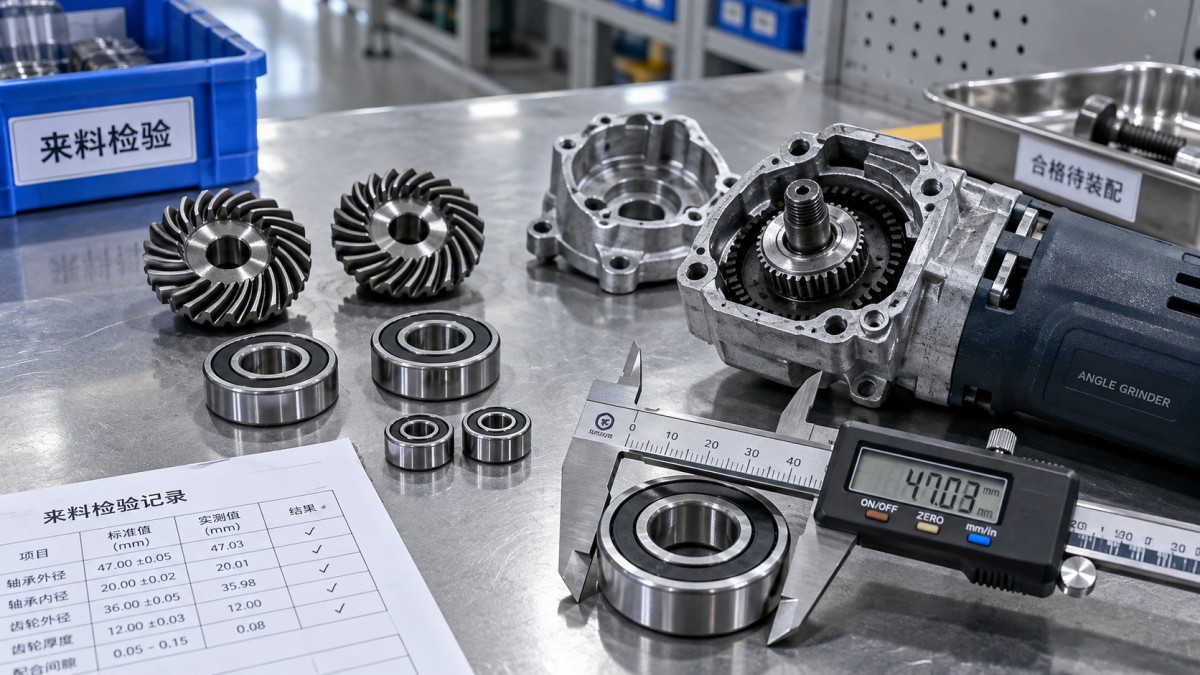
Next, have a qualified service technician assess installation. Record fit, assembly effort, gear engagement, bearing seating, wiring clearance, and any departure from the manufacturer’s repair instructions. A part that requires unapproved machining, improvised spacers, or altered wiring should trigger rejection or engineering review—not quiet acceptance.
Functional evaluation should follow an approved procedure appropriate to the repaired tool. Depending on the component, this may include no-load operation, controlled load testing, current draw, temperature rise, vibration, noise, and verification of relevant safety functions. Electrical repairs may require specified electrical safety checks before return to service.
Do not test questionable parts by sending them straight into production. Testing belongs in a controlled setting with appropriate guarding, extraction, and PPE. Suspect high-speed rotating components may require specialist assessment rather than an ordinary workshop trial.
Document the results against an approved reference or manufacturer limits. “Runs smoothly” is an observation; it is not a complete acceptance criterion. Also recognize the limits of sampling: one successful repair does not establish long-term durability or batch consistency.
Evaluate industrial tools suppliers on repeatability, not the best sample
The approved sample is only useful if subsequent deliveries match it. Ask how the supplier controls specifications, manufacturing sources, inspection records, and product changes.
A practical quality agreement should require notification before changes to materials, heat treatment, component sources, manufacturing location, design revision, or relevant firmware. Define which changes require your approval and renewed validation.
Request an explanation of its nonconformance process. Can it isolate an affected batch? Can it connect a delivered part to a purchase order and inspection record? Will it provide corrective-action findings when repeated failures occur? These capabilities matter more than a promise to send free replacements.
For higher-risk purchases, consider a site audit or independent inspection. Focus on the processes that influence your parts: measurement control, segregation of rejected stock, traceability, and control of outsourced work. An attractive factory tour is not evidence that these controls function.
Price the repair outcome, not just the component
Two quotations may describe the same part while offering very different commercial outcomes. Compare landed cost, inspection effort, technician time, expected service life, and downtime exposure—not unit price alone.
A useful working model is:
Expected repair cost = landed part cost + inspection and installation cost + expected rework and downtime cost.
Use your own maintenance data where available. If durability is unproven, show that uncertainty instead of assigning an optimistic service-life estimate. An inexpensive part may be suitable for a limited application; it is not automatically the economical choice for heavily used site tools.
Check availability at part-number level. “Large inventory” says little about whether your particular controller or spindle assembly is in stock. Ask for current availability, normal replenishment lead time, minimum order quantity, and the policy for discontinued models.
The purchase order should also define:
- Approved part numbers and revisions, with no substitutions without written permission.
- Packaging, identification, and documentation requirements.
- Delivery terms, freight responsibility, and partial-shipment rules.
- Inspection and acceptance arrangements, including handling of latent defects.
- Warranty coverage, return authorization procedures, and responsibility for return freight.
- The escalation process for safety concerns or repeated nonconformities.
Warranty language deserves careful reading. A replacement-only remedy may leave your business carrying diagnosis, labor, and downtime costs. Where those exposures are material, negotiate them explicitly rather than assuming they are covered.
Use hard rejection gates before a weighted score
A scorecard helps purchasing teams compare candidates consistently, but some deficiencies should not be averaged away. Low prices and fast delivery cannot compensate for unresolved compatibility or missing evidence on a safety-critical component.
Set non-negotiable gates: confirmed identity, suitable technical evidence, acceptable sample results, traceability, and agreement on critical commercial terms. Score only the suppliers that pass.
A practical weighting could allocate 30% to compatibility and technical evidence, 25% to quality control and traceability, 20% to delivery reliability, 15% to lifecycle cost, and 10% to support and commercial terms. Treat this as a starting point, not a universal formula. A shutdown-critical repair may justify greater emphasis on proven availability; a spindle assembly may warrant tighter technical scrutiny.
Record the evidence behind each score. This makes the decision explainable when maintenance, finance, and procurement have different priorities.
Keep approval narrow—and monitor what happens next
Approve a supplier for specific part families and tool models, not automatically for its entire catalog. Reliable bearing supply does not establish competence in electronic controllers or wheel-retention components.
Start with a controlled order, then review incoming defects, delivery performance, installation problems, and service failures. Link repair records to supplier batches where practical. Compare results under similar operating conditions so that heavy-duty use is not mistaken for a supplier defect—or used to excuse one.
At SHSS, the procurement perspective connects industrial tool performance with the worker’s last lines of protection. That means treating replacement-part selection as a maintenance and safety decision, not merely a sourcing exercise. PPE remains necessary, but it cannot compensate for an unsuitable component.
The strongest industrial tools suppliers make their claims verifiable. They identify compatibility limits, provide relevant records, support controlled trials, and remain accountable after delivery. For buyers, that is the real approval standard: not whether a part looks right in a quotation, but whether the supply arrangement supports a dependable, properly validated repair.
- Last One:No more articles
- Next Article:Are 316 stainless steel fasteners suitable for heavy-duty marine use?Oct 14, 2026
Recommended News