
Search News
Industry Portal
Hot Articles
Are 316 stainless steel fasteners suitable for heavy-duty marine use?
Time
Click Count
Are 316 stainless steel fasteners suitable for heavy-duty marine use?
316 stainless steel fasteners can be suitable for heavy-duty marine service, but “marine grade” is not an engineering approval. The decision depends on the fastener’s verified strength, the joint’s loading, and the conditions around the threads—not simply its resistance to visible rust.
For engineers selecting heavy duty fasteners for marine use, 316 is a reasonable candidate for many exposed, accessible connections. It becomes a less comfortable choice when permanent immersion, trapped seawater, high cyclic loads, or difficult inspection enter the picture. Molybdenum improves its resistance to chloride-induced pitting compared with 304 stainless steel, but does not make it immune to localized corrosion.
The useful question is therefore not “Can 316 survive near the sea?” It is “Can this particular 316 fastening system maintain the required joint performance throughout its intended service life?”
Separate the alloy designation from the strength requirement
A drawing that specifies only “316 stainless bolts” leaves an important gap. Alloy composition describes the material family; it does not establish the finished bolt’s tensile strength, proof stress, fatigue performance, or suitability for a preloaded structural connection.
Austenitic stainless fasteners can gain strength through cold working. Consequently, two bolts described commercially as 316 may have different mechanical properties because of their manufacturing route, diameter, and specified property class. They should not be treated as interchangeable simply because their corrosion resistance is broadly similar.
ISO 3506-1 addresses mechanical and physical properties of corrosion-resistant stainless steel bolts, screws, and studs. Designations such as A4-70 and A4-80 identify a stainless steel group and a property class. The class numbers correspond to minimum tensile strengths of 700 and 800 MPa, respectively, within the standard’s applicable product conditions. These are not allowable design stresses, and neither designation automatically proves suitability for a specific marine joint.
Also, A4 is a standardized material group, not a guarantee of one exact commercial 316 composition. Where the precise alloy matters, require material documentation. Specify compatible nuts under the relevant standard, such as ISO 3506-2, rather than assuming any stainless nut will develop the bolt’s capacity.
Do not replace a high-strength carbon steel bolt with a same-size 316 bolt without recalculating the connection. Check tensile resistance, shear resistance, combined loading, thread engagement, bearing, and the intended preload. Where threads cross the shear plane, the appropriate threaded-section capacity matters.
The seawater trapped beneath a washer may matter more than the exposed head
An exposed bolt on a deck bracket and a submerged bolt beneath a gasket may share the same alloy but face very different corrosion conditions. Accessible hardware that drains and receives freshwater cleaning is generally easier to justify than a connection that remains wet beneath deposits or inside a sealed-looking overlap.
316 depends on a passive surface film for corrosion resistance. Chlorides can destabilize that film locally. In a tight crevice, oxygen depletion and changes in the trapped solution can create conditions much more aggressive than those on an open surface. Typical trouble spots include washer interfaces, gasket edges, overlapping plates, and poorly drained mounting pockets.
This is why a clean-looking bolt head does not establish that the shank or engaged threads are sound. Damage can develop where visual inspection cannot reach, and a localized pit can become a fatigue initiation site.
Splash-zone exposure is not automatically mild either. Repeated wetting and drying can concentrate salts. Temperature, deposits, biological fouling, water movement, and cleaning access all influence the assessment. There is no single seawater exposure limit that makes every 316 fastener acceptable.
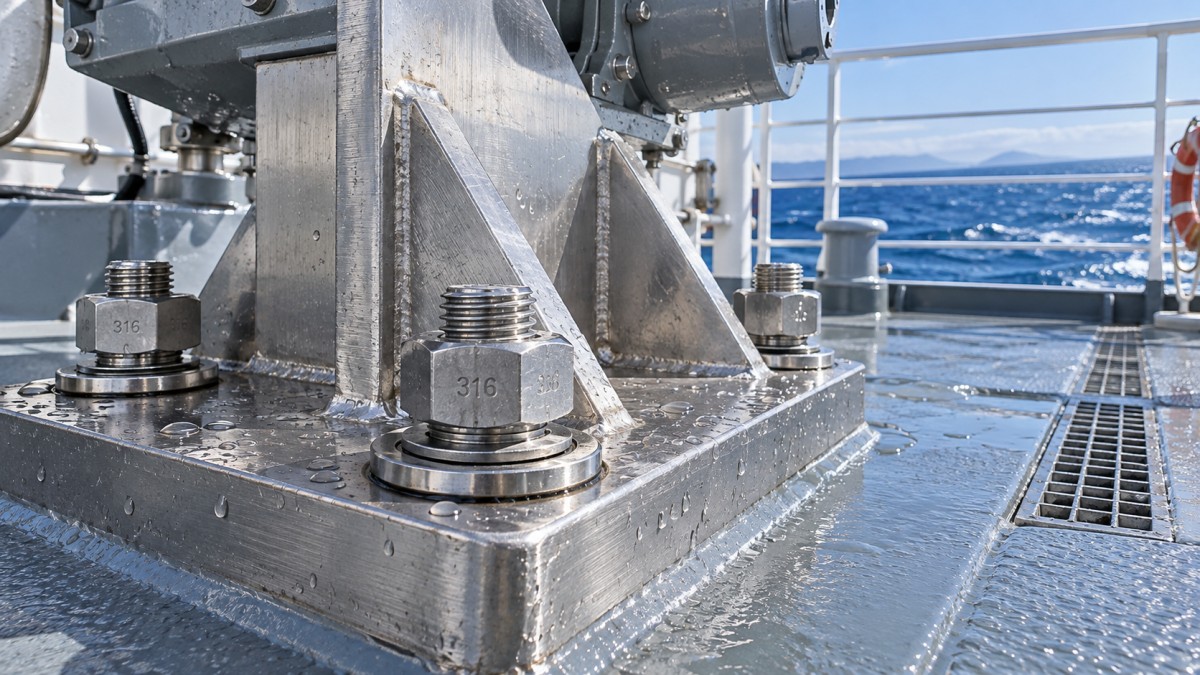
A useful drawing review follows the water: where does it enter, where can it remain, and can the vulnerable surfaces be inspected? That exercise often reveals more than a catalogue corrosion rating.
Heavy-duty performance is usually a joint problem
Consider a machinery support exposed to vessel vibration. The bolt may pass a static strength calculation yet still perform poorly if the connection slips, separates, or subjects the fastener to bending during each operating cycle. Alloy selection cannot compensate for an unstable load path.
For a properly designed preloaded joint, adequate clamp force can limit separation and reduce cyclic changes in bolt load. The benefit depends on joint stiffness, external loading, contact conditions, and retained preload. Soft gaskets, coating compression, embedment, and temperature changes can all undermine the installed condition.
Fatigue assessment should therefore address the load spectrum, not just maximum load. A connection subjected to wave action or repeated machinery starts may need a different evaluation from a rarely loaded access bracket. Thread roots, bending, surface damage, and corrosion pits deserve particular attention.
Likewise, a locking feature is not a substitute for correct preload or joint stiffness. It may help resist rotation, but it cannot restore clamp force lost through settlement or prevent fatigue caused by excessive cyclic stress.
For safety-critical hardware, including lifting attachments and primary structural connections, use the applicable design rules and approval requirements. A supplier’s “heavy-duty” description is not evidence that those requirements have been met.
When 316 remains credible—and when to evaluate alternatives
The following situations help frame an initial selection. They are screening judgments, not substitutes for project calculations.
Duplex stainless steels merit consideration where higher strength and improved resistance to localized corrosion are needed. Common grades such as 2205 can offer advantages over 316, but “duplex” is not one uniform performance level. Grade, processing quality, finished-fastener properties, and exposure conditions still matter.
More aggressive seawater conditions may justify assessing superduplex, higher-alloy austenitic stainless steels, or titanium. These are not automatic upgrades: availability, mating materials, galling behavior, installation requirements, and approved design values can change the decision. Highly stressed subsea systems with cathodic protection also require specialist consideration of hydrogen-related risks for susceptible materials.
Sometimes the better solution is less exotic: eliminate a water-trapping recess, increase the bolt size, stiffen a bracket, or make the connection replaceable. An alloy upgrade should not preserve an avoidable design defect.
Check the surrounding metals before approving stainless hardware
316 fasteners are often installed into aluminum structures or alongside coated carbon steel. In a conductive seawater film, dissimilar metals can form a galvanic couple. The stainless bolt may remain relatively intact while the surrounding, less noble material corrodes.
Risk depends on exposed area ratios, coating condition, electrical continuity, and electrolyte access. Insulating sleeves, washers, and suitable barriers can help, but they must also withstand the connection’s bearing loads and preserve clamp force. A soft insulating washer that creeps under load may solve one problem while introducing another.
Sealants deserve similar scrutiny. A properly designed barrier can exclude seawater; a failed or incomplete seal can retain it. Check compatibility, application access, and repairability rather than treating sealant as permanent protection.
Installation can invalidate an otherwise sound selection
Stainless threads can gall during tightening, particularly under unfavorable combinations of contact pressure, friction, and installation speed. A seized assembly may produce a high torque reading without achieving the intended clamp force. Continuing with an impact wrench is not a reliable remedy.
Use an approved thread pairing and lubricant or anti-seize system, with a tightening procedure based on that actual condition. Lubrication changes the torque–preload relationship; applying a dry-thread torque value to lubricated hardware can overload the bolt. Critical joints may require validated tension-control methods rather than torque alone.
SHSS’s coverage of high-strength hardware and industrial fastening tools intersects here: tool capability and connection quality are separate questions. A powerful brushless tool can accelerate assembly, but it cannot establish the correct preload without an appropriate procedure and verification.
Keep threads clean, avoid carbon steel contamination during handling, and address damaged surfaces. Passivation can help remove free iron contamination when properly specified, but it does not upgrade 316 into a more chloride-resistant alloy.
What a defensible approval should contain
Before approving 316, the selection file should connect the following items:
- The exposure description, including immersion, temperature, trapped water, and inspection access.
- The load cases, fatigue considerations, joint calculations, and required retained preload.
- The material designation, fastener property class, applicable standards, and required traceability.
- The bolt–nut–washer combination, surrounding metals, and corrosion-control details.
- The installation procedure and inspection criteria, including access to concealed damage.
A salt-spray test result alone does not demonstrate long-term suitability in submerged, creviced seawater service. Likewise, a material certificate establishes only the properties it actually reports—not the adequacy of the whole connection.
Choose 316 when both the mechanical assessment and the exposure assessment support it. If approval depends on assuming that seawater will never reach a hidden interface, or that “stainless” means high strength, revisit the design. The next step may be a different alloy, but it may equally be better drainage, a larger fastener, or a joint that can actually be inspected.
- Last One:No more articles
- Next Article:What to include in a PPE checklist before using an angle grinderOct 13, 2026
Recommended News