
Search News
Industry Portal
Hot Articles
What to include in a PPE checklist before using an angle grinder
Time
Click Count
What to include in a PPE checklist before using an angle grinder
Before an angle grinder starts, a missed protection check can leave workers exposed to flying fragments, sparks, harmful dust, and excessive noise. A practical PPE checklist should verify impact-rated eye protection, a suitable face shield, hearing protection, task-appropriate respiratory protection, and properly fitted gloves, clothing, and footwear. It should confirm condition and compatibility—not simply whether each item is present.
The difference matters on a busy shop floor. Safety glasses may be available but scratched beyond useful visibility. A respirator may have the correct filter but a poor seal. Earmuffs may fit well alone, then lose their seal when worn over spectacle arms. A useful pre-use check catches these problems while there is still time to correct them.
Start with the job, not the PPE cabinet
An angle grinder used to dress a steel weld does not create the same exposure as one cutting concrete or removing an unknown coating. Before choosing protection, record the material, operation, working location, and expected duration. Include the coating or surface treatment, not just the base material.
Concrete and masonry can generate respirable crystalline silica. Painted or plated metal may introduce hazardous substances that cannot be identified by appearance. Confined or poorly ventilated spaces can change the risk substantially. If the material or coating is unknown, the correct response is further assessment—not a guess about which disposable mask looks strongest.
Also identify who else may be exposed. A helper holding material, an inspector nearby, or someone passing through the work area may need protection or exclusion from the area. The checklist should reference the task risk assessment and grinder manufacturer's instructions, with additional requirements determined by local rules and site conditions.
Check eye protection and the face shield separately
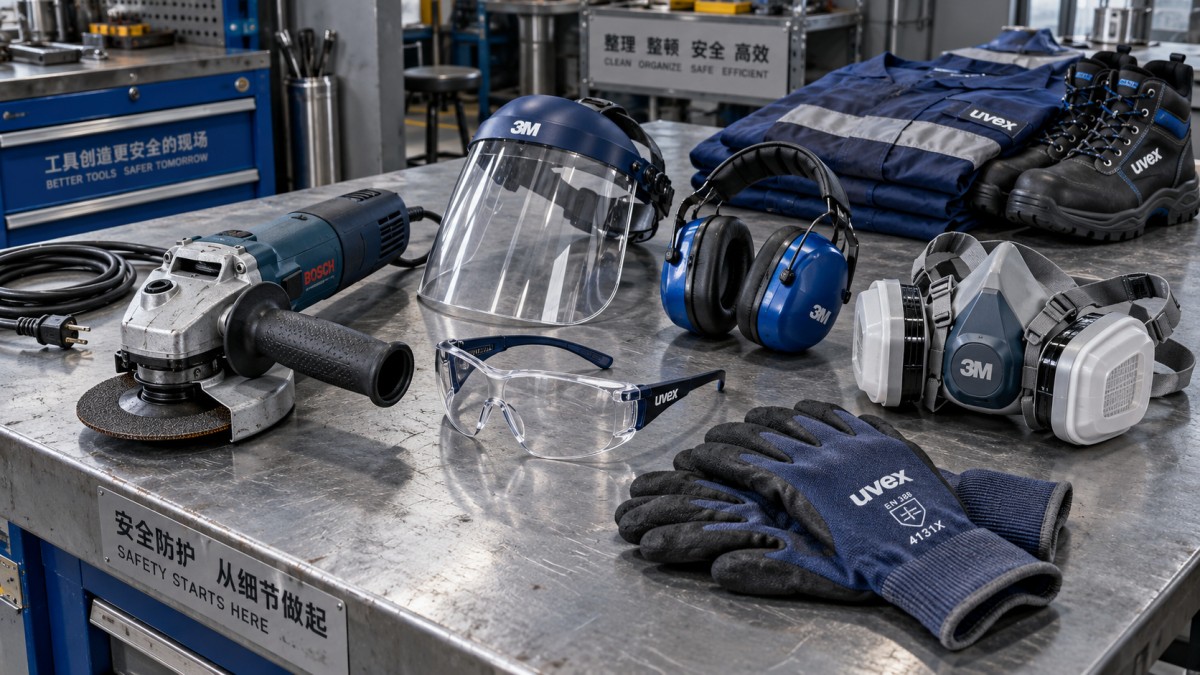
For grinding tasks with flying particles, use impact-rated safety spectacles with side protection or suitable goggles, together with an appropriate impact-rated face shield. A face shield generally provides additional coverage; it is not a substitute for primary eye protection. Ordinary prescription glasses are not safety glasses.
Verify the product marking and manufacturer documentation against the applicable occupational eye-protection standard. For example, ANSI/ISEA Z87.1 is commonly referenced in the United States. Do not assume that any transparent visor is rated for grinder hazards, or that all products carrying a standard reference provide identical protection.
- Inspect lenses and the visor for cracks, deep scratches, clouding, heat damage, and loose fittings.
- Confirm coverage around the eyes and across the face in the actual working position.
- Check that the shield stays lowered without slipping or obstructing the operator's view.
- Confirm that prescription inserts, goggles, and respiratory equipment fit together without interference.
Visibility is a safety issue. If fogging makes the operator lift the visor or remove eye protection, the combination is unsuitable for the task. Address fit, ventilation, and manufacturer-approved anti-fog measures before work begins.
Choose hearing protection from exposure, not tool size
A compact cordless grinder can still create hazardous noise. Exposure depends on the wheel, material, cutting pressure, duration, surrounding equipment, and room acoustics. Brushless motors and newer batteries do not remove the need for a noise assessment.
The checklist should identify the approved hearing protector and confirm correct use. Earplugs must be inserted as instructed; earmuff cushions should be clean, undamaged, and sealed around the ears. Hair, headwear, spectacle arms, and face-shield fittings can compromise that seal.
Do not select protection solely by the largest advertised attenuation number. Laboratory ratings do not automatically represent protection achieved by each wearer. Use the workplace noise assessment, relevant selection guidance, and fit verification where available. If dual protection is required, specify it explicitly; plug and earmuff ratings cannot simply be added together.
Make respiratory protection a task-specific decision
“Mask available” is not a meaningful acceptance criterion. The checklist needs to identify the contaminant, expected exposure, controls already in place, and approved respirator configuration. Particle filters do not protect against gases or vapors, and no filter should be selected without understanding the hazard.
For concrete cutting or grinding, dust extraction or a suitable wet method should be assessed before relying on respiratory PPE. Any wet method must be compatible with the equipment and electrical safety requirements. A visible reduction in dust does not prove that exposure is adequately controlled.
Where a tight-fitting respirator is required, verify that the wearer has completed the applicable fit-testing and medical evaluation requirements. A user seal check is needed each time it is donned, following the manufacturer's procedure; it does not replace fit testing. Facial hair crossing the sealing surface can prevent an effective seal.
Check straps, valves, seals, filter connections, storage condition, and replacement criteria. Reusable equipment needs a cleaning and maintenance arrangement, while gas or vapor cartridges require an appropriate change schedule. Oxygen-deficient atmospheres and certain high-hazard conditions require specialist controls; an ordinary filtering respirator is not a solution.
Inspect gloves, clothing, and footwear as working equipment
Gloves must balance abrasion, cut, and heat hazards with the dexterity needed to control the grinder. Follow the tool instructions and task assessment. A cut-resistance rating does not mean a glove will stop a rotating abrasive wheel, and bulky gloves can make a secure grip harder.
Reject loose, torn, oil-soaked, or poorly fitting gloves. Check that cuffs and sleeves cannot approach rotating parts. Gloves do not justify placing a hand near the wheel or holding a small workpiece that should be clamped.
Clothing should cover exposed skin and be selected for the spark and heat exposure. Avoid loose sleeves, hanging cords, jewelry, and unsecured long hair. Some synthetic fabrics can melt when struck by hot particles; ordinary cotton is not automatically flame-resistant either. Where the assessment requires flame-resistant clothing, verify the garment's intended protection and care instructions.
Inspect pockets, cuffs, and aprons for places where sparks could collect. Clothing contaminated with flammable substances should not be worn for spark-producing work. Footwear should provide the toe, sole, slip, and other protection required by the site, remain in sound condition, and prevent easy entry of hot debris. Head protection is an additional requirement where overhead or site hazards warrant it, not a universal substitute for a face shield.
Do one final compatibility check with everything on
Individual items can pass inspection while the complete ensemble fails. Ask the operator to put on the required equipment, lower the shield, and adopt the working posture with the grinder isolated from its power source. Check visibility, grip, head movement, respirator seal, and earmuff contact.
Look for the practical failure points: a respirator pushing goggles upward, a shield touching the respirator, or a helmet attachment preventing earmuffs from seating. Resolve the incompatibility using approved components or another assessed configuration. Do not improvise by cutting straps or altering protective equipment.
Turn the checklist into a release decision
A useful form separates presence, suitability, condition, and fit. It also provides a place to record a defect and its resolution. The following fields make the check actionable without turning it into a lengthy administrative exercise:
- Task identification: material, coating, operation, location, and risk-assessment reference.
- Required protection: approved types, relevant ratings, and any task-specific additions.
- Pre-use result: satisfactory, replace or adjust, or stop pending assessment.
- Compatibility confirmation: the complete PPE combination checked on the wearer.
- Corrective action: defect, replacement or adjustment, and confirmation before release.
- Accountability: operator, date, and reviewer where site procedures require one.
Avoid allowing “not applicable” without a reason for task-dependent protection. Repeat the assessment when the material, accessory, location, controls, or working conditions change. A morning signature should not authorize an unassessed operation later in the shift.
Keep PPE checks connected to grinder safety
Even a complete PPE checklist cannot make an unsafe grinder ready for use. The accompanying equipment check should confirm the correct guard for the operation, a compatible and undamaged accessory, and an accessory speed rating suitable for the grinder's maximum speed. Verify secure workholding, the required handle, dust-control readiness, and a safe spark direction. Remove combustibles or apply the site's hot-work controls where required.
Disconnect the power supply or remove the battery before accessory changes and relevant inspections. Follow the manufacturer's procedures; do not side-load a cutting wheel or remove a guard to gain access. Nearby workers need protection from the operation through separation, screening, or other assessed measures.
The Global Smart Hardware & Security Systems (SHSS) covers industrial tools and protective equipment as connected subjects. That perspective is useful here: tool capability, exposure control, and wearable protection should be evaluated together, rather than treating PPE as an isolated purchasing decision.
Before issuing a checklist, test it against one real grinding task with the actual operator and equipment. If it cannot distinguish a scratched visor, an incompatible respirator, or an uncontrolled dust exposure from a safe setup, revise it. The release decision should be clear: unresolved protection or control defects mean the grinder does not start.
- Last One:No more articles
- Next Article:How to qualify a thread rolling fasteners supplier for critical boltsOct 12, 2026
Recommended News