
Search News
Industry Portal
Hot Articles
Heat Treatment Basics: How It Changes Strength, Hardness, and Wear
Time
Click Count
Why does heat treatment matter so much in modern hardware?
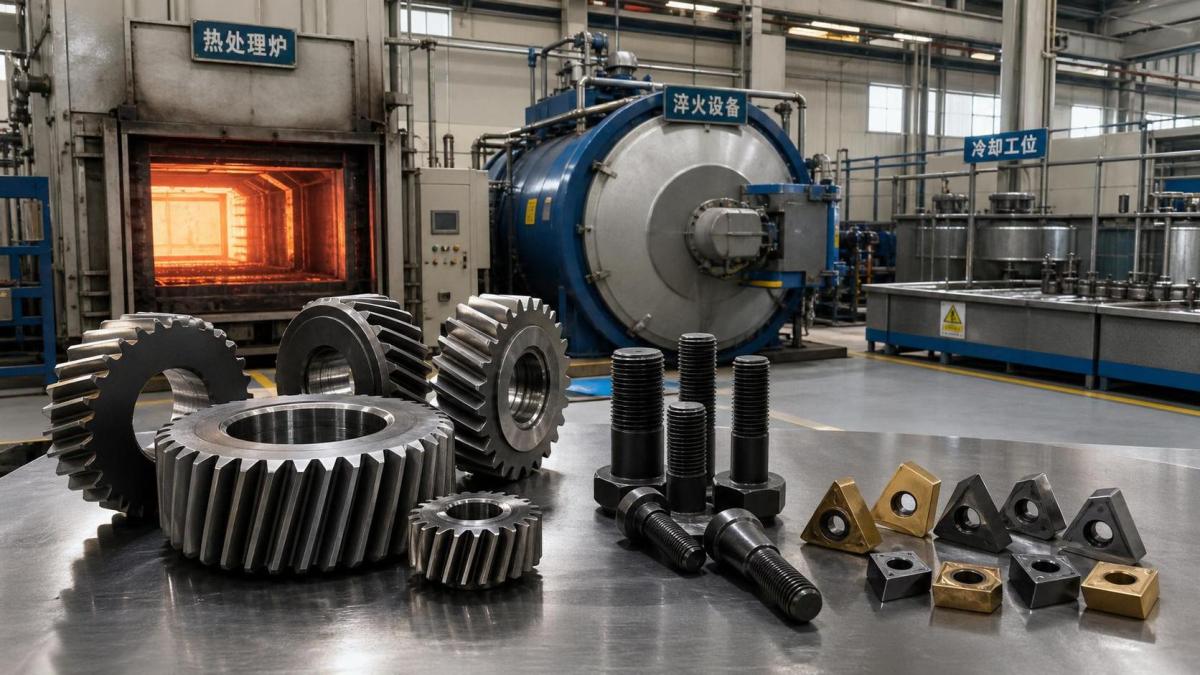
Heat treatment looks simple on paper. Metal is heated, held, and cooled. In practice, it changes how a part survives stress, friction, and impact.
That is why heat treatment appears across tools, high-strength fasteners, protective hardware, and structural components used in construction and smart infrastructure.
A bolt, gear, cutting edge, or lock component may share the same alloy. Their final performance can still differ sharply because of heat treatment.
The key idea is straightforward. Heat treatment changes the internal structure of metal. That structure decides hardness, strength, toughness, and wear resistance.
For SHSS, this topic is especially relevant because fasteners, brushless tools, access hardware, and protective equipment all depend on reliable material behavior.
When people ask whether a part is durable, safe, or fit for repeated loading, the answer often starts with heat treatment basics.
What does heat treatment actually change inside the metal?
Heat treatment does not only change surface appearance. It reorganizes grains and phases inside the metal, which then changes mechanical behavior.
In carbon steel, for example, heating and cooling can produce softer or harder microstructures. The same part can become easier to machine or harder to wear down.
This is where many first-time readers get confused. Strength, hardness, and wear resistance are related, but they are not identical.
A harder part usually resists indentation better. A stronger part carries higher loads before deforming. A wear-resistant part lasts longer under rubbing contact.
However, pushing one property too far can reduce another. Extremely hard steel may become brittle if tempering is not controlled properly.
That balance matters in real applications. A structural fastener needs strength and toughness. A drill bit or blade edge may need higher hardness and wear resistance.
In security hardware, repeated opening cycles and forced-entry resistance also depend on getting that balance right, not just making metal “as hard as possible.”
A quick reference helps separate the common terms
This comparison is useful when reviewing technical sheets. It helps explain why two steel parts with similar chemistry can behave very differently in service.
Which heat treatment methods show up most often, and where are they used?
Most people encounter a few core methods repeatedly. Each one solves a different performance problem, so selection starts with the job the part must do.
Annealing and normalizing
These methods usually reduce hardness, refine structure, and improve consistency. They are common before machining, forming, or later hardening steps.
For hardware production, this can improve dimensional stability and reduce internal stress before final processing.
Quenching and tempering
This is one of the most familiar heat treatment routes for steel. Quenching raises hardness. Tempering then adjusts brittleness and restores usable toughness.
High-strength fasteners often rely on this balance. They must hold preload, resist fatigue, and avoid sudden fracture under vibration.
Case hardening
Case hardening creates a hard outer layer and a tougher core. That combination is valuable for gears, shafts, lock parts, and wear-prone interfaces.
In practical terms, the surface resists damage while the inner section still absorbs shock and repeated loading.
Surface hardening by induction or similar methods
This route targets selected areas rather than the entire part. It is useful when wear appears only on specific contact zones.
That can make sense for tool components, drive features, and certain safety hardware where geometry and cycle life both matter.
- Use through-hardening when the whole section must carry high stress.
- Use case hardening when the surface wears but the core must stay tougher.
- Use stress-relief steps when distortion or residual stress could create later failures.
If a part is harder, is it always better?
Usually not. This is one of the biggest misunderstandings around heat treatment.
Higher hardness can improve abrasion resistance and edge retention. Yet a part that is too hard may chip, crack, or fail under impact.
Think about a high-strength fastener in a vibrating assembly. It does not only need hardness. It needs a controlled mix of tensile strength and toughness.
The same principle appears in industrial brushless tools. Internal anvils, gears, and spindle parts see repeated loading cycles, not just static force.
More commonly, the best heat treatment choice depends on failure mode. Is the real threat wear, bending, shock, fatigue, thread stripping, or corrosion-assisted cracking?
Once that question is clear, the target hardness range becomes much easier to judge.
A practical judgment table
This kind of comparison often prevents overspecifying hardness where balanced performance would produce a longer service life.
What should you check when evaluating heat-treated hardware?
The first thing to confirm is not the process name alone. “Heat treated” is too broad to mean much by itself.
A better review looks at the required property range, the alloy grade, the section size, and the quality controls used after treatment.
In actual sourcing or technical review, these points matter most:
- Hardness result and test method, such as Rockwell or Vickers.
- Strength class or tensile data if the part carries load.
- Core versus surface condition for case-hardened parts.
- Distortion control for tight-tolerance components.
- Evidence of tempering, stress relief, and crack inspection.
This matters across SHSS-related sectors. Tool drive parts need cycle durability. Fasteners need preload reliability. Security hardware needs repeated-use stability.
Even lighting infrastructure can depend on heat-treated brackets, anchors, and mounting hardware that face weather, vibration, and sustained loads.
Where do mistakes happen most often, and how can they be avoided?
The most common mistake is choosing heat treatment by habit instead of by failure risk. A process that works for one part may be wrong for another.
Another issue is reading hardness as the whole story. Hardness is easy to test, so it gets attention. Service conditions are often more complex.
Distortion is another hidden problem. Heating and cooling can change shape, especially in thin sections or asymmetrical geometries.
There is also the risk of delayed cracking or reduced fatigue life if quenching, tempering, or post-process handling is inconsistent.
A practical way to reduce mistakes is to build the review around service reality, not only around process labels.
- Define the dominant failure mode before choosing the heat treatment route.
- Match alloy capability with the required hardness and section thickness.
- Ask whether the surface, the core, or both need improvement.
- Confirm testing, traceability, and consistency between batches.
That final point matters more than many expect. A good heat treatment specification still fails if execution varies from batch to batch.
So how should heat treatment basics guide the next decision?
The most useful takeaway is simple. Heat treatment is not a finishing detail. It is a core performance decision.
When reviewing metal parts, ask what must resist load, what must resist wear, and what must survive shock, cycling, or deformation.
From there, the right heat treatment questions become clearer. Is the goal full-section strength, a hard surface, stress relief, or balanced toughness?
In sectors tracked by SHSS, that clarity supports better judgment across fasteners, tool components, security hardware, and critical support structures.
If the next step is evaluation, compare property targets, not just process names. If the next step is specification, define testing, tolerance, and service conditions early.
That approach makes heat treatment basics genuinely useful, not just technical vocabulary, and leads to more confident decisions on safety-critical hardware.
Recommended News