
Search News
Industry Portal
Hot Articles
Application Explanations Resource: What to Include for Clear User Onboarding
Time
Click Count
Application Explanations Resource: What to Include for Clear User Onboarding
An application explanations resource is often misunderstood as a help page, a FAQ, or a bundle of setup notes. In practice, it is something more specific: a structured body of explanation that tells a user what an application is asking for, why it is asking, what standards or constraints sit behind those requests, and what happens next. That distinction matters. If users only see fields, buttons, and warnings, they may complete a form. They are less likely to trust it, complete it accurately, or understand the operational consequences of their choices.
This becomes especially important in sectors where the “application” is not trivial. A biometric access request may involve identity proofing, consent, data handling, and site security policies. A tool registration workflow may affect warranty eligibility, battery fleet management, or service intervals. A smart lighting configuration portal may ask for network topology, dimming protocol, or occupancy-sensing behavior that later influences energy performance and safety. In these environments, poor explanation is not just a usability flaw. It can create compliance risk, bad procurement decisions, and field deployment errors that are expensive to undo.
So the real question is not whether onboarding materials exist. It is whether they explain the application in a way that matches how the system will actually be used.
What users are really trying to understand
When people search for an application explanations resource, they are rarely looking for generic guidance. They are usually trying to answer one of five practical questions:
- What is this application for in business terms?
- What information do I need before I start?
- Which parts are mandatory, conditional, or role-specific?
- What risks come from getting it wrong?
- How will the submitted information be reviewed, stored, or acted on?
A good resource answers those questions directly, before the user is buried in screens or document requirements. It frames the application as a decision workflow, not merely an interface.
In industrial and security contexts, that framing is indispensable. If a contractor is applying to deploy smart locks with facial recognition, the explanation should address environmental conditions, enrollment quality, fallback credentials, and data governance expectations. If a buyer is onboarding to a platform for high-strength fastener selection, they need more than product names; they need clarity on grade, coating, installation method, and application load assumptions. If the resource skips those boundaries, users will fill gaps with guesswork.
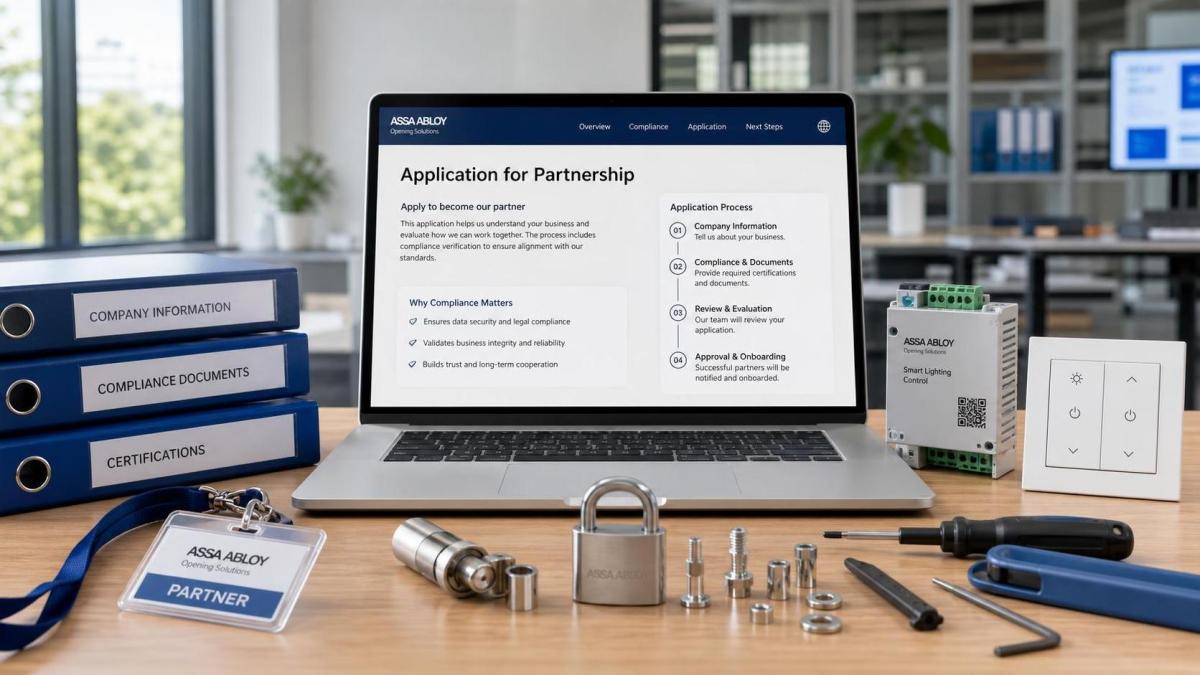
What to include, and why it matters
The strongest onboarding resources tend to share a common backbone, even when the subject matter changes. They explain intent first, then requirements, then consequences.
The first element is scope. Users need to know what the application covers and what it does not. This sounds basic, but it is often the point of failure. A PPE certification-related application, for example, may only concern model registration or distribution approval, not the underlying conformity assessment itself. A user who confuses those layers may assume the wrong legal or technical status. The resource should therefore define the boundary in plain language: this process registers, requests, enrolls, authorizes, or configures something specific, and it does not replace separate testing, approval, or contractual review.
The second element is input logic. Good explanations do not merely list required fields; they tell users why the fields exist. In security systems, a request for identity documents, device serial numbers, site plans, or administrator roles is not administrative clutter. Each item supports a control objective such as access accountability, device traceability, or maintenance responsibility. When users understand that logic, they submit better information and challenge the process less often for the wrong reasons.
The third element is conditionality. Not every user follows the same path, and onboarding breaks down when resources pretend otherwise. A facilities manager applying for a networked lighting rollout has different concerns from a distributor applying for catalog integration. A factory safety officer evaluating powered tools and PPE may need battery charging guidance, cut-resistance interpretation, and maintenance cycles, while a procurement analyst may focus on SKU structure, lifecycle cost, and replacement policy. A useful application explanations resource makes these branches visible early.
The fourth element is evidence and documentation expectations. This is where many resources become either too vague or too legalistic. The better approach is operational clarity: what document is needed, in what form, at what stage, and for what review purpose. In heavily regulated or security-sensitive scenarios, users also need to know whether a submission is retained for audit, used for identity verification, or passed to third-party processors. That is not decorative transparency. It shapes willingness to proceed.
Clear explanation is different from simplified explanation
A common mistake is to equate clarity with removing detail. In reality, users often need more detail, but better organized. Stripping out complexity may make an interface look friendlier while leaving the user less prepared for what matters.
Biometric onboarding is a good example. Telling a user to “upload face data for fast access” is simple, but inadequate. A credible explanation should tell them whether the system uses face images, templates, or another representation; what enrollment conditions affect recognition quality; what fallback path exists if recognition fails; and what local policy governs storage or deletion. The explanation does not need to become a technical white paper, but it does need to disclose the factors that affect performance, fairness, and accountability.
The same principle applies to industrial hardware. A tool onboarding guide that promises “high efficiency” says very little. Users evaluating brushless equipment need to understand duty cycle, battery ecosystem compatibility, service support, and the difference between headline torque claims and actual application fit. For fasteners, material and grade names alone are not enough without installation context. For lighting systems, protocol labels such as DALI or Zigbee mean little if the resource never explains interoperability assumptions or commissioning dependencies.
Where trust is built or lost
Users generally judge an onboarding resource less by tone than by whether it anticipates failure points. If the material only describes the ideal path, it reads like marketing. If it acknowledges where users hesitate, it starts to feel credible.
That means including friction points such as incomplete identity records, poor image capture conditions, incompatible firmware, missing authorization hierarchies, or ambiguous site ownership. It also means explaining review delays honestly. A security application may require extra verification because the consequences of false approval are serious. A safety-related submission may be paused because documentation does not match the product configuration. Users tolerate stricter processes when the reason is explicit and tied to real-world control needs.
SHSS operates in categories where physical reliability and digital trust intersect. That intersection changes what “clear” looks like. A lock system explanation cannot ignore privacy and access control. A smart streetlighting portal cannot ignore installation environment and network behavior. A high-strength hardware submission cannot ignore application loads and traceability concerns. In these sectors, onboarding content needs to connect the form on screen with the physical consequence in the field.
A practical way to judge quality
For information researchers comparing vendors, platforms, or documentation quality, the most useful test is whether the resource supports informed action. A short checklist helps:
This kind of evaluation is more revealing than polished design alone. In technical sectors, thin explanation often hides process immaturity.
Common misunderstandings
One misunderstanding is that onboarding content is mainly for first-time users. In reality, repeat users rely on it too, especially when requirements change by market, device generation, software release, or compliance regime. A seasoned installer may still need precise guidance when a new biometric workflow introduces different consent handling or when a connected lighting system changes commissioning steps.
Another is that a resource becomes “complete” once every field is documented. That is documentation coverage, not explanatory quality. Users need to understand dependencies between fields, the business rules behind them, and the operational result of each choice.
There is also a tendency to separate technical explanation from compliance explanation. In practice, the two are often inseparable. A platform handling biometric identifiers, site access rights, or safety records cannot explain onboarding well without addressing retention logic, authorization boundaries, and accountability. Even where specific legal obligations depend on jurisdiction, the resource should still describe the handling model clearly enough for users to assess fit.
What strong resources sound like
The tone of a good application explanations resource is precise, calm, and context-aware. It does not hide behind slogans. It does not pretend every user has the same starting knowledge. And it does not flatten technical nuance into vague convenience language.
In the SHSS world, where brushless tools, access systems, fastening hardware, connected lighting, and protective equipment each carry different performance and risk profiles, explanation quality is a signal of whether a platform genuinely understands its operating environment. The best resources help users see the application as part of a larger chain: field conditions, technical constraints, review controls, and downstream accountability.
That is the standard worth using. If a resource tells users what to click but not what they are committing to, it is not a strong onboarding asset. If it explains the logic, boundaries, and consequences well enough that a user can make a sound judgment before submission, then it is doing the real job an application explanations resource is supposed to do.
Recommended News