
Search News
Industry Portal
Hot Articles
Pneumatic Tools for Assembly: When Air Power Beats Cordless Options
Time
Click Count
Pneumatic Tools for Assembly: When Air Power Beats Cordless Options
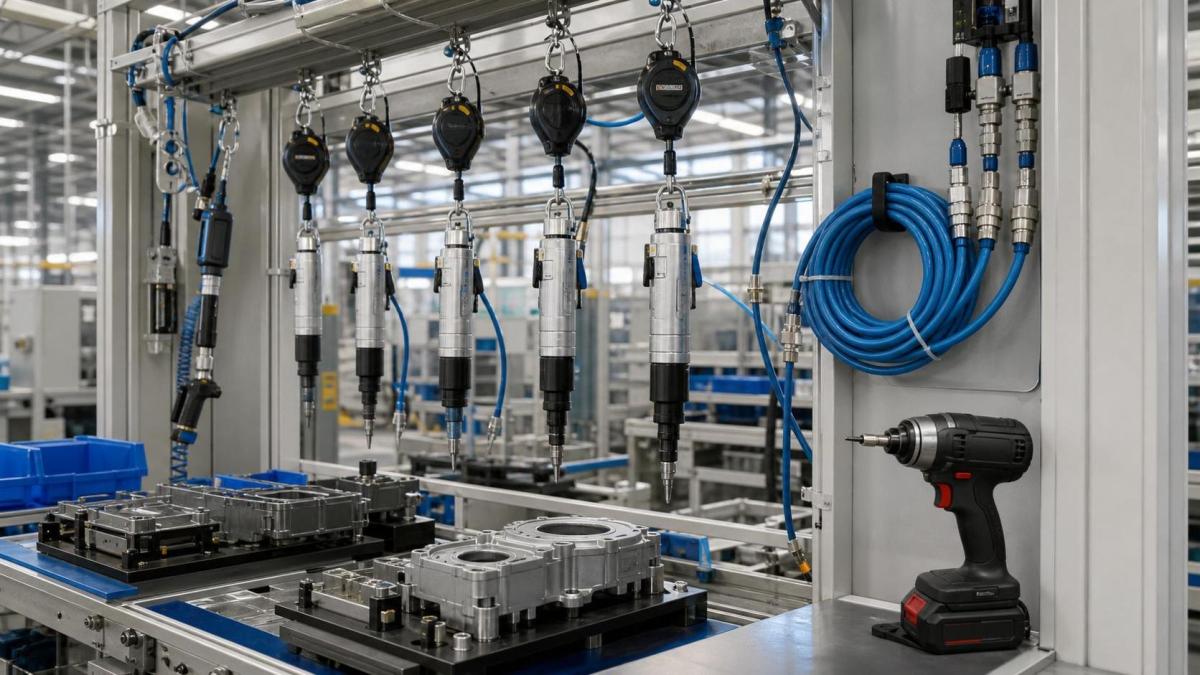
For technical evaluations, the cordless-versus-air debate is no longer about novelty. It is about output, stability, maintenance burden, and total cost across the full life of the line.
Cordless systems improved fast. Brushless motors, smarter electronics, and stronger batteries made them serious production tools. Still, pneumatic tools for assembly remain the better choice in many demanding operations.
That advantage shows up where duty cycles are high, fastening windows are tight, and process drift creates expensive rework. In those settings, air power is not old-fashioned. It is often the more disciplined platform.
The practical question is not which technology sounds more advanced. The real question is which one delivers repeatable assembly results with the least interruption and the clearest cost structure.
This is where pneumatic tools for assembly still stand out. They can reduce tool weight, support nonstop shifts, simplify spare planning, and stabilize fastening consistency in ways cordless systems sometimes struggle to match.
Where Pneumatic Tools for Assembly Still Win
The strongest case for pneumatic tools for assembly appears in fixed or semi-fixed workstations. If operators stay near a balancer, reel, or overhead hose system, battery mobility loses much of its value.
In return, air tools often give a lighter in-hand feel. Much of the energy source sits outside the tool, not inside a battery pack hanging off the grip.
That matters in repetitive fastening. Over long shifts, a few hundred grams less can improve operator comfort, reduce fatigue, and support steadier positioning at the joint.
Continuous-duty performance is another major factor. Pneumatic tools for assembly do not pause for battery swaps, charging rotation, or thermal slowdowns in the same way cordless fleets can.
That creates a simpler rhythm on multi-shift lines. When takt time is tight, fewer interruptions directly support output and staffing efficiency.
Air tools also remain highly competitive in torque repeatability for many fastening tasks. With the right pressure regulation, lubrication strategy, and socket condition, process behavior can be very stable.
This is especially useful for applications where variation hurts quality more than raw speed helps productivity. Consistency is often the hidden driver behind lower scrap and fewer warranty issues.
Typical assembly environments that favor air power
- High-volume fastening cells with stable station layouts
- Metal fabrication lines with repeated screw or nutrunner cycles
- Appliance, automotive, and industrial subassembly stations
- Facilities already operating a reliable compressed air network
- Workflows where downtime costs more than mobility benefits
When Cordless Options Make More Sense
A fair evaluation must also define where cordless tools lead. They are often better for field assembly, wide-area movement, ladder work, or mixed stations that change layout frequently.
Cordless platforms also reduce hose management. In spaces with complex routing, frequent repositioning, or strong safety concerns around trailing lines, that can be decisive.
Recent cordless systems also offer stronger digital controls. Some platforms make torque traceability, error-proofing, and fleet analytics easier to deploy than basic pneumatic tools for assembly.
So the comparison should not start with brand preference. It should start with process conditions, fastening risk, infrastructure reality, and the cost of a missed cycle.
A simple decision rule
If mobility drives the task, cordless usually gains ground. If repeat cycles, lower hand weight, and nonstop operation drive the task, pneumatic tools for assembly often regain the advantage.
Cost Analysis Beyond Purchase Price
Selection errors often come from comparing tool price only. That is too narrow for any serious assembly decision.
Pneumatic tools for assembly can look expensive when air infrastructure upgrades are included. Cordless tools can look cheaper until battery replacement, charger inventory, and spare fleet sizing are counted properly.
The useful comparison is lifecycle cost per fastening point, or at least per station per year. That shifts the discussion toward measurable operating reality.
In plants with existing compressed air systems, pneumatic tools for assembly often benefit from lower incremental deployment cost. The network is already there, so new stations add less financial friction.
By contrast, greenfield sites should evaluate compressor energy, air treatment, leaks, and pressure drop carefully. Air is useful, but poorly managed air is expensive.
Battery economics also deserve hard scrutiny. High-cycle tools can consume batteries faster than procurement teams expect, especially where fast charging and frequent rotation accelerate degradation.
Performance Risks That Shape the Decision
A good tool choice is really a risk decision. The best platform is the one that removes the biggest production failure modes at the lowest total burden.
For pneumatic tools for assembly, the main risk is infrastructure quality. Poor air regulation, moisture, leaks, and undersized lines can erase the expected performance benefit.
For cordless systems, the risks usually sit elsewhere. Battery aging, charging discipline, extra tool weight, and thermal behavior during heavy cycles can affect availability and consistency.
The better signal is not brochure torque. It is real fastening performance under actual station conditions, operator posture, and shift length.
Questions worth asking during evaluation
- What is the true duty cycle per tool per shift?
- How much downtime comes from energy source handling?
- Does operator fatigue affect angle control or seating quality?
- How stable is torque output across long production runs?
- What does maintenance history show for similar stations?
- Can the plant support clean, regulated, efficient compressed air?
How to Compare Pneumatic Tools for Assembly in Practice
A controlled pilot gives better answers than a specification sheet. The evaluation should mirror actual production, not a short bench test.
Run the candidate pneumatic tools for assembly and cordless alternatives on the same joints, by similar operators, across comparable shift durations. Track both hard and soft outcomes.
Measure fastening time, completion rate, battery or air interruptions, torque drift, rework incidents, and operator feedback. Small differences become clearer over several days.
More importantly, evaluate the system around the tool. Hoses, balancers, regulators, charging racks, spare packs, and preventive maintenance schedules all change station performance.
- Define the exact fastening task and quality window.
- Audit current air infrastructure and electrical support.
- Pilot both platforms under full-shift conditions.
- Calculate lifecycle cost, not just acquisition cost.
- Score ergonomics, uptime, and process control together.
A Practical Selection View
Pneumatic tools for assembly are still highly relevant because many assembly lines still reward stability more than mobility. That is the core decision point.
If the process depends on long shifts, low hand weight, rapid repeat cycles, and limited interruptions, air power can outperform modern cordless options in measurable ways.
If the process depends on movement, flexible layouts, and digital tool-side controls, cordless may offer better operational fit. The stronger platform is the one aligned with the station reality.
The most reliable path is straightforward. Test both in the real environment, quantify interruption costs, and let lifecycle evidence decide. In many fixed production cells, pneumatic tools for assembly still come out ahead.
Recommended News