
Search News
Industry Portal
Hot Articles
Pneumatic Tools or Cordless Options: What Performs Better on Site?
Time
Click Count
Choosing between pneumatic tools and cordless systems now affects more than operator preference. On active sites, the decision shapes torque consistency, mobility, maintenance effort, energy planning, and safety control across fastening, drilling, cutting, and assembly work.
That is why the comparison matters across construction, industrial maintenance, utility work, and smart city infrastructure. In practice, the better option depends less on hype and more on airflow access, duty cycle, tool weight, uptime risk, and total operating conditions.
Within the broader SHSS view of smart hardware, this choice also reflects a larger shift. Sites are balancing brute mechanical output with data-driven efficiency, tighter safety controls, stronger fastener demands, and more disciplined lifecycle evaluation.
What the comparison really measures
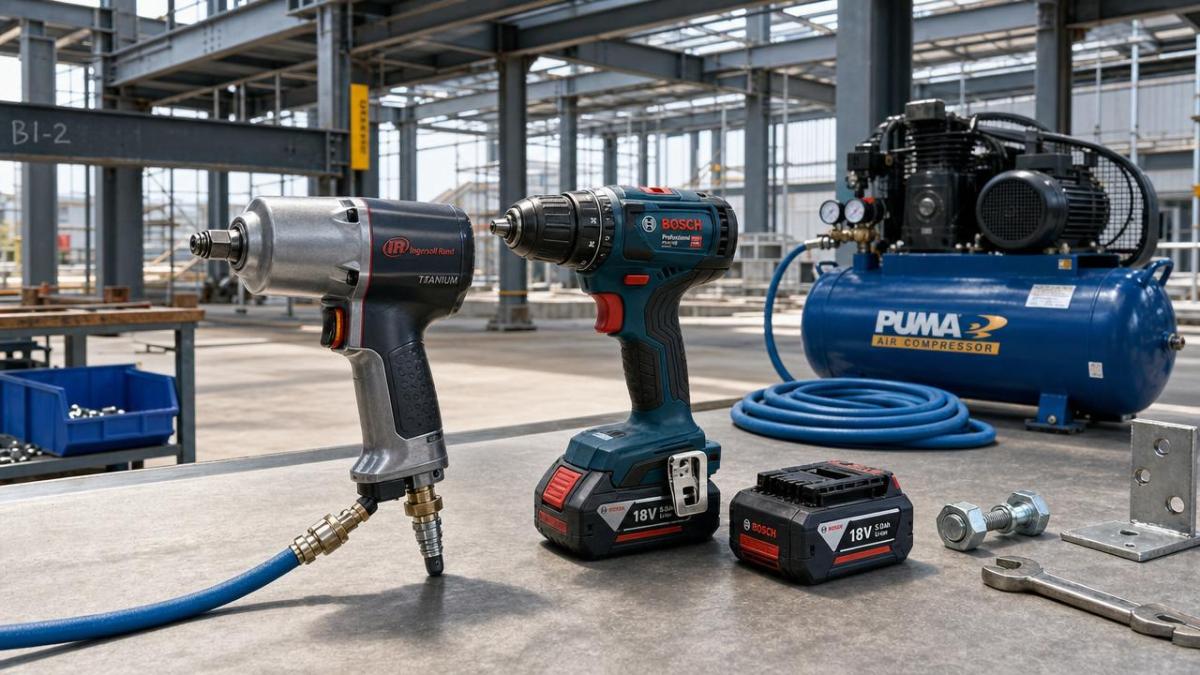
The question is not whether pneumatic tools are old and cordless tools are new. The real issue is how each platform performs under repeated jobsite stress, variable materials, and uneven working environments.
Pneumatic tools use compressed air to deliver power. Cordless tools rely on BLDC motors, control electronics, and lithium-ion batteries. Both can be highly capable, but they behave differently when site conditions become demanding.
For technical evaluation, the useful metrics are practical. Output, repeatability, runtime, recovery speed, service burden, and ergonomic impact usually matter more than nameplate numbers alone.
Why pneumatic tools still hold ground
Pneumatic tools remain strong where continuous duty is non-negotiable. In repetitive fastening lines, metal fabrication, tire service, and plant maintenance, they still offer a stable power source with little concern about battery fade during the shift.
They are also valued for favorable power-to-weight performance at the handpiece. When the compressor system is already in place, the tool body can stay lighter than many cordless alternatives with equivalent output.
Another advantage is thermal endurance. Pneumatic tools often tolerate high-cycle use without the same battery heat constraints or electronic throttling that some cordless tools face under sustained heavy load.
In environments where dust, impact, and rough handling are common, simpler internal architecture can also help. That does not remove maintenance needs, but it changes the maintenance profile.
Where their limits show up
The compressor, hose network, moisture control, and air quality management are part of the real system cost. A high-performing pneumatic tools program is never just about the handheld unit.
Mobility is the other obvious constraint. On scaffold work, service vehicles, remote repairs, or punch-list movement between zones, hoses can slow repositioning and introduce trip hazards.
Noise is often overlooked at the planning stage. Compressor operation and exhaust sound can affect worker comfort, hearing protection requirements, and indoor site coordination.
Why cordless options gained site momentum
Cordless systems improved because batteries, motor control, and brushless design advanced together. Modern units now deliver serious fastening and drilling capability in a portable format that fits fragmented site workflows.
For mobile crews, speed between tasks often matters as much as raw peak force. A cordless impact wrench or drill can move from rooftop to basement plant room without hoses, compressor checks, or air line routing.
That mobility supports mixed-trade projects, retrofit jobs, field service calls, and expanding smart infrastructure work. It also aligns with digitized fleet management, where battery health, charger usage, and tool allocation can be monitored more systematically.
SHSS tracks this shift closely because it mirrors a broader hardware pattern. Tools are becoming part of connected operational ecosystems, much like smart lighting, access systems, and monitored safety equipment.
Where cordless still needs caution
Cordless performance is not uniform across all applications. Heavy structural fastening, long-duration grinding, and repeated high-torque cycles can expose runtime drops, heat build-up, and battery rotation pressure.
The battery platform itself becomes part of the asset strategy. Charging discipline, spare inventory, storage temperature, and replacement intervals affect the true economics of the system.
Performance on site depends on the task, not the trend
A useful comparison starts with the task profile rather than the tool category. The same site can justify pneumatic tools in one zone and cordless tools in another.
This is why broad claims can mislead. Pneumatic tools may outperform on one metric while losing on logistics. Cordless may win on access and response time while trailing in sustained cycle stability.
The wider jobsite factors that change the decision
Tool performance is affected by more than the tool itself. Fastener grade, substrate hardness, humidity, dust load, shift length, and PPE requirements all influence the result.
For example, high-strength hardware installation may demand precise and repeatable torque behavior. In that case, the tool platform must be judged alongside socket wear, calibration practice, and joint criticality.
Safety conditions also matter. Hose routing can create movement risk, while batteries introduce charging, storage, and thermal considerations. Neither platform is automatically safer without process discipline.
In enclosed industrial sites, air exhaust, compressor placement, and noise exposure deserve attention. On remote civil work, the issue shifts toward battery charging resilience and spare pack availability.
Typical use patterns
- Choose pneumatic tools for repetitive, fixed-location, high-cycle production or service bays.
- Choose cordless tools for dispersed workfaces, retrofit movement, and access-limited repairs.
- Use mixed fleets where one project includes assembly stations and roaming installation crews.
- Review PPE, lighting, and space constraints together with tool choice, not afterward.
How to judge lifecycle value more accurately
Upfront price rarely tells the whole story. Pneumatic tools can look economical per unit, but the air system, leaks, filtration, lubrication, and downtime from infrastructure faults must be counted.
Cordless tools can look expensive at purchase, especially across multiple battery packs and chargers. Yet they may reduce setup time, simplify movement, and cut productivity loss in fast-changing site layouts.
A sound review usually tracks five cost layers:
- Acquisition cost of tools, accessories, and core infrastructure.
- Energy cost for compressed air or battery charging.
- Maintenance burden, including scheduled and unplanned service.
- Downtime exposure tied to failures, logistics, or depleted capacity.
- Productivity impact from movement, fatigue, and task changeover speed.
This is where disciplined intelligence matters. SHSS often frames hardware decisions through durability, safety, and operational continuity rather than isolated purchase comparisons.
A practical decision path for current projects
If the worksite already has reliable compressed air and the task is repetitive, pneumatic tools often remain the stronger performer. Their advantage grows when uptime and sustained force outweigh movement flexibility.
If the work shifts constantly across floors, rooms, vehicles, or outdoor zones, cordless systems often create better real-world productivity. Their benefit appears in transit reduction, faster deployment, and simpler crew coordination.
Where the answer is still unclear, run a field comparison with the same fasteners, substrates, cycle count, and PPE conditions. Measure torque consistency, completion time, stoppages, operator fatigue, and energy support demands.
That approach usually reveals the truth faster than brochure claims. It also creates a repeatable internal standard for future tool selection, whether the next priority is construction speed, industrial reliability, or smart infrastructure deployment.
The best next step is to map tools against actual duty cycles, site mobility, and support infrastructure. Once those conditions are clear, the choice between pneumatic tools and cordless options becomes far more precise and easier to defend.
Recommended News