
Search News
Industry Portal
Hot Articles
Hall Sensor BLDC Motor Issues: Startup Jitter, Timing Errors, and Fixes
Time
Click Count
Hall Sensor BLDC Motor Issues: Startup Jitter, Timing Errors, and Fixes
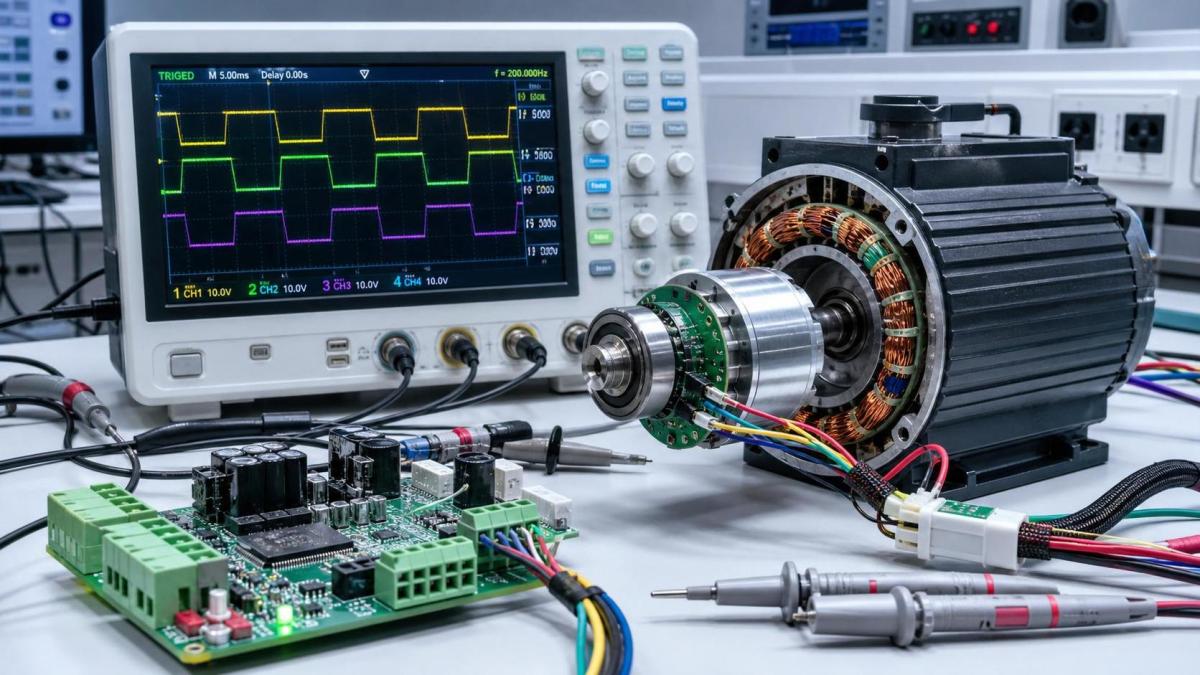
When a hall sensor BLDC motor shows startup jitter, phase timing drift, or unstable commutation, fast diagnosis matters more than theory.
In field service, these faults often appear in brushless drills, fastening tools, pumps, fans, access systems, and smart hardware modules.
A hall sensor BLDC motor usually fails in recognizable patterns. Once you match the symptom to the signal path, repairs become much faster.
This guide focuses on practical checks, timing logic, common fault sources, and reliable fixes that reduce repeat failures.
What Startup Jitter Usually Means
Startup jitter is the short shaking, clicking, or hesitation seen when the rotor cannot lock into the correct commutation sequence.
On a hall sensor BLDC motor, this often points to incorrect Hall transitions, weak supply voltage, phase wiring errors, or controller timing mismatch.
The motor may twitch forward, stop, then retry. In heavier tools, it may buzz under load but recover when unloaded.
That difference matters. A no-load startup issue often suggests signal quality. A load-only issue often exposes weak torque margin or phase advance errors.
Typical startup symptoms
- Rotor shakes but does not rotate
- Motor starts only after manual spin assistance
- Reverse kick before forward rotation
- Intermittent startup failure after warm operation
- High current spike with low torque output
Most Common Root Causes in a Hall Sensor BLDC Motor
Most failures fall into five areas: Hall sensors, wiring, controller logic, mechanical drag, or power supply quality.
A hall sensor BLDC motor depends on stable rotor position feedback. If the controller reads the wrong state, commutation timing shifts immediately.
1. Hall sensor signal faults
A damaged Hall element may stick high, stick low, or switch late. That creates missing or distorted state transitions.
Heat is a frequent trigger. Some motors behave normally when cold, then develop timing errors after several minutes of operation.
2. Connector or harness problems
Loose terminals, oxidized pins, broken shielding, and cable flex damage can corrupt Hall outputs even when the sensor itself is healthy.
In portable industrial tools, repeated vibration and strain near the motor exit point are especially common failure points.
3. Wrong Hall-to-phase mapping
After board replacement or motor swap, the Hall order may not match the phase sequence expected by the controller.
This is a classic hall sensor BLDC motor startup issue. The motor may spin roughly, draw excess current, or run in the wrong direction.
4. Power rail instability
Low battery voltage, poor DC bus capacitors, or regulator noise can disturb Hall reference voltage and logic thresholds.
From recent field trends, this is becoming more visible in compact, high-power brushless tools with aggressive current demand.
5. Mechanical resistance
Worn bearings, contamination, bent shafts, or gearbox drag can make a timing problem look worse than it really is.
A hall sensor BLDC motor with marginal startup torque will show jitter sooner when friction rises.
How to Diagnose Timing Errors Step by Step
A structured process saves time. Random parts replacement usually hides the real fault and increases return visits.
Step 1: Check mechanical freedom first
Rotate the shaft by hand with power off. Look for tight spots, scraping, gearbox drag, or bearing noise.
If rotation is not smooth, correct that first. Hall timing analysis is less reliable when mechanical load is abnormal.
Step 2: Verify Hall supply and ground
Measure Hall supply voltage at the motor connector, not only at the controller board. A drop under load is a strong clue.
Ground offset also matters. A few unstable millivolts can distort logic recognition in a sensitive hall sensor BLDC motor system.
Step 3: Observe Hall state transitions
Turn the rotor slowly and record the three Hall outputs. You should see a clean six-step sequence without missing states.
If one channel never changes, changes late, or flickers, isolate the sensor, cable, or connector.
Expected Hall sequence check
Step 4: Compare Hall signals with phase commutation
Use an oscilloscope if available. Check whether each Hall edge aligns with the controller’s phase switching event.
A delayed or advanced trigger can cause a hall sensor BLDC motor to lose torque, run hot, or produce audible roughness.
Step 5: Test under realistic load
Some motors pass bench tests but fail in the actual application. Load reveals weak startup current control and unstable commutation.
In practical service work, a short loaded run often exposes the real issue faster than long no-load testing.
Field-Proven Fixes That Usually Work
Once the fault category is clear, repairs become straightforward. The goal is clean Hall feedback and stable commutation from zero speed.
Replace unstable Hall devices
If one Hall channel drifts with temperature or vibration, replace the sensor set, not only the single failed device.
Matching response characteristics across all channels improves consistency in a hall sensor BLDC motor.
Repair the harness properly
Do not leave temporary splices inside a high-vibration product. Re-terminate damaged pins and protect flex zones with proper strain relief.
This also reduces noise pickup, which is a growing issue in compact smart hardware with dense power electronics.
Correct Hall-phase mapping
After replacing motors or control boards, confirm the Hall order and phase order against the controller’s commutation table.
One wrong combination can make a healthy hall sensor BLDC motor look defective.
Stabilize supply quality
Replace weak bus capacitors, check regulator ripple, and verify battery or adapter voltage during startup current peaks.
This is especially important where high torque and lightweight design push the electrical margin very hard.
Update firmware or timing parameters
Some startup faults come from controller settings, not hardware. Check commutation delay, start current, and phase advance values.
A small timing correction can turn a rough hall sensor BLDC motor into a stable one without replacing major parts.
How to Prevent Repeat Failures
A repair is only complete when the same issue is unlikely to return. Prevention usually comes from process discipline.
- Log Hall sequences before and after repair
- Check connector retention on every service visit
- Inspect cable bend points near the motor housing
- Measure startup voltage sag under actual load
- Confirm firmware version after controller replacement
- Watch temperature rise during a short loaded run
More importantly, keep a known-good signal reference for each product line. That shortens diagnosis on future hall sensor BLDC motor complaints.
Final Service Checklist
Before closing the case, verify four points: clean Hall transitions, correct phase mapping, stable startup voltage, and smooth loaded acceleration.
If all four are confirmed, most hall sensor BLDC motor startup jitter and timing errors will stay resolved.
The practical takeaway is simple. Follow the signal path, confirm the sequence, then validate under load. That approach fixes problems faster and with fewer repeat returns.
Recommended News