
Search News
Industry Portal
Hot Articles
How to verify a safety solutions manufacturer's NIOSH respirator approvals
Time
Click Count
Before placing an order with an industrial safety solutions manufacturer, verify the exact respirator configuration being offered. A supplier may legitimately hold NIOSH approvals for some products while selling other models or component combinations that are not covered. The manufacturer’s name, a NIOSH logo, or an approval number on its own does not establish that the item in your purchase order is approved.
Start with the approval number and compare it against official NIOSH records. Then check the model, protection class, approval holder and approved components against the supplier’s quotation and the product you expect to receive. If those details do not align, resolve the discrepancy before accepting the approval claim. Verification also needs a separate workplace assessment: a genuine NIOSH-approved respirator can still be unsuitable for the hazard or the wearer.
Start with the exact product being quoted
Ask the supplier for the product’s full identification before searching. A catalog description such as “NIOSH-approved N95 mask” or “approved full-face respirator” is too broad to support a purchase decision. Request the manufacturer’s model designation, the NIOSH approval number, the protection designation and a copy of the applicable approval label or user instructions.
For reusable and powered systems, obtain a complete bill of materials. Include the facepiece or head covering, filters or cartridges, and, where applicable, the blower, battery, breathing tube and other components specified for the configuration. Model numbers for replacement parts matter as much as the name of the assembled system.
Also identify the company named as the approval holder. It may differ from the seller or brand shown on the quotation. A distributor can sell an approved product, and branding arrangements can complicate the paperwork, but the supplier should be able to explain the relationship and show how the offered model corresponds to the official approval.
Keep the supplier’s evidence with the quotation. A photograph of a package can be helpful, but it should show enough detail to read the model and approval markings; a cropped image of a logo is not a substitute for the approval information.
Find and interpret the NIOSH approval record
Use NIOSH’s Certified Equipment List, commonly called the CEL, to search for the approval number and compare the result with the product offered. NIOSH also publishes resources for identifying approved filtering facepiece respirators and information about counterfeit or misrepresented respirators. Access these resources through the official CDC/NIOSH website rather than a link supplied only by the seller.
NIOSH approval numbers generally begin with TC, followed by a designation and identifying numbers. Copy the full number exactly, including its separators where shown. A partial number, a test report number or a quality-system certificate number is not enough to identify the respirator approval.
Work through the result in this order:
- Approval holder: Compare the listed holder with the supplier’s documentation. If the brand or seller differs, ask for documentation connecting the offered product to that approval.
- Model or series: Check the complete designation, including letters, suffixes and variants. Similar-looking model numbers should not be treated as interchangeable without supporting approval documentation.
- Respirator type and protection: Compare the listed type and protection designation with the quoted item and its intended use.
- Approved configuration: Use the applicable approval label and instructions to check which components may be used together.
- Approval status: Check the information available in the official record, including any applicable status or limitations. If the record or documentation leaves the status unclear, seek clarification before purchase.
Search results are a starting point for matching the approval, not permission to substitute any component sold under the same brand. The approval label and manufacturer’s instructions provide the configuration details needed to assess a complete assembly.
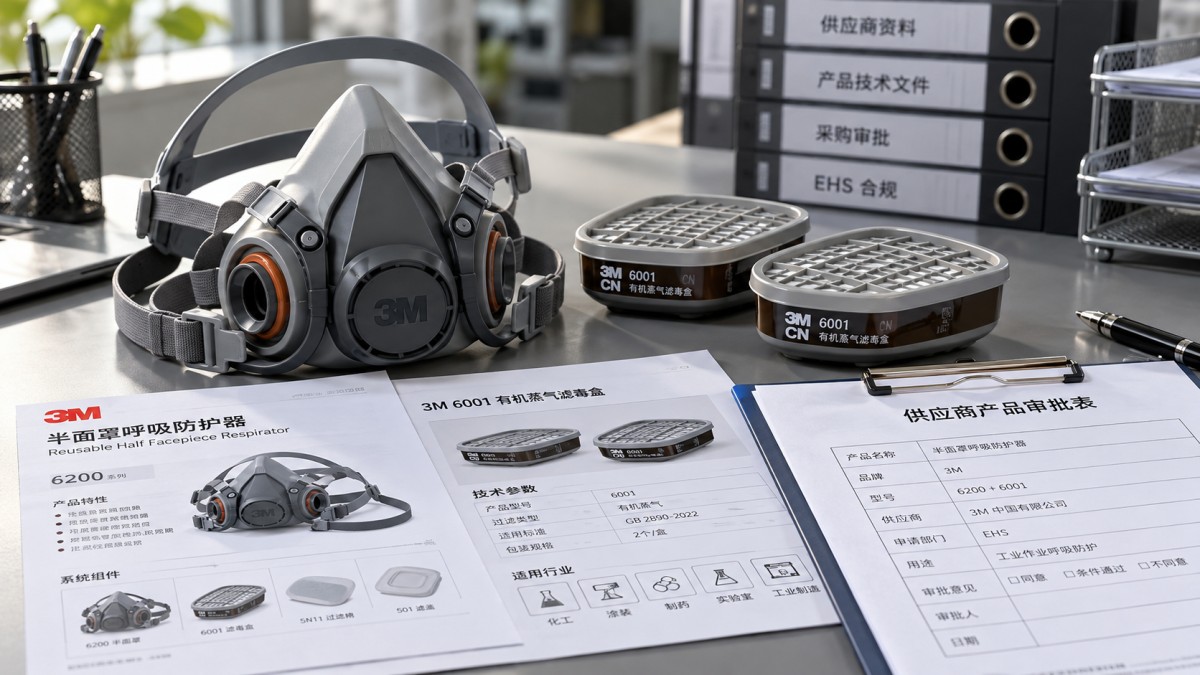
If a search returns no matching record, recheck the number and model for transcription errors, then ask the supplier for the exact approval documentation. An unsuccessful search does not by itself explain whether the issue is a typo, a search limitation or a false claim. Until the match is resolved through authoritative information, do not treat the item as verified.
Check the configuration, not just the facepiece
For a disposable filtering facepiece, the relevant check is comparatively direct: match the approval number, manufacturer, model and protection designation to the official information, and inspect the markings and packaging of the item offered. For a reusable respirator, the approved configuration may depend on several separate parts.
A full-face respirator, for example, may have a NIOSH approval when used with particular filters or cartridges. That does not establish approval for the same facepiece fitted with an alternative cartridge, a look-alike adapter or a part from another manufacturer. Likewise, a powered air-purifying respirator must be checked as a system: the head covering, blower and other specified components must correspond to an approved configuration.
Review the quotation and replacement-parts schedule together. A supplier may quote an approved initial assembly but propose a different filter for recurring orders. Ask the supplier to identify the approval documentation supporting each combination, especially when a component has been superseded or its part number has changed. Similar appearance, threading or physical fit is not evidence of approval.
The same caution applies to kits. A kit’s commercial stock-keeping unit can be useful for ordering, but it may not be the model designation shown in the NIOSH record. Ask for a component-level mapping if the kit number cannot be matched directly.
Separate approval from suitability for the hazard
NIOSH approval verifies that a respirator configuration has met the applicable requirements for its approval. It does not, by itself, establish that the product is suitable for every workplace or that it will protect a particular worker under actual conditions.
Selection depends on the hazard, its concentration or expected exposure, the work being performed and the applicable respiratory protection requirements. For example, a particulate filtering facepiece such as an N95 is intended for particles; it should not be selected as protection against gases or vapors. Gas and vapor cartridges must be appropriate for the contaminants and conditions of use. Some environments require a different class of respiratory protection altogether.
Have the person responsible for the organization’s respiratory protection program review the proposed configuration before the order is finalized. In the United States, OSHA’s respiratory protection standard, 29 CFR 1910.134, addresses selection and program requirements for covered workplaces. Depending on the respirator and circumstances, these include medical evaluation, fit testing, training and maintenance. Tight-fitting respirators require attention to fit; approval of the model does not demonstrate that it seals properly on an individual wearer.
Procurement specifications should therefore state both the required approved configuration and the workplace selection criteria supplied by the safety team. This avoids accepting a technically genuine approval for a product that does not meet the intended application.
Recognize weak evidence and resolve discrepancies
Supplier documentation deserves closer scrutiny when it relies on a broad statement such as “NIOSH certified” without identifying the approval number and model. Other warning signs include a number that points to a different approval holder, a protection designation that conflicts with the official record, or a configuration whose components are absent from the applicable approval label.
Be equally careful with documents that look authoritative but answer a different question. A laboratory report may describe a test; a quality-management certificate may address an organization’s processes. Neither alone establishes NIOSH approval of the offered respirator configuration. Similarly, another jurisdiction’s certification or a statement that a product “meets NIOSH standards” is not the same as a NIOSH approval.
A matching number is necessary evidence, but it is not conclusive proof that an individual item is authentic. Markings can be copied onto counterfeit products or packaging. Compare the physical product and packaging with the manufacturer’s instructions and official NIOSH resources, including counterfeit alerts where relevant. Unexplained differences in markings, packaging, construction or supply route warrant investigation; appearance alone should not be the sole basis for deciding authenticity.
When a mismatch appears, put the purchase on hold and send the supplier a specific question: identify the quotation line, the claimed approval number and the detail that does not match. Request the applicable approval label, a clear explanation and, where necessary, confirmation from the approval holder. If the explanation cannot be reconciled with authoritative information, do not accept the approval claim for that configuration.
Build the check into ordering and receipt
Once a configuration is verified and selected for the workplace, carry its details into the purchase order. Specify the approval number, model, protection designation and approved component part numbers as appropriate. Require the supplier to obtain acceptance before substituting a model or component, including replacement filters and cartridges.
At receipt, compare the delivered product and its markings with the approved specification and the supplier’s documentation. For systems assembled from multiple parts, check the contents against the approved configuration rather than relying only on the outside carton. Quarantine discrepancies while they are investigated, particularly when workers may otherwise receive the equipment immediately.
Retain the official record consulted, approval documentation, supplier correspondence and receiving checks with the procurement file. Revisit the verification when the supplier, model, component list or intended use changes. That record gives the safety and purchasing teams a basis for deciding whether a future order is the same approved configuration they originally accepted.
Recommended News