
Search News
Industry Portal
Hot Articles
What makes biometric authentication GDPR compliant in practice?
Time
Click Count
A biometric system is not GDPR compliant simply because it encrypts facial images, fingerprints, or iris scans. In practice, biometric authentication GDPR compliant means the entire identity-verification process has been designed around a justified purpose, limited data collection, controlled access, and provable accountability.
That distinction matters most in physical access control. A reader with strong liveness detection may prevent spoofing, but the deployment can still create unnecessary legal and operational risk if it stores raw images indefinitely, sends templates to an unrelated cloud service, or gives employees no meaningful alternative to biometric entry.
For a technical evaluation, the useful question is not “Does this terminal support GDPR?” It is: Can we explain, configure, operate, and audit every stage of biometric processing in a way that is necessary and proportionate for this site?
Start with the processing purpose, not the sensor
Biometric data used to uniquely identify a person is treated as sensitive personal data under the GDPR. A deployment therefore needs more than a general security objective. The organisation should define the specific access problem it is solving and show why biometric verification is appropriate for that problem.
For example, controlling entry to a high-security laboratory, a data centre, or a restricted production area may create a stronger case than replacing ordinary office badges at every internal door. The more intrusive the system and the broader the population affected, the harder it becomes to justify collecting biometric identifiers.
This is where procurement discussions often go wrong. A supplier may describe facial or iris recognition as fast, contactless, and resistant to credential sharing. Those can be valid operational benefits, but they do not independently establish a lawful basis for processing. The organisation deploying the system must connect the technology to a defined security need, assess less intrusive alternatives, and document its reasoning.
Biometrics are usually easier to defend where the system protects a clearly restricted zone and is only used at the point where stronger identity assurance is required. A design that applies the same biometric check to every visitor, employee, and doorway without differentiating risk is more difficult to support.
Consent is not a universal shortcut
Consent is often presented as the simplest route to biometric compliance. In an employment setting, however, consent may not be freely given when an individual believes refusal could affect access to work, attendance records, or professional standing. A signed form alone does not solve that imbalance.
Technical evaluators should ask the project team which legal condition is intended to support both the general processing of personal data and the additional conditions that apply to sensitive biometric data. This is a governance decision, not a checkbox in the device interface.
Where consent is used, it should be genuinely optional, informed, and as easy to withdraw as it was to give. In many workplace access deployments, that means providing a practical non-biometric route, such as a managed credential and PIN process, rather than treating an alternative as a deliberately inconvenient exception.
An alternative method is also good operational design. It supports users whose biometric enrollment fails, users who cannot use a particular modality reliably, temporary contractors, and business-continuity procedures when a reader is unavailable.
Data minimisation changes the system architecture
The strongest privacy decision is usually made before installation: avoid collecting information that the access decision does not need. A door controller needs to answer whether an enrolled person matches an authorised identity. It rarely needs to retain a video-like facial image, a broad movement profile, or a detailed analytics record to do that job.
In a well-designed biometric access workflow, enrollment data is transformed into a biometric template. The matching process then compares a live capture with that reference template. This does not make the template anonymous, but it can reduce exposure compared with holding reusable raw images or scans.
Ask vendors clear technical questions:
- Is the original capture retained after enrollment, and can retention be disabled?
- What data is stored in the template, and can it be used outside this access-control purpose?
- Where does matching occur: on the reader, at an on-site controller, or in a remote cloud service?
- Can templates be deleted individually and reliably when access rights end?
- Are access events separated from biometric reference data where possible?
Local or edge matching can reduce data flows and simplify network exposure, particularly for facilities that need resilient operation during connectivity problems. It is not automatically compliant, though. The organisation still needs role controls, lifecycle rules, secure device management, and evidence that the local system is not quietly exporting data for diagnostics, analytics, or model improvement.
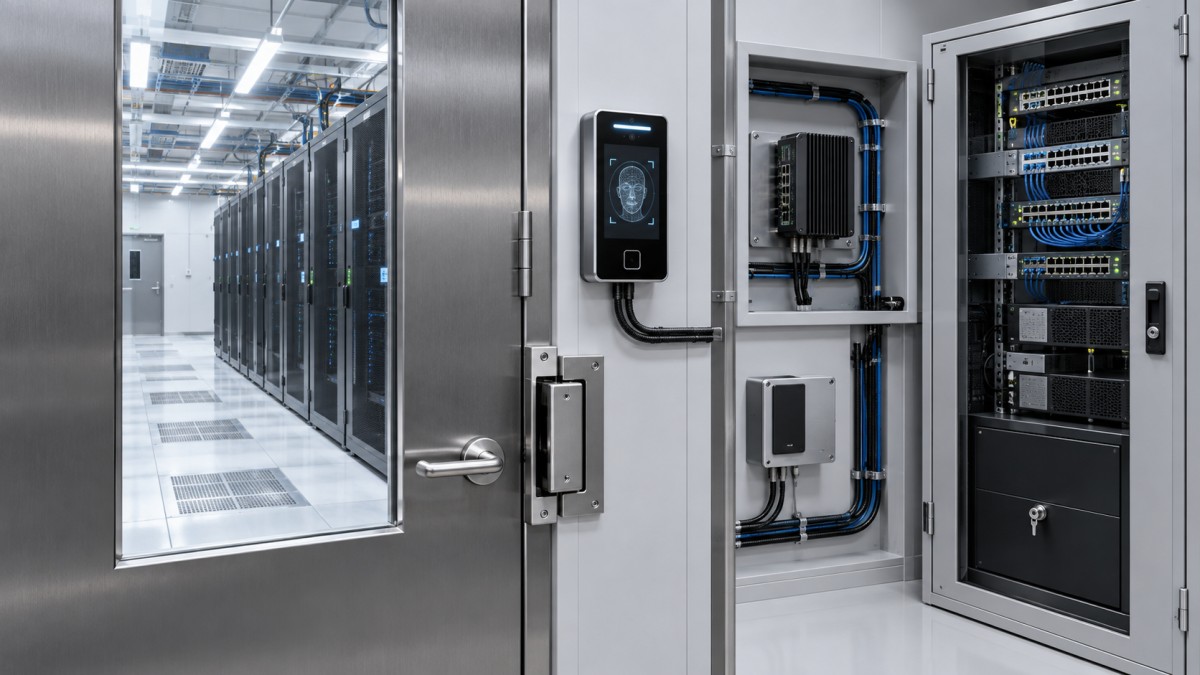
Privacy by design must be visible in the configuration
“Privacy by design” becomes meaningful when it appears in system choices that an auditor or system owner can inspect. The practical controls are often ordinary engineering controls, but they must be enabled, assigned, and maintained.
Security features should not be accepted as vague vendor claims. Encryption, for example, raises practical questions: who controls the keys, how are keys rotated, what happens when a reader is replaced, and can support staff retrieve biometric information during remote troubleshooting? The answer should be reflected in the architecture and contractual support model.
Retention is an operational process, not a policy sentence
Biometric records should not outlive the reason for enrollment. That sounds simple, yet it is one of the most frequent implementation gaps because access systems are commonly connected to multiple identity sources.
An employee may leave the organisation, a contractor may finish a site assignment, or a visitor pass may expire. If the biometric platform is not linked to an authoritative identity-lifecycle process, templates can remain active or dormant long after the underlying access right has ended.
A workable retention design defines events, owners, and evidence. It should answer who initiates deletion, whether deletion is automated or reviewed, how backups are handled, and how the organisation demonstrates that a template was removed. Backups need special attention: they may be necessary for resilience, but should follow controlled restoration and expiry procedures rather than becoming an undeclared permanent archive.
Access logs require their own rule. A log showing that a credential was accepted at a door is not the same as the biometric template used to authenticate the person. Treating all biometric and access data as one retention category often leads either to excessive storage or to losing records needed for a legitimate security investigation.
Run a data protection impact assessment before scale changes the risk
Biometric access control can create a high-risk processing activity, particularly when it involves systematic monitoring, a large employee population, sensitive locations, or linkage with other datasets. A data protection impact assessment is valuable because it forces the project team to test the deployment before it becomes embedded in building operations.
The assessment should map enrollment, capture, matching, storage, transmission, support access, incident response, deletion, and supplier involvement. It should also examine practical failure modes: false matches, failed matches, spoofing attempts, operator misuse, compromised administrator credentials, offline operation, and the consequences of a reader or controller being stolen.
This exercise is not merely a privacy document. It exposes technical assumptions that affect security and usability. A system that has no accessible manual-entry path, unclear enrollment ownership, or no method for revoking a compromised template may be difficult to operate safely even before GDPR concerns are considered.
Evaluate the supplier as part of the compliance boundary
For a biometric system, compliance does not stop at the terminal. Hosted management platforms, remote maintenance tools, mobile enrollment applications, installers, and subcontracted support can all handle or access personal data. Their role, access level, hosting location, and instructions from the deploying organisation need to be clearly defined.
During technical selection, request documentation that is specific enough to test. Useful material includes a data-flow diagram, a description of template generation and storage, interface documentation, access-control roles, deletion functions, audit-log coverage, incident-support procedures, and a clear statement of any remote support access. A generic privacy statement is not enough to validate the actual deployment model.
For smart access environments such as commercial buildings and critical facilities, platforms reviewed by SHSS can be assessed most effectively as a complete chain: reader, controller, network, identity source, management console, and operator process. High-quality facial, iris, or fingerprint recognition remains only one part of that chain.
Do not confuse accuracy, liveness detection, and compliance
Recognition performance and presentation-attack detection are important security properties. A system that accepts a printed photograph, replayed video, or copied fingerprint can create serious access risk. Yet stronger liveness detection does not justify collecting more biometric data than necessary, retaining it longer than needed, or repurposing it for monitoring.
Likewise, a technically accurate biometric system may still be unsuitable where badge access with appropriate controls meets the same security objective. The correct design is driven by the threat model and the proportionality of the response, not by the most sophisticated sensor available.
Before approval, technical evaluators should be able to state in plain language what is captured, why it is needed, where matching occurs, who can access it, how long it remains, what alternative exists, and how the system is audited. When those answers are concrete, biometric authentication is far more likely to be defensible in practice rather than merely described as compliant in a product brochure.
- Last One:No more articles
- Next Article:When does iris recognition make sense for data center access control?Oct 05, 2026
Recommended News