
Search News
Industry Portal
Hot Articles
- How does keyless access control for hotels work during a power outage?Dr. Matthias Vance
- Report: Tariff Disruption Could Shift $4 Billion in Aerospace Fastener Revenue by 2030Hardware Mechanics Fellow
- Industrial Fasteners Market Forecast to Reach $128.3 Billion as Tariffs Disrupt Supply ChainsHardware Mechanics Fellow
How does keyless access control for hotels work during a power outage?
Time
Click Count
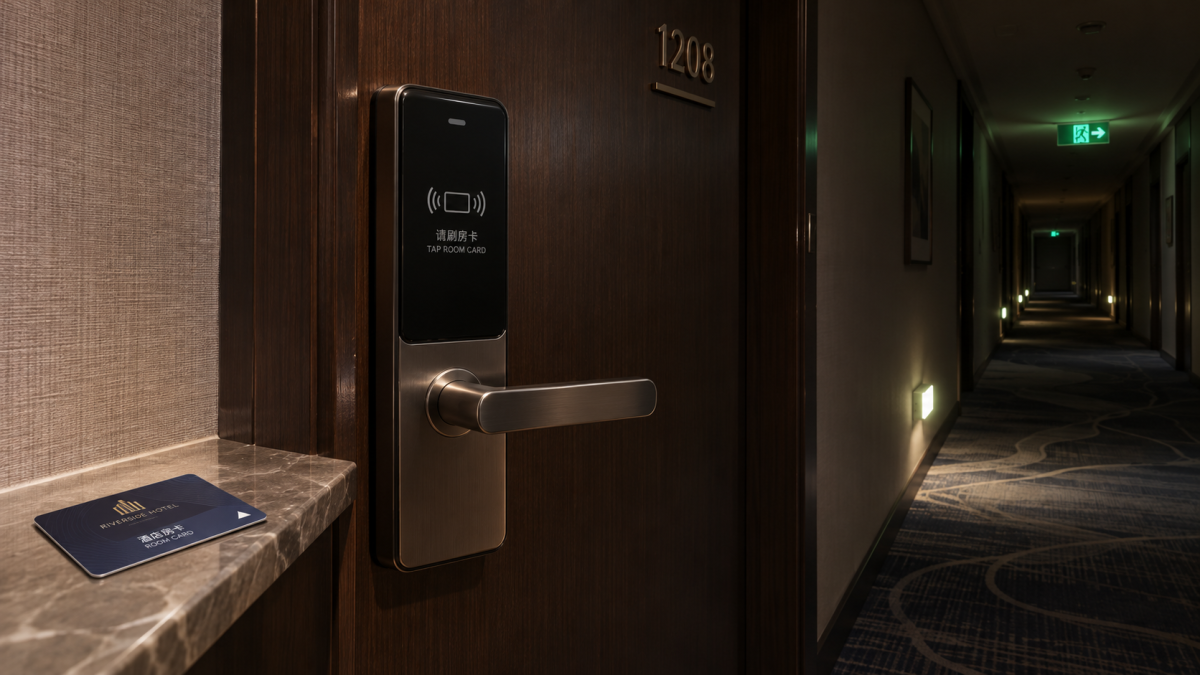
During a power outage, many hotel room locks continue to operate because their batteries power both the locking mechanism and local credential checks. A guest can often enter with an existing card or mobile credential even when the building’s mains supply is down. That outcome is not guaranteed: the lock’s battery, the credential’s offline capabilities, and the availability of supporting equipment all matter.
The disruption may instead appear at reception, where staff cannot encode a new card, or at a lift or entrance controlled by a mains-powered panel. Evaluating keyless access control for hotels therefore means tracing each step from credential issuance to door release, rather than asking only whether the room lock has a battery.
Separate the lock from the rest of the system
A typical battery-powered guestroom lock contains a reader, electronics, a motor or other actuator, and memory for the information needed to recognize authorized credentials. Depending on the design, it may make an access decision without contacting a server. The card or phone presents a credential, the lock checks it against locally available rules, and the mechanism releases if the check succeeds.
Other parts of the access system may have different power dependencies. Reception workstations, card encoders, network switches, wireless gateways, controllers and management servers can all stop working when their normal supply fails. A lock that can recognize an existing credential offline does not necessarily receive a new authorization or revocation immediately.
A wired online door is a different case. Its reader and locking hardware may depend on a central controller and power supply. A controller with a suitable battery backup may continue to make decisions locally, but only for as long as its power reserve and configuration permit. If the controller loses power, the door’s behavior depends on its locking device and emergency design.
Follow the credential through an outage
Cards already issued to guests
An existing card can continue to work at an offline-capable, battery-powered room lock if its authorization is still valid and the lock has the information needed to verify it. Some systems carry relevant authorization data on the card; others check stored information at the door. The precise handling of expiration, replacement cards and access changes is product-specific.
Consider a guest who extends a stay while reception equipment is unavailable. The card may work until its original expiration but fail afterward if the extension cannot be encoded or communicated. Similarly, a lost card may not be revoked at every offline lock at once. Ask the supplier how replacement credentials, revocation lists and lock updates propagate when normal communications return.
Mobile credentials
A mobile key can work without a live internet connection at the door when the credential is already provisioned on the phone and the lock supports the relevant local communication method. The phone still needs enough power, and the app or credential service must permit the necessary operation offline. Bluetooth, NFC and app behavior vary by implementation; the presence of one of these technologies alone does not prove outage capability.
Issuing a new mobile key can have a longer dependency chain. It may require the reservation or property-management system, the access platform, an internet connection, and a functioning phone. Even when a guest can open the room offline, a new arrival may be unable to receive or activate a credential. Test issuance and first use separately from the use of a key that was provisioned before the outage.
Shared doors and lifts
A guestroom credential may be valid while the route to that room is blocked. Main entrances, parking gates, lift readers and doors to shared corridors can use central controllers, electric strikes, magnetic locks or lift interfaces with their own backup arrangements. A successful room-door test is not evidence that these devices will operate in the same way.
Map the guest journey from the property boundary to the room, including accessible routes. For each controlled point, record its power source, controller location, offline decision capability and behavior when power is lost. Include reception and staff routes: employees may need access to equipment rooms before they can restore guest services.
Fail-safe and fail-secure describe the hardware, not the whole escape route
A fail-safe electrically controlled locking device releases when power is removed; a fail-secure device remains locked on the secured side when power is removed. These terms describe the behavior of the locking device under loss of power. They do not by themselves establish whether people can leave safely, whether a credential reader remains active, or whether a door complies with the applicable requirements.
A fail-secure door, for example, may still allow free mechanical egress from the inside. Conversely, an electrically locked door may need a specific release arrangement, emergency power design or fire-alarm interface. The correct configuration depends on the door’s function, occupancy, hardware and locally applicable fire, life-safety and accessibility requirements. Do not change release settings merely to make an outage test pass; involve the responsible fire and life-safety authorities and qualified door-system personnel where required.
Battery-operated room locks should also be assessed on their actual mechanical behavior rather than assigned a label from the central access system. Verify whether the inside handle permits egress, what happens when lock batteries are exhausted, and which approved emergency entry method is available to authorized staff.
Backup power has a defined boundary
An uninterruptible power supply can keep selected network and access components running, but it cannot support equipment that is not connected to it. A controller, its power supply, the network switch, the server and a workstation may sit on different circuits. Backup at only one point can leave the service unavailable despite a healthy battery.
Request a load inventory and an autonomy calculation for the actual installation. Include the normal and expected outage loads of controllers, readers, network equipment, servers and any required peripherals. Battery condition, ambient conditions, inverter losses and future additions can reduce usable runtime. Confirm whether the system shuts down gracefully when the reserve is exhausted and whether it restarts without manual intervention.
For locks with replaceable batteries, mains backup is largely separate from the door’s own battery maintenance. Review low-battery warnings, how those warnings reach staff when the network is unavailable, the replacement procedure and the availability of suitable batteries. A backup supply for reception cannot compensate for a depleted battery inside a standalone lock.
Test the failure modes separately
Conduct outage tests under an approved procedure that preserves safe egress and guest security. Coordinate with property operations and the relevant life-safety personnel; use controlled test doors and credentials where practical. Record the software versions, configuration, battery condition and exact failure introduced so the result can be reproduced.
- Remove normal building power while retaining backup. Confirm which components remain powered and whether an existing card and an already provisioned mobile key open their intended test doors. Check the complete route, not just the room lock.
- Isolate communications without removing lock power. Disconnect the relevant network path in a controlled manner. Test existing credentials, authorization changes and access attempts to establish which decisions are genuinely local.
- Test reception operations. Attempt to issue, replace and extend credentials using the equipment expected to be available during an outage. Note any dependence on the property-management interface, cloud service or manual authorization process.
- Exercise loss of backup at a test point. With the door secured for testing and egress protected, verify the actual behavior of the controller and locking device when their backup is exhausted or disconnected. Do not infer the result from a configuration label alone.
- Restore power and communications. Check that controllers reconnect, clocks are correct, queued events upload where supported, and changes made during the outage synchronize without overwriting newer information.
Record both successful and failed operations. A door opening with an existing card is useful evidence, but the result should state whether the card was issued before the outage, whether the lock had current authorization data, and which network services were unavailable. Repeat tests after material firmware, configuration or infrastructure changes.
Plan for the operations that cannot remain online
The outage procedure should distinguish guests who already have working credentials from arrivals, guests needing extensions, and those reporting lost phones or cards. Staff need an approved way to verify identity and occupancy before issuing a replacement or granting entry. That process must remain usable if the usual reservation screen is unavailable, while limiting exposure of guest information.
Document the authorized emergency-entry method for each lock type. Depending on the installed hardware, this may involve a controlled mechanical override, an approved external power connection, or a designated emergency credential. None should be assumed to exist. Specify who can use it, where equipment is secured, how use is logged, and how access is withdrawn when the incident ends.
Clock behavior deserves its own check. Credential start and expiration times depend on a lock or controller maintaining an accurate time reference. Ask how long its clock is retained without its normal power source, how drift is corrected, and what happens to time-limited credentials after a prolonged interruption. Also establish whether audit events are stored locally, how much storage is available, and what happens when it fills.
Questions to settle before acceptance
Supplier documentation should identify offline functions by device and credential, not simply describe the system as “battery backed.” Obtain the expected behavior for power loss, network loss and simultaneous loss; these conditions can produce different results. Ask for the supported recovery sequence and any limits on local credential storage, event buffering and revocation propagation.
Acceptance criteria should name the required outcome at each door: for example, whether a previously issued guest credential must work, whether staff must be able to create a replacement, and how safe egress is maintained. Where an operation cannot be supported during an outage, record the operational alternative and its dependencies. That turns a broad resilience claim into a testable boundary for the installed system.
Recommended News