
Search News
Industry Portal
Hot Articles
What a Hardware Product Knowledge Platform Should Include for Faster Technical Evaluation
Time
Click Count
What a Hardware Product Knowledge Platform Should Include for Faster Technical Evaluation
A hardware product knowledge platform is often mistaken for a cleaner product catalog. That is too narrow to be useful. For technical evaluation, the real job of the platform is to reduce uncertainty: what a product actually does, under which conditions it does it, which standards apply, what will break the fit, and what still needs to be verified offline. If those questions are not answered quickly, engineers and sourcing teams end up rebuilding the same comparison spreadsheet every time a new brushless tool, biometric reader, anchor bolt, LED driver, or respirator enters consideration.
That distinction matters because hardware decisions are rarely made on headline specifications alone. A 1,000 N·m fastening tool, a face-recognition terminal with sub-second authentication, or a high-strength fastener with strong tensile values may all look competitive in isolation. The evaluation slows down when teams need to understand battery platform compatibility, environmental limits, installation constraints, certification scope, firmware dependencies, maintenance intervals, or whether a performance claim came from a controlled lab condition that does not resemble the field.
So the first thing a serious hardware product knowledge platform should include is not more data. It is better-structured evidence.
Specifications Need Context, Not Just Precision
Most teams already have access to PDFs. What they usually lack is a way to read specifications in context. Torque, luminous efficacy, ingress protection, cut resistance, false acceptance rate, or tensile class are all meaningful, but only when tied to the conditions that make those numbers decision-relevant.
A useful platform should separate at least three layers of technical information: declared product specifications, test or certification references, and application interpretation. Those layers are regularly mixed together in marketing sheets, which is where confusion starts. In power tools, for example, no-load speed and peak torque do not tell the same story as sustained fastening performance under repeated duty cycles. In smart lighting, a luminaire may show strong efficacy on paper, but the evaluator still needs to know dimming protocol support, thermal management assumptions, and the environment in which rated life was established. In biometric security, matching speed alone is not enough; template storage method, liveness detection approach, network architecture, and privacy obligations can determine whether the product is even deployable.
This is where a knowledge platform earns its place. It should tell the evaluator what a parameter means, what it does not mean, and what nearby parameters must be checked before drawing a conclusion.
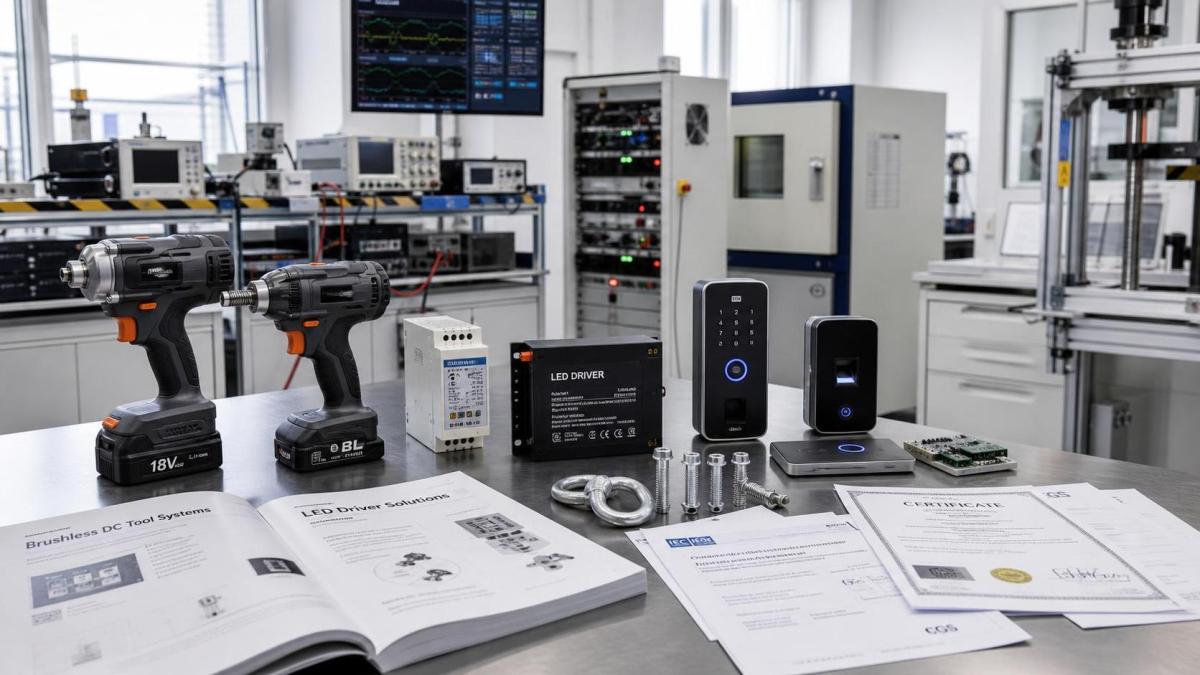
Comparison Should Happen Across Use Cases, Not Only Across SKUs
Technical evaluation rarely begins with a product. It begins with a job: installing structural anchors in concrete, securing access to a server room, selecting anti-vibration fasteners for heavy machinery, retrofitting a municipal lighting system, or choosing respiratory protection for a dusty confined space. A platform built only around SKU pages forces evaluators to translate job requirements into product filters on their own. That wastes time and introduces avoidable mistakes.
A stronger model maps products to application scenarios and makes boundary conditions visible. That means showing whether a biometric device is better suited to high-throughput entrances or controlled low-volume access points; whether a fastener is meant for dynamic loading or mostly static assembly; whether an LED system is appropriate for warehouses, roadways, horticulture, or offices; whether PPE is selected for particulate exposure, splash hazard, cut risk, or multi-hazard environments. These are not marketing segments. They are evaluation frames.
Once products are organized around real evaluation tasks, comparison becomes faster because irrelevant options drop out earlier. The platform stops being a database and starts functioning as a decision support layer.
Compliance Information Must Be Searchable at the Point of Decision
One of the most expensive delays in hardware selection comes from late-stage compliance discovery. A product may appear technically suitable and commercially attractive, only for the team to discover that the required certification is missing, the documentation is incomplete, or the regulatory obligations were misunderstood.
A platform meant for faster technical evaluation should surface compliance information alongside technical data, not in a separate archive that someone remembers to check later. For PPE, that can include the relevant standard family and certification scope. For lighting and electrical hardware, it may involve safety, EMC, and regional market access requirements. For biometric systems, the issue often extends beyond device certification into data governance, retention policy, lawful basis for collection, and cloud architecture implications under privacy regimes such as GDPR. For structural hardware, declared mechanical properties still need to be read in relation to the standard or grade system being used in the target market.
The key is not to turn the platform into a legal memo. It is to show enough compliance intelligence that an evaluator can quickly distinguish between “technically plausible,” “procurement-ready,” and “requires specialist review.” That single distinction can remove weeks from a longlist process.
Performance Claims Need a Traceable Basis
Technical teams tend to trust numbers less when the source is unclear, and they are right to. A hardware product knowledge platform should make the basis of a claim visible whenever possible: datasheet declaration, third-party certification, test report summary, manufacturer statement, installation guideline, or field note. Not every claim will have the same evidentiary weight, but the evaluator needs to see the difference immediately.
This matters especially in categories where performance can be unintentionally overstated by selective framing. Brushless tools may advertise peak output without clarifying runtime behavior or thermal derating. Facial recognition systems may emphasize recognition speed while saying little about spoof resistance under difficult lighting. High-strength fasteners may be compared by grade alone, even though coating choice, installation method, and substrate condition can alter real performance. PPE can look equivalent at a glance even when comfort, fit range, and task compatibility make one option far more usable in practice.
A platform that records claim provenance helps the evaluator avoid false equivalence. It also supports internal review, because engineers, compliance staff, and procurement managers can all see what the conclusion rests on.
The Best Platforms Capture Technical Friction, Not Just Product Strengths
One common weakness in product databases is that they describe where a product performs well but say almost nothing about integration friction. In evaluation work, friction is often what decides the shortlist.
For example, a smart access device may meet authentication targets but require network topology changes the site cannot support. A lighting system may support DALI or Zigbee but still create commissioning complexity if the controls ecosystem is fragmented. A fastener may be mechanically suitable but difficult to source consistently in the required finish or dimension. A cordless industrial tool may fit the duty profile, yet force the buyer into a battery ecosystem that does not match the fleet already in use. A respirator may meet protection requirements while creating excessive communication or heat-stress issues for long shifts.
A mature hardware product knowledge platform should therefore include known adoption constraints: compatibility limitations, installation prerequisites, maintenance burden, consumables dependence, training needs, and environmental exclusions. Those details often sit outside the headline specification, but they are exactly what technical evaluators need in order to move quickly without inviting downstream rework.
A Simple Comparison Table Helps, but Only If It Reflects How Decisions Are Actually Made
What Evaluators Commonly Misread
Several misconceptions appear again and again. One is that more granular specifications automatically mean better decision support. In practice, excessive unstructured detail slows evaluation because teams spend time locating the few parameters that actually affect fit. Another is that platform completeness means hosting every available document. It does not. Completeness in this context means that the evaluator can answer the critical go or no-go questions without chasing scattered files across email threads and distributor portals.
There is also a category-specific trap: assuming that products in different hardware domains can be evaluated using the same information architecture. They cannot, at least not entirely. The core fields for industrial tools, biometric devices, structural fasteners, networked lighting, and PPE should share a common comparison logic, but the technical depth has to reflect the realities of each category. The platform needs a consistent framework without flattening domain differences.
What Makes the Platform Valuable in Practice
For organizations dealing with smart hardware and security systems, the practical value lies in stitching together engineering meaning across disciplines. A lighting engineer, a security integrator, a compliance lead, and a procurement analyst often look at the same product from different angles. A good hardware product knowledge platform allows each of them to start from the same factual base while still seeing the risks that matter in their role.
That is particularly important in sectors where failure is physical, not abstract. A poor fastener decision shows up under load. Weak biometric governance creates operational and legal exposure. Inadequate PPE selection is tested at the moment of hazard, not during sourcing. The platform should therefore help users move faster, but never by hiding uncertainty. The right acceleration comes from making limits, dependencies, and evidence easier to read.
If a platform can do that consistently, it becomes far more than a repository. It becomes a working layer of technical judgment: one that helps evaluators compare products with less noise, escalate the right questions earlier, and decide with a clearer view of what will hold up once the hardware leaves the datasheet and enters the field.
Recommended News