
Search News
Industry Portal
Hot Articles
UK Starts AI Hardware Import Review for Cloud Security Gateways
Time
Click Count
On June 11, 2026, the UK Department for Digital Infrastructure (DCMS) introduced an immediate pre-import review for declared Cloud Security Gateways under a “trusted AI stack” requirement. The move matters not only to device manufacturers, but also to importers, public-sector procurement participants, security testing providers, and supply-chain teams tied to UK government-facing business, because access to the UK Government G-Cloud catalogue is now linked to auditability commitments and vulnerability testing documentation rather than product shipment alone.
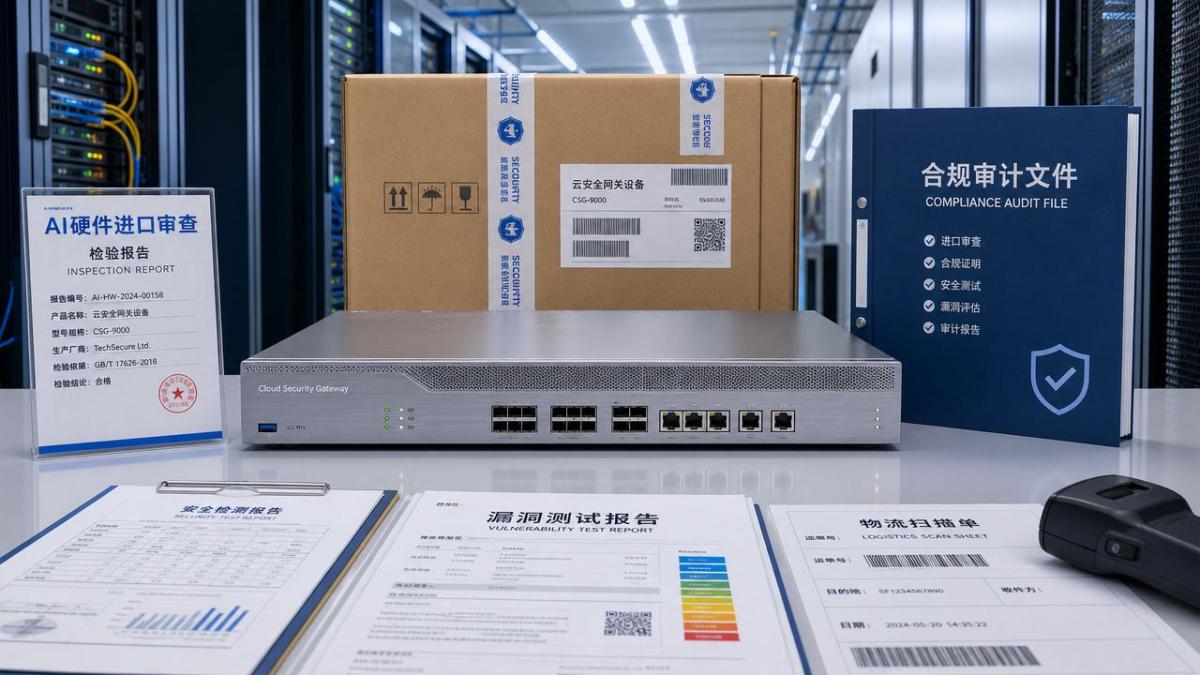
What the UK has formally required
According to the information provided, DCMS announced on June 11, 2026 that all imported Cloud Security Gateways declared for entry into the UK will be subject to a prior review focused on a “trusted AI stack.” Manufacturers are required to sign a source-code auditability commitment and submit a complete third-party penetration testing report covering CWE-119 and CWE-787. The same information states that manufacturers that do not sign the commitment will face restrictions on entry into the UK Government G-Cloud procurement catalogue.
Where the business impact is likely to appear first
Manufacturers facing compliance at the point of market entry
From an industry perspective, manufacturers are the first group likely to feel the practical effect, because the new requirement is tied directly to import declaration and procurement eligibility. The main pressure point is documentation readiness: source-code auditability commitments and complete third-party penetration testing reports may become necessary parts of market access preparation for Cloud Security Gateways intended for the UK.
Importers and channel participants managing delivery risk
Importers, distributors, and channel partners may be affected through shipment planning, document coordination, and customer communication. Analysis shows that when a product category becomes subject to pre-review, the commercial issue is not only whether a product can be imported, but whether supporting materials are complete enough to avoid delays or procurement exclusion in government-related sales processes.
Public-sector procurement and framework participants reviewing supplier eligibility
For procurement teams and framework participants connected to UK government buying, the announced restriction on G-Cloud access creates an immediate screening issue. What deserves closer attention is whether suppliers can provide the required commitment and testing evidence in time for qualification, listing, or continued participation in public-sector purchasing channels.
Security testing and assurance service providers seeing new documentation demand
Third-party security assessment providers may also see a direct operational effect because the announcement specifically references complete penetration testing reports for CWE-119 and CWE-787. Observably, this shifts part of the commercial discussion from general product claims to the quality, completeness, and usability of formal testing outputs in procurement and import contexts.
What companies should monitor now
Watch for any refinement in official wording
Analysis shows that businesses should closely track whether DCMS further clarifies scope, submission format, or review procedures. The current announcement establishes the compliance direction, but companies still need to distinguish between the policy signal itself and any later operational guidance that could affect timelines, document standards, or product classification.
Check which SKUs and customer channels are exposed
Companies selling Cloud Security Gateways into the UK should identify which product lines, import flows, and customer segments may be affected first. This is particularly relevant where business depends on government procurement visibility, because G-Cloud catalogue access is explicitly linked to the manufacturer’s willingness to sign the auditability commitment.
Prepare evidence chains, not only product claims
What deserves closer attention is the practical readiness of supporting materials. Firms may need to confirm whether internal teams, manufacturing partners, and testing providers can assemble the commitment documentation and complete penetration testing records in a form suitable for review, customer due diligence, and procurement discussions.
Align sales communication with compliance reality
For commercial and account teams, the immediate issue is expectation management. Analysis shows that supplier communication with UK buyers may need to address review status, documentation availability, and any effect on procurement participation or delivery scheduling, especially where government-related opportunities are involved.
Why this looks like more than a one-off procedural step
Observably, this development can be read as more than a narrow customs formality because it connects import review, source-code auditability, and vulnerability testing to public-sector procurement access. That said, it would be premature to treat it as a fully defined long-term regime based only on the information provided. It is more appropriate to understand this as an early but concrete compliance signal: the UK is attaching higher evidentiary expectations to a specific hardware category associated with cloud security and AI trust.
How to read the signal at this stage
At this stage, the announcement is best understood as an actionable compliance change with wider policy significance, rather than as a complete reshaping of the entire market. The confirmed facts already matter for manufacturers, importers, and procurement-facing suppliers, but the broader industry effect will depend on how review practice, documentation expectations, and enforcement detail evolve after the initial announcement. A measured reading is therefore more useful than either dismissal or overstatement.
Basis of this article and points for continued verification
This article is based on the user-provided news title, event date, and event summary concerning the DCMS announcement on June 11, 2026. For developments of this kind, relevant source types typically include official government notices, company disclosures, industry association updates, authoritative media reporting, and standards-related documentation. A specific official source link was not provided in the input, so the exact primary publication should be continuously verified. Follow-up attention should focus on whether DCMS issues additional guidance on scope, review mechanics, documentation standards, or procurement implementation.
Recommended News