
Search News
Industry Portal
Hot Articles
Smart Lighting Chip Lead Times Stretch to 32 Weeks
Time
Click Count
The timing of this development is not clearly specified in the available information, but the signal is already relevant for the smart street lighting industry: a sharp extension in lead times for NPU SoCs used in edge AI controllers is beginning to affect delivery planning, procurement discipline, and contract execution. In practice, this is less about a new written regulation than about a supply-side change that can quickly feed into bidding documents, delivery commitments, technical compliance review, and after-sales planning across OEMs, suppliers, and project buyers.
What the supply-chain update confirms
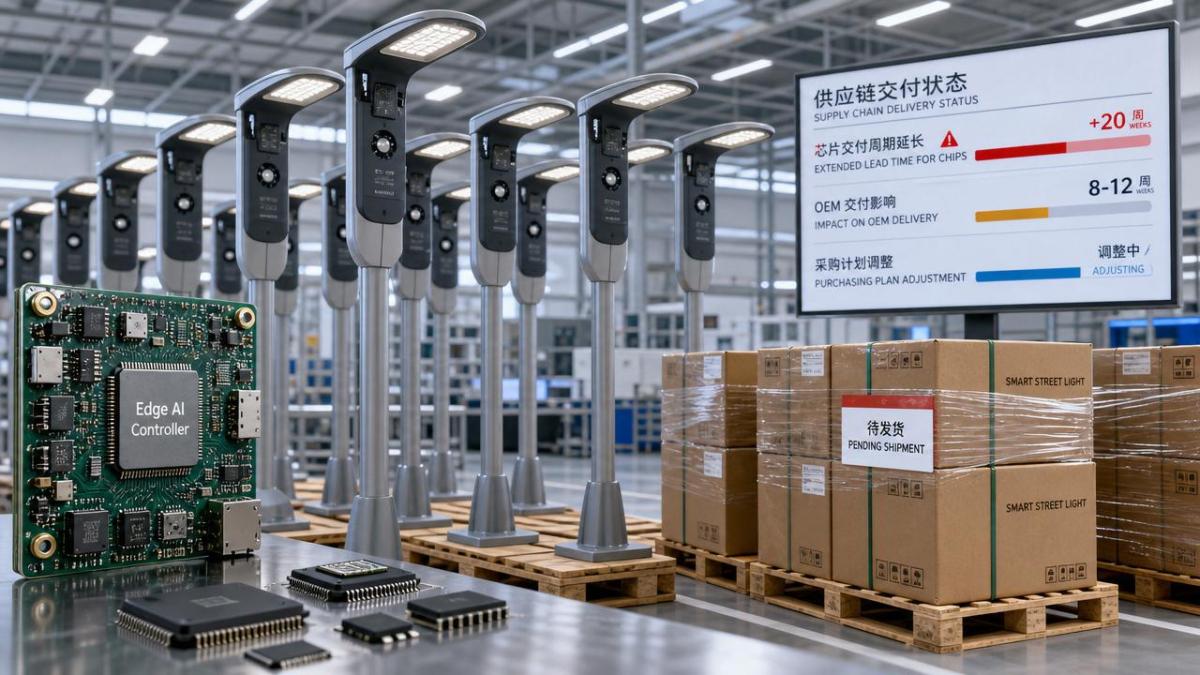
According to a Strategy Analytics supply-chain brief dated June 13, 2026, HBM memory capacity pressure associated with the NVIDIA Vera Rubin platform has affected the availability of NPU SoCs used in smart street lighting edge AI controllers.
The brief indicates that lead times for relevant chips, including products such as NVIDIA Jetson AGX Orin-X and Renesas RZ/V2L, have extended from an average of 14 weeks to 32 weeks.
It also states that the global Top 20 smart street lighting OEM manufacturers are urgently adjusting their Q3 delivery plans in response.
Where execution pressure is likely to appear first
OEM delivery commitments may face tighter contract controls
From an industry perspective, smart street lighting OEMs are likely to feel the most immediate pressure because controller availability directly affects assembly schedules and committed shipment windows. The practical impact may appear in project milestone management, delivery-date revisions, and closer review of whether originally quoted configurations can still be supplied on time.
What deserves closer attention is the documentation chain around delivery obligations, technical specifications, and approved component lists. If a bid or supply contract is tied to a specific controller architecture or named chip platform, any adjustment in sourcing or scheduling may require more formal customer communication and internal compliance review.
Procurement teams may need to reassess sourcing and qualification logic
For purchasing functions, the issue is not only a longer waiting period but also a potential shift in supplier qualification workflow. Where projects depend on designated NPU SoCs for edge AI capability, procurement teams may need to review whether substitute parts, if considered, would affect technical files, testing records, or previously accepted compliance materials.
Observably, this makes lead-time tracking, supplier status verification, and document consistency more important than routine price comparison. In categories linked to intelligent control functions, procurement decisions can influence later certification, acceptance testing, and warranty handling.
Project buyers and channel-side operators may face schedule and acceptance risks
Buyers, integrators, and channel-side operators may be affected because delayed controller supply can alter installation sequencing and acceptance timing. Even without any confirmed policy amendment, supply constraints of this type often push market participants to revisit delivery clauses, penalty exposure, and evidence requirements for technical equivalence.
Analysis shows that the key concern is not merely late hardware arrival, but whether project documentation, technical submittals, and service commitments remain aligned with what was originally contracted or tendered.
Service and support functions may need stronger traceability discipline
After-sales and service-related teams may also need to prepare for more complex configuration management if delivery plans change. When component sourcing shifts or production batches are rescheduled, quality traceability, spare-parts planning, and maintenance records can become more sensitive, especially where installed systems rely on specific edge AI controller platforms.
What companies should monitor now
Check whether technical commitments are tied to named chip platforms
Companies should closely review whether tenders, purchase orders, customer specifications, or technical annexes refer to specific NPU SoCs or platform-level performance assumptions. If they do, any delivery adjustment or sourcing change may require a more formal review path rather than a routine planning update.
Revisit certification and compliance files before any substitution
Analysis shows that any discussion of substitute components should be handled carefully. If existing declarations, test records, technical documents, or product approval materials were prepared around a defined controller configuration, companies should verify whether those materials remain valid before treating any alternative as operationally interchangeable.
Track delivery language in contracts and tender documents
What deserves closer attention is the wording used in delivery schedules, acceptance milestones, and liability clauses. With lead times moving from 14 weeks to 32 weeks, companies may need to monitor whether customers, distributors, or project owners begin tightening documentary requirements around revised schedules, shipment commitments, or technical confirmation.
Maintain closer watch on supplier qualification and execution updates
Because the available information does not provide detailed execution rules or formal downstream requirements, companies should treat this stage as one that requires monitoring rather than assumption. Supplier notices, updated production schedules, and any revised qualification statements may become important reference points for procurement and project execution teams.
How this signal should be interpreted
Observably, this development is better understood as an execution signal than as a fully defined rule change. The confirmed facts point to supply pressure in a critical chip category and urgent delivery-plan adjustments by major OEMs, but they do not yet establish a uniform market response, a formal procurement rule revision, or a confirmed compliance outcome.
From an industry perspective, the reason this matters is that supply-chain disruption in a designated control component can quickly influence practical rules of trade and delivery: how bids are written, how equivalent parts are judged, how supporting documents are checked, and how project obligations are enforced. That is why continued attention to market feedback and execution language is warranted.
A practical reading for the market
The current information points to a real operational constraint in smart street lighting supply chains, particularly for products relying on edge AI controller chips. It is more appropriate to understand this as an early but meaningful signal affecting procurement discipline, delivery management, and technical-document consistency, rather than as a settled industry-wide rule outcome.
A neutral reading is that companies involved in manufacturing, sourcing, project delivery, and service support should prepare for tighter schedule management and more careful compliance checks, while continuing to verify whether any downstream tender, certification, or customer-side requirements begin to change in response.
Basis of this article and what still needs verification
This article is generated based on the user-provided news title, event timing, and event summary. The specific official source link was not provided in the input, so further verification remains necessary.
For developments of this kind, commonly relevant source types may include official notices, regulatory publications, customs or trade authority information, industry association updates, standards organization documents, tender documents, and reporting by authoritative media.
Further observation is still needed on any later policy detail, certification interpretation, tender-document revision, market feedback, and company-level execution response that may follow from the reported lead-time extension.
Recommended News