
Search News
Industry Portal
Hot Articles
IEC 62471-2:2026 Tightens Safety Limits for Horticultural Lighting
Time
Click Count
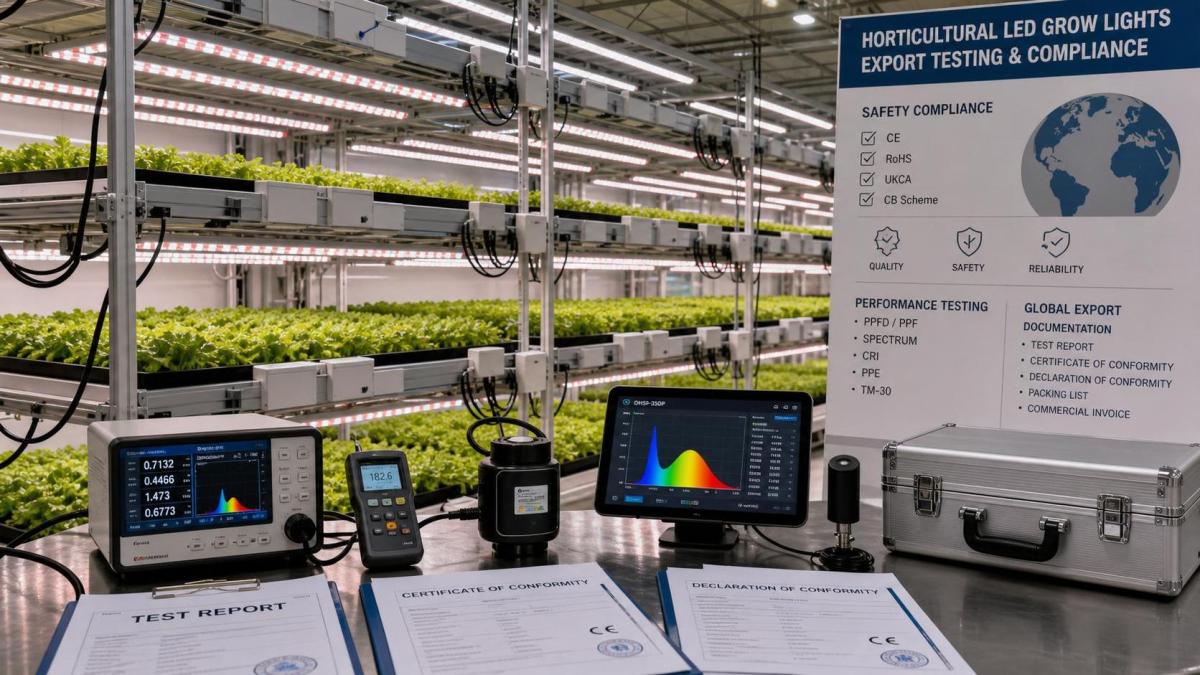
On June 29, 2026, IEC released IEC 62471-2:2026, introducing tighter photobiological safety requirements for horticultural lighting. The update matters beyond a technical standard revision because it is already tied to market access in Japan, South Korea, and Canada, while Chinese exporters are required to complete renewed spectral safety assessments for their full product lines by December 2026. For manufacturers, exporters, buyers, certification-related firms, and testing service providers, the issue is not only product design but also compliance timing, documentation readiness, and shipment continuity.
What the New IEC Release Confirms
IEC issued IEC 62471-2:2026 on June 29, 2026 for horticultural lighting products. According to the provided event summary, the new edition adds a peak blue-light radiance limit of no more than 100 W·sr⁻¹·m⁻² in the 435–485 nm range and a near-UV cumulative dose threshold of no more than 30 J·m⁻² per 8 hours.
The summary also states that these limits are up to 40% tighter than those in the 2019 edition. In addition, Japan, South Korea, and Canada have adopted the new standard as a mandatory market-entry basis. Chinese export enterprises are required to complete renewed spectral safety assessments for all horticultural lighting product lines before the end of December 2026.
Where the Pressure Moves Across the Supply Chain
Export-facing product lines now carry a narrower compliance margin
From an industry perspective, exporters are likely to feel the impact first because the standard is already linked to mandatory entry requirements in several overseas markets named in the event summary. The main pressure point is the need to confirm whether existing horticultural lighting models still meet the tighter blue-light and near-UV thresholds. What deserves closer attention is that compliance is no longer limited to new product launches; the summary indicates that full product lines must undergo renewed spectral safety assessment.
Manufacturing and delivery planning may be affected by reassessment needs
Analysis shows that manufacturing enterprises may need to pay closer attention to how reassessment schedules interact with production and delivery. If a product family requires updated spectral safety verification, the operational effect is likely to appear in technical file preparation, model-by-model review, and shipment planning for destination markets that have already adopted the rule as a mandatory basis. This does not automatically mean disruption, but it does mean that delivery readiness becomes more closely tied to updated compliance evidence.
Testing and certification-related services become part of the commercial timetable
For testing service providers and certification-related firms, the rule change shifts attention toward spectral evaluation capacity, document consistency, and timing coordination. Observably, once a standard becomes a mandatory access condition in multiple markets, test reports and technical records are no longer a back-end formality; they become part of the transaction timetable. Buyers and channel partners may also need to review whether supplier files, conformity statements, and product technical documents are current enough for procurement and customs-facing use.
What Companies Should Track in the Next Few Months
Start with product portfolio screening
Analysis shows that companies involved in horticultural lighting exports should first identify which product lines are sold into the affected markets and which models may be more exposed to the tightened spectral thresholds. The practical question is not only whether a flagship model passes, but whether legacy and long-tail models can still be supported with updated safety assessment materials.
Review technical documents tied to market access
What deserves closer attention is the completeness of technical records connected to compliance review. Based on the event summary, renewed spectral safety assessment is a clear focal point, so firms should closely watch the status of test reports, spectral evaluation materials, and related product documentation used in certification review, customer qualification, or shipment support. Where execution details are not yet provided in the input, companies should avoid assuming that older files will remain acceptable without update.
Watch procurement and order commitments carefully
For procurement teams and buyers, this development may affect supplier qualification checks, model approval lists, and delivery commitments for the second half of 2026. It is more appropriate to understand this as a compliance scheduling issue as much as a product issue. Orders tied to affected export markets may need closer review of whether the supplying product line has already completed the required reassessment before shipment or project delivery.
Follow later execution language and market-facing documents
Observably, the current information confirms the standard release, the tighter limits, the named adopting markets, and the December 2026 reassessment requirement for Chinese exporters. It does not provide fuller execution detail. For that reason, companies should continue monitoring later official wording, certification interpretation, tender documentation, and customer-side compliance requests rather than treating the current summary as the complete operational rulebook.
Why This Looks More Like an Execution Signal Than a Distant Update
Analysis shows that this development is better understood as an active compliance signal rather than a remote standards change. The reason is straightforward: the new edition has already been adopted by Japan, South Korea, and Canada as a mandatory basis for market entry, and a specific reassessment deadline for Chinese exporters is identified in the provided summary. At the same time, it remains necessary to watch how the rule is reflected in actual certification workflows, procurement documents, and customer acceptance practice. In other words, the direction is already clear, while some execution details still require continued observation.
How the Market Is Likely to Read This Update
From an industry perspective, the main significance of this event is that photobiological safety for horticultural lighting is moving from a technical reference point into a more immediate trade and compliance condition in certain export markets. The confirmed facts do not support broad claims about market outcomes, but they do support a cautious conclusion: companies serving the affected destinations should treat the 2026 revision as a near-term operational requirement, with particular attention to reassessment timing, documentation readiness, and shipment-related compliance alignment.
Basis of This Article and What Still Needs Verification
This article is generated based on the user-provided news title, event date, and event summary. For developments of this type, relevant source categories usually include official announcements, regulator releases, trade or customs authority notices, industry association updates, standards organization documents, and reporting by authoritative industry media.
No specific official source link was provided in the input, so the exact official publication path still needs to be verified on an ongoing basis. Observably, the areas that still merit follow-up include detailed execution language, certification interpretation, tender document changes, market feedback, and how companies implement reassessment requirements in practice.
Recommended News