
Search News
Industry Portal
Hot Articles
How accurate are biometric authentication devices in high-traffic access control
Time
Click Count
Anyone who has stood near a busy entrance at shift change has seen the same tension build in minutes: a line forms, one person gets rejected unexpectedly, someone tries again with a different angle, another user is waved through by security, and suddenly the “fast” access system is no longer fast. In that moment, the question is not whether biometrics look modern. It is whether the device can keep making correct decisions when hundreds or thousands of transactions pass through it under uneven lighting, rushed behavior, gloves, sweat, backpacks, and pressure to keep people moving.
That is where many evaluations go wrong. A device may look accurate in a controlled demo room and still become frustrating in a real lobby, factory gate, campus building, or data center mantrap. For anyone comparing biometric authentication devices, the practical problem is usually not one single metric. It is the tradeoff between admitting the right person quickly, blocking the wrong person consistently, and doing both without creating a queue that operations staff eventually bypass.
When access control is high-traffic, accuracy has to be understood as operational accuracy, not just lab accuracy. A unit that matches well for cooperative users in ideal enrollment conditions may struggle when faces are partially obscured, fingers are dry or worn, users approach at different heights, or readers are exposed to glare, dust, vibration, or cold mornings followed by humid afternoons. In these settings, “accurate enough” becomes a site-specific judgment.
Where accuracy usually breaks down in real entrances
A common mistake is to treat the biometric engine as if it works independently from the rest of the doorway. In practice, the authentication result is shaped by enrollment quality, sensor placement, user guidance, network architecture, door hardware timing, and anti-spoofing thresholds. If one part is off, the whole entry experience feels inaccurate even when the matcher itself is technically strong.
Take facial recognition at a main entrance. The software may be capable of very fast matching, but if the camera angle is wrong for shorter users, if direct backlight washes out facial detail at certain hours, or if people approach while looking at a phone badge or turning to speak with a coworker, the number of failed first attempts goes up. The same pattern appears with fingerprint systems in industrial settings, where skin condition, dirt, and frequent hand use make the raw sample less reliable than the brochure implied.
Iris and structured-light systems often perform better where lighting is poor and stronger anti-spoofing is required, but they still need attention to user flow. If users do not naturally pause in the right zone, you can end up with repeated retries even though the core technology is sound. In other words, high-traffic accuracy is partly a throughput design problem disguised as a sensor question.
The first comparison that matters: false accepts versus false rejects
Most people evaluating biometric authentication devices start by asking, “How accurate is it?” A better starting question is, “Which error hurts this site more, and at what frequency does it become disruptive?”
False acceptance is the security side of the equation. If an unauthorized person is accepted, the risk may be unacceptable for a server room, laboratory, controlled warehouse, or restricted operations area. False rejection is the operational side. If authorized users are blocked too often, the result is congestion, guard intervention, user distrust, and eventually pressure to weaken the system or create bypass habits.
High-traffic sites rarely have the luxury of optimizing only one. They need a threshold and device type that keeps false accepts very low without making legitimate users re-attempt too often. That is why raw marketing claims are less useful than understanding how a device behaves when the population is diverse, the pace is uneven, and the same readers are used repeatedly across long shifts.
For selection purposes, it helps to separate four layers of “accuracy”:
- Capture accuracy: can the sensor obtain a usable sample quickly from ordinary users who are not carefully posing?
- Matching accuracy: once the sample is captured, how reliably is it matched against the enrolled identity?
- Liveness or anti-spoof reliability: how well does the device reject photos, masks, lifted prints, or replay attempts?
- Workflow accuracy: does the entire lane, including door release timing and retry logic, support consistent first-pass success?
Many procurement discussions focus only on the second item and underweight the first and fourth, which are often where high-traffic failures appear.
Why one modality does not fit every entrance
If you are deciding between face, fingerprint, iris, or a multimodal combination, the right choice depends less on trends and more on the site’s friction points.
Facial systems are often attractive where users need a contactless experience and natural walk-up interaction. They can work well at office entries, smart building lobbies, and common access points, especially when paired with good positioning and stable lighting control. But they deserve closer testing where people regularly wear masks, face shields, heavy helmets, or deeply reflective eyewear.
Fingerprint systems can still make sense in smaller controlled zones or places where users present themselves deliberately. In heavy industrial environments, though, finger condition often becomes the issue before matching quality does. Dry skin, abrasions, residue, and gloves can all reduce consistency, which matters much more when throughput peaks are short and intense.
Iris-based or advanced 3D infrared approaches are more attractive when anti-spoofing and low-light performance are high priorities. They are worth attention for data centers, critical infrastructure, and spaces that cannot rely on visible-light imaging alone. Their advantage is not simply “higher security” in the abstract, but the ability to keep recognition stable when ambient conditions are less forgiving and presentation attacks are a real concern.
Multimodal systems can reduce dependency on a single factor, but they are not automatically better. If implemented badly, they create more steps, more hesitation, and more failure points. If implemented well, they provide fallback logic: face first for speed, another modality for exceptions, or biometric plus credential for higher-risk zones.
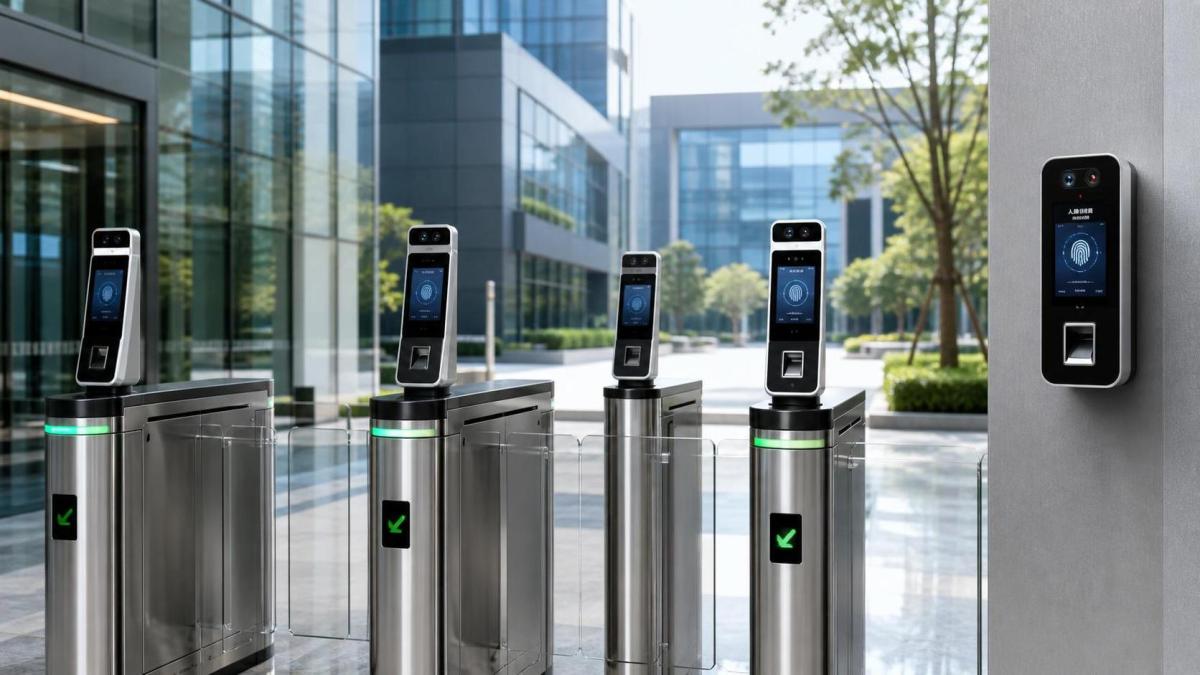
Throughput pressure changes the evaluation method
A quiet pilot at midday tells you less than a short observation during the busiest entry window. Accuracy under high traffic depends on behavior that only appears when users are in a hurry. People do not stand where floor markings suggest. They follow each other too closely. They arrive in groups. Some are new and under-enrolled. Some are carrying tools or boxes. Security staff start helping, then helping turns into manually overriding.
That means a realistic evaluation should pay attention to these questions:
How many users succeed on the first attempt without coaching? How often does a successful match still feel slow because the door response lags? Are there certain user groups who experience more retries because of height range, PPE, eyewear, or work conditions? Does the queue itself cause presentation errors because people crowd the sensor? Does the system maintain performance if the local network is unstable and the edge device must keep working?
Notice that none of these questions require inflated promises or lab-style claims. They require observation. A technically solid device can look inaccurate if the lane design is poor. Conversely, a modest device can appear better than it is if the test group is too small, too cooperative, or too unrepresentative.
A more reliable way to compare devices before selection
When you narrow options, compare them as if you will be the one answering complaints after deployment. That usually leads to a more grounded shortlist.
Start with enrollment, because many recurring access issues begin there. Ask how the system handles low-quality first captures, whether it supports re-enrollment workflows cleanly, and what happens when user appearance changes. High-traffic accuracy often degrades quietly over time because the original enrollment set is uneven.
Then look at environmental resilience. A device suitable for a climate-controlled office may not behave the same near a loading dock, exterior turnstile, or manufacturing corridor. Evaluate lighting tolerance, dust exposure, temperature swings, and whether the enclosure and optics can stay stable without constant manual cleaning.
Anti-spoofing deserves separate scrutiny. It is easy to overfocus on convenience and forget that some sites need more than simple presentation matching. Systems using 3D structured light infrared projection or stronger iris recognition methods may be more appropriate where photo-based or mask-based deception is a concern, especially if the entrance remains active in low-light conditions. The point is not to choose the most complex technology by default, but to align the spoofing risk with the modality’s defensive strength.
Scalability also affects perceived accuracy. As the enrolled database grows, some systems remain responsive while others depend heavily on architecture choices such as edge matching, local caching, or cloud lookup. In busy facilities, even a small delay can lead users to reposition unnecessarily, which creates the illusion of poor matching when the real problem is response timing.
It is also worth checking how the device interacts with the rest of access control. A strong biometric reader attached to a weak door policy can still leave gaps. Tailgating, door-held-open conditions, and poorly timed unlock intervals undermine the practical security benefit of accurate matching. In some sites, combining biometrics with lane control, door sensors, or secondary credentials for selected zones makes more sense than demanding one reader solve every problem alone.
The most common evaluation mistakes
One frequent mistake is treating manufacturer metrics as directly transferable to your doorway. They are useful, but they are not the same as your outcome. Another is testing with a narrow user group: office staff only, experienced users only, or users enrolled on the same day under ideal conditions. That tends to hide the exceptions that later dominate support calls.
Another pattern is choosing the fastest-looking demo rather than the most stable behavior over repeated daily use. A system can appear impressive in a controlled walk-through and still perform inconsistently once real-world variables arrive. Accuracy that depends on highly compliant user behavior is less valuable in busy entrances than slightly slower performance that remains steady across diverse conditions.
There is also a tendency to ignore policy questions until late in the process. If privacy handling, data retention, template storage location, or regional compliance rules are not settled early, technical teams may end up comparing devices that cannot be deployed in the intended model anyway. For biometric authentication devices, operational fit and governance fit should be reviewed together, not separately.
If you have to make a decision without perfect test conditions
Sometimes the site cannot support a long pilot, or the rollout timeline is fixed. In that case, the safest approach is to reduce uncertainty where it matters most.
Favor devices with strong performance in the exact conditions your entrance will face most often, not just the broadest feature list. If traffic is dense and contactless flow matters, prioritize natural capture behavior and low-friction retries. If lighting is unpredictable or spoof resistance is a serious concern, give more weight to systems designed around infrared depth or iris capture rather than basic visible-light matching. If the user base includes workers with gloved, worn, or dirty hands, do not assume fingerprint will remain consistent at peak periods just because it tested well indoors.
Think in layers. A main public-facing entrance may benefit from one biometric modality optimized for speed, while inner restricted spaces use a stricter method or an added factor. This often produces better overall accuracy than forcing one technology to cover every risk level and every user behavior.
Also decide in advance what failure should look like. Not every rejection means the device failed. Some rejections are correct and should trigger another step. The important part is that exceptions are manageable: guard intervention is clear, re-attempt guidance is simple, and fallback rules do not quietly become the normal path.
So, how accurate are they?
The honest answer is that biometric authentication devices can be very accurate in high-traffic access control, but only when accuracy is judged in the context of the entrance, user behavior, and system design. A device is not accurate just because its matcher is strong. It becomes accurate in practice when authorized people are recognized quickly under everyday conditions, unauthorized attempts are rejected reliably, and the surrounding process does not create unnecessary failure.
If you are comparing options now, the best next step is not to look for the single highest claim. It is to define your busiest use case, your most sensitive zone, and your most likely failure mode. Once those are clear, the right biometric choice usually becomes much easier to defend.
Recommended News