
Search News
Industry Portal
Hot Articles
Vertical Farming Lighting: How to Balance Yield and Energy Cost
Time
Click Count
Why vertical farming lighting changes from technical choice to operating strategy
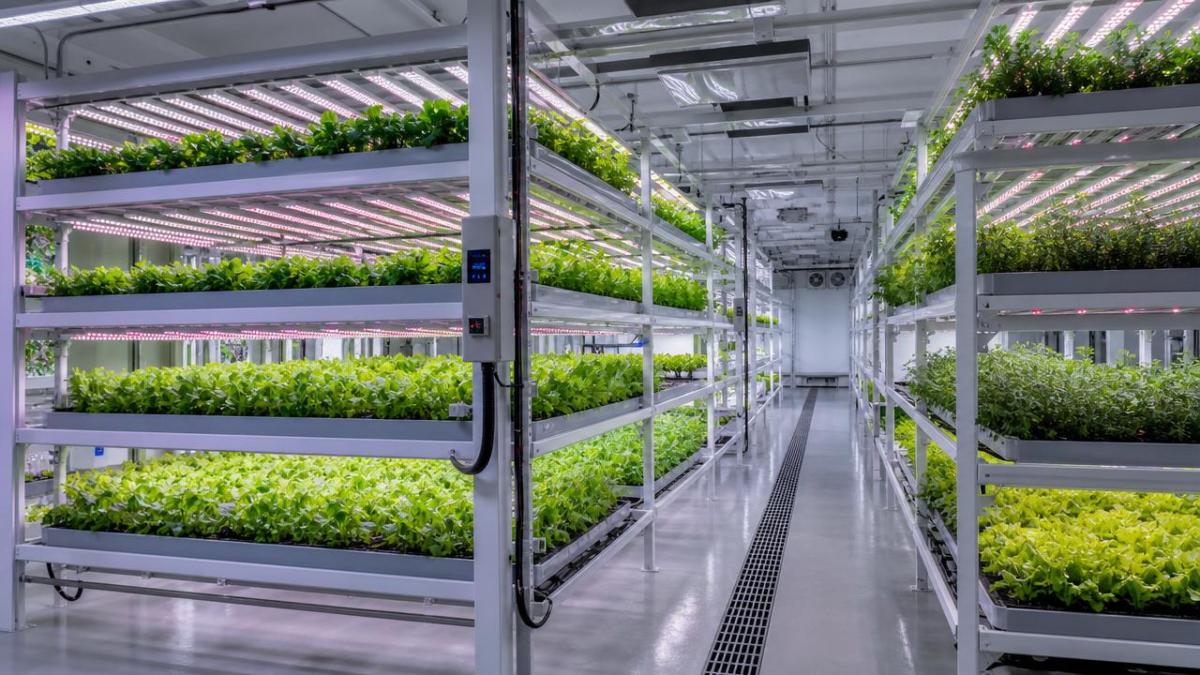
Vertical farming lighting now sits at the center of crop quality, energy planning, and facility expansion.
In controlled agriculture, light is not only illumination. It is the production engine that replaces daylight, drives photosynthesis, and shapes harvest timing.
That is why vertical farming lighting often reaches the boardroom before it reaches the grow rack.
A lighting mistake can raise electricity bills for years, limit crop flexibility, and reduce output per square meter.
A better decision links spectrum design, fixture efficiency, controls, and maintenance into one operating model.
This matters beyond agriculture alone.
SHSS follows smart lighting as part of a wider hardware ecosystem, where energy efficiency, digital controls, and dependable physical systems support industrial resilience.
Within that lens, vertical farming lighting is a real-world test of how LED intelligence turns power into measurable business value.
The first useful question is not fixture wattage, but growing context
Different facilities ask different things from vertical farming lighting because crops, rack heights, climate loads, and market goals rarely match.
A leafy greens site focused on fast turnover usually values predictable biomass and low heat load.
A herb producer may care more about aroma compounds, compact morphology, and retail appearance.
A propagation room has another priority entirely: stable rooting, gentle intensity, and uniformity across trays.
In practice, the right vertical farming lighting decision comes from matching light recipe to business constraints.
Those constraints often include utility tariffs, cooling capacity, local power reliability, automation level, and future crop changes.
This is where many evaluations go wrong.
Teams compare fixture efficacy in isolation, while the real performance difference appears at system level.
Mounting distance, dimming behavior, control integration, and heat removal can change actual results more than brochure numbers suggest.
Leafy greens operations usually prioritize consistency over aggressive intensity
For lettuce, kale, and similar crops, vertical farming lighting often succeeds through balance rather than maximum output.
These crops usually reward uniform PPFD, stable photoperiods, and low fixture heat near dense multilayer racks.
If intensity is pushed too high, the extra electricity may not convert into proportional saleable yield.
Instead, operators may see tip burn risk, uneven heads, or added HVAC burden.
A more useful approach is to optimize light uniformity and daily light integral before chasing peak intensity.
This keeps crop cycles predictable and simplifies labor scheduling.
In these environments, dimmable vertical farming lighting also helps absorb demand-response events or seasonal energy price swings.
Where herbs and specialty crops shift the decision
Basil, mint, microgreens, and premium specialty crops change the calculation.
Here, vertical farming lighting is often asked to influence flavor, color, stem length, and shelf appeal at the same time.
That means spectrum tuning becomes more valuable, but only if the crop program is stable enough to justify it.
A highly adjustable fixture may look attractive, yet its payback weakens when recipes keep changing without disciplined data tracking.
In real use, the better option may be a narrower spectrum strategy with repeatable setpoints and lower control complexity.
Propagation rooms and research zones need precision more than raw output
Propagation is one of the easiest places to misjudge vertical farming lighting.
Because the plants are smaller, some assume lighting can be treated as a reduced version of the main grow area.
Usually it cannot.
Young plants are more sensitive to uneven intensity, excessive heat, and unstable scheduling.
The best vertical farming lighting setup here often emphasizes gentle output, close control, and simple repeatability between batches.
Research rooms add another layer.
They may require zone-level control, reliable dimming curves, and clean data links with sensors or building systems.
This is where smart lighting practices from broader industrial sectors become relevant.
Protocols used in commercial lighting control can support traceability and repeatability when integrated carefully.
Different vertical farming lighting scenarios do not reward the same metrics
A side-by-side comparison helps clarify why one lighting design rarely fits every cultivation zone.
The practical lesson is simple.
Vertical farming lighting should be measured against crop response and operating logic, not against a single universal benchmark.
Energy cost is shaped as much by control strategy as by LED efficiency
High-efficacy LEDs matter, but they are only one layer of cost control.
In many facilities, vertical farming lighting spends more money through poor scheduling, overdesign, or unmanaged peak demand than through fixture weakness alone.
A smart strategy often includes staggered photoperiods, zone dimming, and coordination with HVAC operation.
If local tariffs penalize peak usage, lighting windows may need to shift even when agronomy targets stay the same.
This is where commercial smart lighting experience becomes valuable.
Control systems developed for buildings can inform reliable scheduling, fault detection, and long-life asset management in plant factories.
For SHSS, that crossover is important because modern hardware value increasingly comes from coordination between the device, the driver, and the control layer.
What often gets overlooked before installation
- Cooling systems may erase lighting savings if fixture heat is not modeled rack by rack.
- Power quality and driver reliability matter in dense facilities with long operating hours.
- Cleaning access affects lumen retention and labor cost more than many initial layouts assume.
- Control interfaces should match the broader facility system, not create a separate data island.
- Future crop changes may require dimming headroom or different mounting geometry.
Common misjudgments appear when similar rooms are treated as identical
One common error is assuming every multilayer room needs the same vertical farming lighting recipe.
Even within one facility, perimeter racks, nursery shelves, and finishing zones may perform differently.
Another mistake is buying for nominal output while ignoring maintenance cycles.
If replacement requires production disruption, the cheapest fixture can become the most expensive choice.
There is also a tendency to overvalue tunable spectrum without a testing protocol.
Without consistent crop data, advanced control becomes a cost center rather than an optimization tool.
In broader industrial terms, this resembles other smart hardware deployments.
A powerful tool, secure sensor, or smart luminaire only creates value when the operating conditions are clearly defined.
A grounded way to choose vertical farming lighting before scaling
A practical selection path starts with crop zones, not catalog pages.
Map each zone by crop type, target cycle time, rack density, and allowable heat load.
Then compare vertical farming lighting options using four filters.
- Can the fixture deliver the required uniformity at the real mounting height?
- Can the control system support dimming, scheduling, and energy response without extra complexity?
- Does the thermal profile fit HVAC limits during peak operating periods?
- Will maintenance, cleaning, and future crop shifts remain manageable after expansion?
If those answers are clear, vertical farming lighting becomes easier to scale with confidence.
If they are vague, the safer move is usually a pilot zone with disciplined measurement.
The strongest long-term results come from linking agronomy data, energy data, and hardware reliability from the start.
That is the real balance point between yield and energy cost.
Before the next upgrade, it helps to define site-specific lighting targets, compare scenario-based operating costs, and confirm how controls, cooling, and maintenance will interact over time.
Recommended News