
Search News
Industry Portal
Hot Articles
Vertical Farming Lighting: How to Balance Yield, Energy Use, and Light Uniformity
Time
Click Count
Why Vertical Farming Lighting Has Become a Management Issue
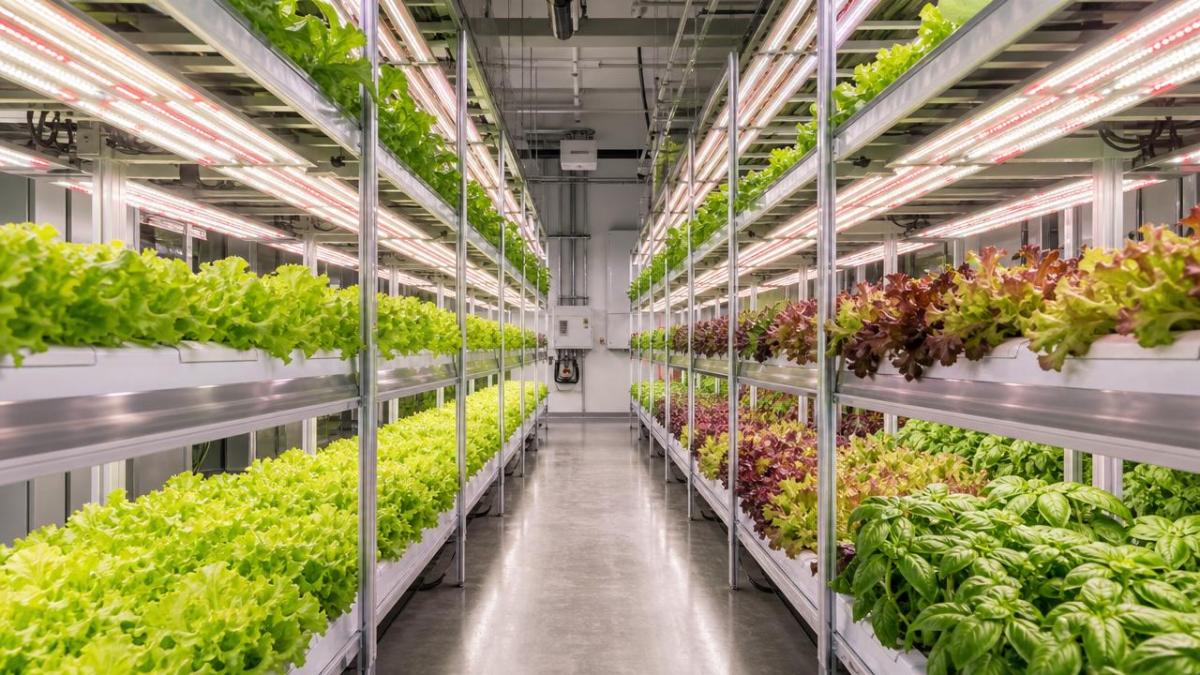
For most indoor farms, lighting is the largest controllable load. It also drives photosynthesis, crop quality, harvest timing, and labor planning.
That is why vertical farming lighting now sits at the center of project design. It is not only an agronomy choice.
It is a facility decision with direct impact on yield, energy use, maintenance cycles, and expansion flexibility.
In practice, the hardest part is balance. More light can raise output, but it also raises heat and electricity demand.
A highly efficient fixture may cut watts, yet still underperform if canopy coverage is uneven across racks.
This is where vertical farming lighting should be treated as a system. Spectrum, intensity, optics, controls, and rack geometry must work together.
From a project perspective, good lighting decisions reduce rework later. They also support more predictable output per square meter.
The best approach is not chasing the highest PPFD number. It is choosing the right light strategy for crop, tier spacing, and operating model.
Start with Crop Targets, Not Fixture Specs
Many lighting plans fail early because teams start with fixture catalogs. A better starting point is crop requirement.
Leafy greens, herbs, strawberries, and seedlings all respond differently to light intensity, photoperiod, and spectrum balance.
For example, lettuce may perform well at moderate PPFD. Fruiting crops usually need much more light and tighter environmental control.
So before selecting vertical farming lighting, define four baseline targets:
- Daily light integral needed for each crop stage.
- Expected cycle length and harvest frequency.
- Quality goals such as color, leaf size, or flavor.
- Energy budget per kilogram of output.
This early alignment helps avoid overspecifying the system. It also makes supplier comparisons more realistic.
In other words, the right vertical farming lighting plan begins with business outcomes, not only technical features.
How to Balance Yield and Energy Use
The first instinct is often simple. Add more photons and expect more biomass. Real projects are rarely that linear.
Plants have useful response ranges. Beyond certain thresholds, extra light may bring smaller gains while power use keeps rising.
That is why vertical farming lighting should be evaluated by crop output per kilowatt-hour, not fixture brightness alone.
Use efficacy, but do not stop there
Fixture efficacy matters. High micromoles per joule helps lower operating cost. Still, efficacy by itself does not guarantee better farm performance.
A very efficient fixture can waste useful light if beam distribution misses canopy edges or overlaps too much in the center.
Match dimming to growth stages
Seedlings do not need the same intensity as finishing crops. Dimmable vertical farming lighting lets teams avoid unnecessary power draw.
This also reduces thermal load, which can lower HVAC demand and improve room stability.
Coordinate light with tariffs and scheduling
In facilities facing peak electricity pricing, photoperiod timing can influence cost. Some farms shift part of the lighting window off-peak.
The point is practical. Vertical farming lighting works best when energy strategy and crop scheduling are planned together.
Why Light Uniformity Often Decides Real Yield
Uniformity does not always get headline attention. Yet it often determines whether harvest quality is consistent across every tray.
If one side of the shelf receives stronger light, plant size and maturity begin to drift. That creates sorting losses and labor inefficiency.
Good vertical farming lighting should deliver stable PPFD across the usable canopy area, not only under the fixture centerline.
Key factors behind uniformity
- Fixture spacing relative to rack width and plant density.
- Mounting height above the canopy.
- Optical design and beam spread.
- Reflective surfaces and side losses.
- Canopy growth over time, not just day-one measurements.
This matters even more in multi-layer farms. Small deviations multiply when repeated across hundreds or thousands of growing positions.
A useful rule is simple. Never approve vertical farming lighting from a datasheet alone. Request mapped light simulations and pilot validation.
If possible, measure uniformity after installation with crops in place. Empty racks can give an incomplete picture.
Choose the Right Spectrum for Business Goals
Spectrum selection is often discussed in technical terms. On the project side, it should connect to commercial goals.
Broad-spectrum white light may support visual inspection and worker comfort. Red and blue heavy recipes may improve efficiency in specific cases.
There is no single best spectrum for every farm. The right vertical farming lighting recipe depends on crop type and sales priority.
Ask these decision questions
- Is biomass the main goal, or is premium appearance more valuable?
- Will operators need clear visual access for scouting and sanitation?
- Are multiple crops sharing the same room or rack zone?
- Does the control system support adjustable spectral channels?
From recent market changes, one clearer signal stands out. Flexible lighting platforms are gaining favor over fixed, one-recipe systems.
That flexibility supports trials, crop changes, and future optimization without full fixture replacement.
Design for Maintenance, Controls, and Scale
A lighting plan can look excellent on paper and still fail operationally. Maintenance access and control architecture often decide long-term success.
Vertical farming lighting should be easy to service without major crop disruption. Driver location, connector quality, and cleaning tolerance all matter.
Control features worth prioritizing
- Zone-based dimming for different crop stages.
- Scheduling integration with HVAC and irrigation.
- Energy monitoring by room, rack, or circuit.
- Alarm visibility for driver or communication failures.
- Open or widely supported protocols for expansion.
This is where smart lighting experience becomes useful. Proven control logic from commercial LED systems can support farm reliability too.
Scalability matters as well. If expansion is likely, standardize fixture families, connectors, and spare part strategy from the start.
That keeps the vertical farming lighting platform manageable as facilities add more rooms, racks, or crop programs.
A Practical Evaluation Framework for Procurement
When comparing suppliers, avoid choosing on fixture price alone. The lowest purchase price can become the highest operating cost.
A stronger evaluation model combines performance, risk, and lifecycle value. This makes vertical farming lighting procurement more defensible internally.
In actual business settings, this kind of scorecard also helps align engineering, operations, finance, and procurement.
That shared view reduces the chance of buying vertical farming lighting that looks efficient but performs poorly in production.
Common Mistakes and How to Avoid Them
Several mistakes show up repeatedly in new projects. Most are avoidable with earlier cross-team review.
- Choosing light output without considering HVAC interaction.
- Using one lighting recipe for all crop stages.
- Ignoring edge uniformity on wide shelves.
- Skipping pilot trials before full rollout.
- Underestimating maintenance access in dense rack layouts.
The fix is usually straightforward. Run a pilot, measure real canopy response, then tune the final design around evidence.
That process may feel slower at first. In reality, it often prevents expensive changes after installation.
For any team planning a new facility, vertical farming lighting should be validated like core infrastructure, not treated as a plug-and-play item.
The Smarter Way to Move Forward
Strong lighting strategy is really about fit. The best vertical farming lighting solution is the one that supports crop goals, energy discipline, and reliable scaling.
Start with crop targets. Test for uniformity. Connect controls to operating schedules. Evaluate suppliers by lifecycle value, not only fixture cost.
That approach creates a more stable path to better yield and lower waste. It also gives future optimization room without rebuilding the system.
If the next project decision is coming soon, begin with a lighting audit, a pilot zone, and a measurable performance scorecard. That is usually where better results start.
Recommended News