
Search News
Industry Portal
Hot Articles
Smart Access Control Risks: What to Check Before Deployment
Time
Click Count
Why smart access control decisions change by site
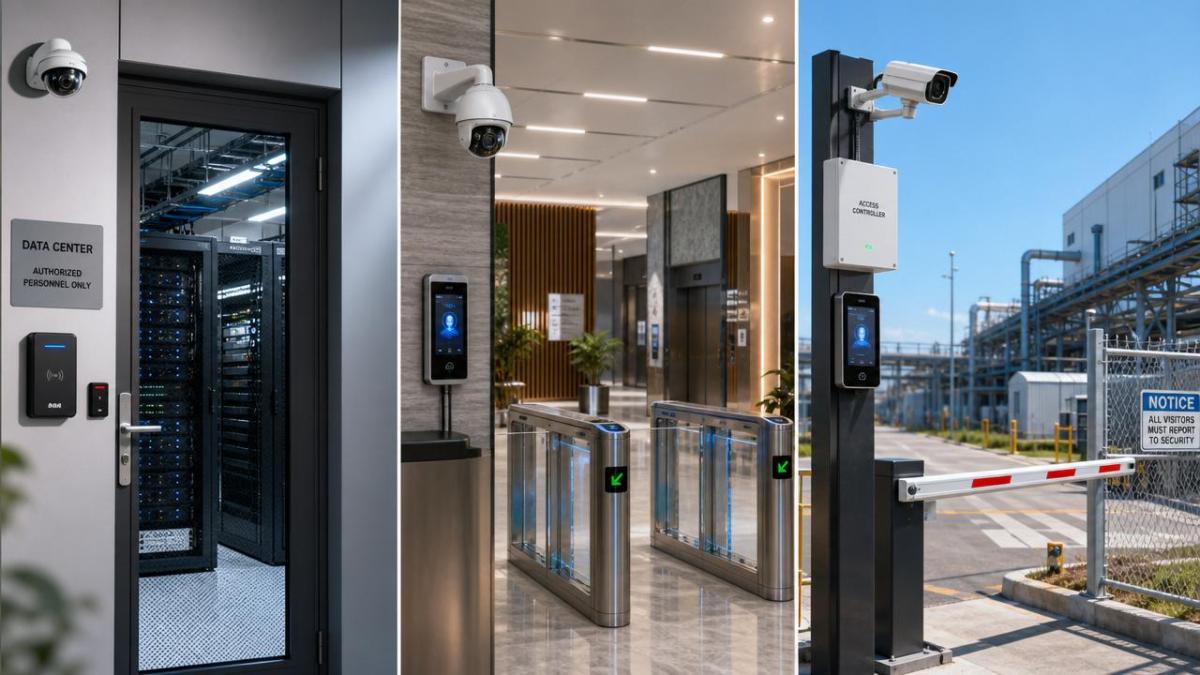
Smart access control looks simple at the door level, yet deployment risk is shaped by the building, the users, and the operational consequence of failure.
A biometric reader at a data room entrance faces different pressure than one at a logistics gate or a mixed-use office tower.
That is why smart access control should be judged as part of a broader physical security system, not as a standalone device decision.
In practice, the first checkpoint is not feature count. It is whether the system can protect continuity, satisfy compliance, and fit existing building operations.
This matters across the SHSS ecosystem, where biometric security, smart lighting, structural hardware, and site safety often converge in one project environment.
A door controller may depend on stable power, reliable network edges, secure mounting hardware, and emergency procedures that align with life-safety rules.
Before deployment, smart access control needs a site-based review of risk tolerance, traffic flow, identity assurance, and recovery expectations.
Actual deployment risk starts with environment, not software alone
Many early mistakes happen because teams compare algorithms and ignore the entrance itself.
Outdoor gates introduce glare, rain, dust, and thermal variation. Indoor security vestibules usually bring cleaner inputs but tighter throughput pressure.
Industrial settings add gloves, helmets, face shields, and particulate contamination. Those conditions affect enrollment quality and repeat authentication far more than brochures suggest.
For smart access control in these sites, false rejection can become an operational issue, not just a user inconvenience.
A blocked shift entrance can delay production, crowd turnstiles, and create unsafe behavior around emergency routes.
More controlled buildings care less about dust resistance and more about anti-spoofing depth, audit granularity, and segmented permissions.
The better approach is to map the site first, then choose reader type, sensor method, and authentication sequence around real conditions.
Where site conditions usually change the decision
- High dust or moisture areas need enclosure ratings, cleaning access, and stable recognition after surface contamination.
- Low-light or backlit entrances need sensor performance verification, not just vendor speed claims.
- Heavy PPE zones may require multimodal smart access control, combining badge, PIN, and biometrics.
- High-traffic lobbies need fast decision logic and queue management as much as strong identity checks.
Different facilities ask different questions before smart access control goes live
The same smart access control platform can perform well in one facility and create friction in another.
That difference usually comes from what the site treats as the primary risk.
This kind of comparison helps keep smart access control aligned with actual security outcomes instead of generic technical scoring.
Biometric accuracy matters differently in high-security and high-flow entrances
Biometric speed is often highlighted first, but the real question is what kind of error the site can tolerate.
At a research lab or server room, a false acceptance is the larger threat. At a staff entrance, repeated false rejection can disrupt operations.
That changes how smart access control should be configured, tested, and supported after installation.
3D structured light, infrared sensing, and iris recognition can offer strong assurance, especially in poor lighting.
Still, accuracy claims must be tested against local enrollment quality, user movement, head angle, and seasonal variations in appearance.
In real buildings, access events rarely happen under laboratory conditions.
A sound smart access control trial includes live sampling during busy periods, not just vendor demonstrations in controlled rooms.
Useful validation points before launch
- Test enrollment quality across different lighting, eyewear, and facial covering conditions.
- Measure false rejection during peak traffic, not only average daily use.
- Confirm fallback credentials work without weakening the security policy.
- Review anti-spoofing performance with realistic attack simulation.
Integration risk often decides whether smart access control stays manageable
A reader can authenticate well and still fail as a project because integration was treated as a later step.
Smart access control often touches video systems, visitor management, alarms, elevators, HR directories, and building management layers.
In larger campuses, it may also connect with smart lighting schedules, emergency mustering logic, and edge analytics.
If interfaces are weak, the result is fragmented identity records, delayed provisioning, and unclear event accountability.
The deployment check should cover API maturity, latency tolerance, offline behavior, and ownership of data synchronization.
This is especially relevant in the SHSS context, where security layers often coexist with hardened hardware, connected lighting, and safety infrastructure.
A strong smart access control design works as part of that operational fabric, not beside it.
Privacy, cybersecurity, and retention rules should be settled early
Biometric convenience can hide a governance problem if privacy rules are handled late.
Smart access control stores sensitive identity data, and the legal burden rises when templates are centralized or transferred across regions.
The smarter question is not whether the system supports cloud functions, but whether the data model fits local compliance and incident response obligations.
In many international deployments, GDPR-style expectations influence consent records, retention windows, administrator access, and deletion workflows.
Cybersecurity review should also cover firmware signing, credential storage, device hardening, and segmented network placement.
A connected lock or controller is part of the attack surface. It should be assessed like any other operational technology endpoint.
For smart access control, a cheap deployment can become expensive quickly if a privacy redesign or security patching program is needed after rollout.
The most common misjudgments appear after the first year
Initial performance rarely tells the full story of smart access control.
Sites often underestimate maintenance cycles, reader cleaning, battery replacement, credential lifecycle changes, and firmware coordination.
Another frequent error is treating similar entrances as identical. A side service door and a public lobby may share hardware, but not risk logic.
Some projects also focus on purchase price and ignore mounting strength, cabling rework, and door hardware compatibility.
That matters because unreliable fixings, poor environmental sealing, or weak exit device integration can undermine the whole system.
In mixed industrial sites, maintenance access should also be coordinated with PPE rules and lockout procedures.
Smart access control remains dependable when long-term service conditions are treated as part of the original design brief.
Checks that reduce later rework
- Define who owns template updates, user revocation, and audit review.
- Verify door hardware, power supply, and emergency egress compatibility before procurement.
- Estimate cleaning, recalibration, and firmware windows by environment type.
- Document offline access behavior during network or power disruption.
What to confirm before moving from pilot to full deployment
A successful pilot should answer operational questions, not just prove that doors open correctly.
Review smart access control by entrance type, user profile, compliance burden, and failure consequence.
Then compare those findings against integration effort, support capacity, and life-cycle cost.
The strongest rollout plans create a site matrix covering reader method, fallback path, privacy controls, maintenance rhythm, and tamper response.
That approach fits the wider SHSS view of modern infrastructure, where unbreachability depends on intelligent systems and dependable physical foundations working together.
Before full deployment, confirm the actual scene, the critical risk, the integration boundary, and the service commitment behind the smart access control choice.
That is usually the point where deployment risk becomes visible enough to manage, rather than expensive enough to regret.
Recommended News