
Search News
Industry Portal
Hot Articles
Smart Hardware Cost Breakdown: What Really Drives Total Ownership
Time
Click Count
Smart hardware cost breakdown starts with ownership, not sticker price
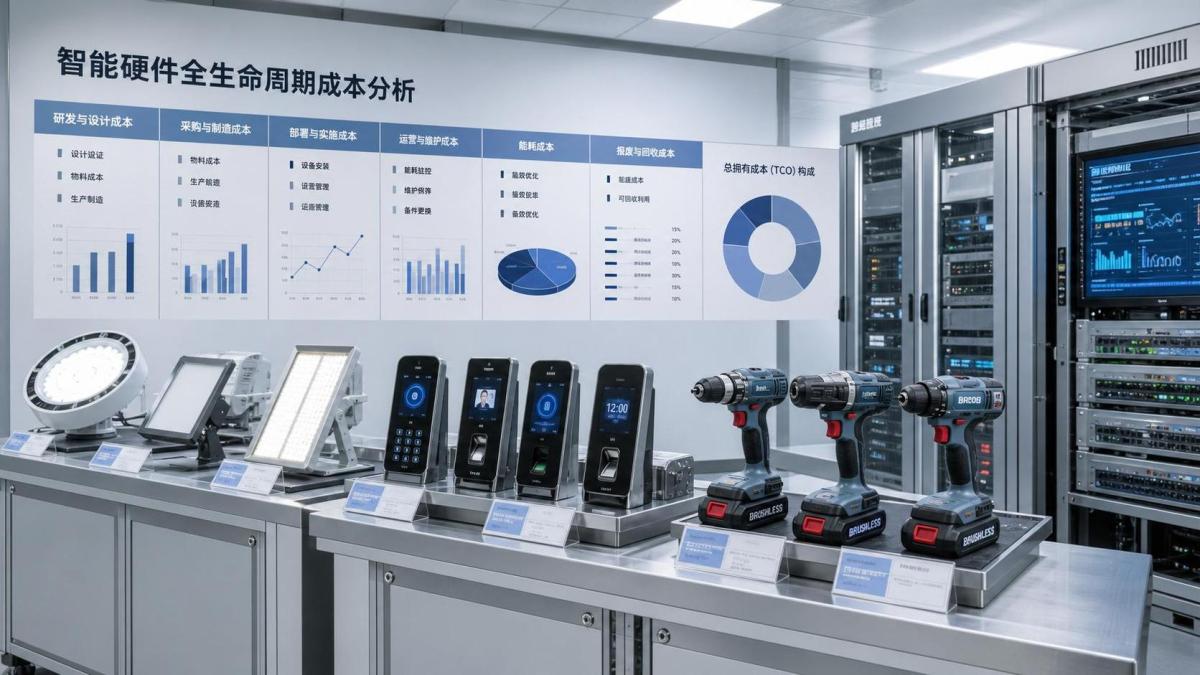
The first number on a quote rarely tells the full story.
In smart hardware, total ownership is shaped by power draw, servicing, software support, compliance exposure, and operational disruption.
That is why a lower purchase price can still lead to a more expensive outcome over three to seven years.
This matters across biometric access control, BLDC tools, high-strength hardware, smart lighting, and protective equipment.
SHSS often frames these categories as the physical anchors of safety and continuity.
It is a useful lens, because ownership costs usually appear where physical reliability meets digital dependency.
So what really drives smart hardware cost over time, and where do budgets usually leak?
What should be included in total ownership for smart hardware?
A practical smart hardware model includes far more than unit price and freight.
The better question is: what must stay functional, compliant, and supportable through the entire service life?
In actual projects, ownership usually includes six cost layers.
- Initial acquisition, including accessories, gateways, batteries, mounts, and spare parts.
- Installation, commissioning, calibration, and system integration.
- Energy use, especially for lighting fleets and always-on security devices.
- Maintenance, replacement cycles, firmware patches, and consumables.
- Downtime losses from failure, false alarms, or delayed field work.
- Compliance and data governance, particularly for biometric systems and connected devices.
A brushless tool with a longer battery life may reduce labor interruption.
A smart LED system with higher efficacy may cut utility spend and relamping labor.
A stronger fastener may look expensive per piece, yet prevent rework under vibration-heavy conditions.
The hidden issue is that these savings appear in different budgets.
If evaluation stays locked on procurement price alone, smart hardware often gets misjudged.
Why do two smart hardware options with similar specs produce very different lifetime costs?
This happens more often than many teams expect.
On paper, two devices may share similar wattage, torque, recognition speed, or protection level.
In operation, however, cost divergence usually comes from durability, software policy, and service response.
Where the gap usually appears
One common example is connected lighting.
Fixtures with equal brightness can have very different driver quality, thermal management, and network stability.
That affects lumen maintenance, replacement timing, and troubleshooting visits.
The same pattern appears in biometric access control.
Recognition speed is only one metric.
Template storage design, anti-spoofing reliability, update cadence, and local failover decide long-term cost exposure.
For industrial tools, battery cycle life, motor heat resistance, and charger interoperability often matter more than headline torque.
For PPE, replacement frequency and fit consistency can outweigh the initial carton price.
This is usually where smart hardware comparisons become clearer.
What looks equivalent in a catalog rarely behaves the same in a live environment.
Which hidden costs are easiest to miss before approval?
The most expensive items are often absent from the first quotation sheet.
One frequent blind spot is integration.
Smart hardware may require protocol conversion, edge gateways, cloud connectors, or building management alignment.
Another overlooked area is update management.
Connected locks, biometric readers, and intelligent lighting controls need patches, testing, and rollback planning.
Those activities consume internal time even when the vendor supplies the software.
Data compliance is also easy to underestimate.
SHSS regularly highlights this for biometric security, where storage location, consent logic, and retention rules matter financially.
A technically strong device can still become costly if local regulations require redesign or restricted deployment.
Then there is downtime.
If a smart streetlight network fails, the cost is not only replacement.
It may include site dispatch, safety exposure, public complaints, and missed operating targets.
If a cordless BLDC platform suffers charger inconsistency, labor delay becomes part of ownership cost.
Needless short replacement cycles create similar leakage in PPE and fastening systems.
How can smart hardware ROI be judged across very different categories?
A single ROI formula rarely works across all assets.
Still, the evaluation becomes more reliable when each category is linked to one operational outcome.
A practical way to compare
- For smart lighting, focus on energy reduction, control performance, and relamping intervals.
- For biometric access, focus on incident reduction, staffing impact, and compliance resilience.
- For brushless tools, focus on task throughput, battery uptime, and repair frequency.
- For fasteners, focus on structural integrity, rework avoidance, and lifecycle reliability.
- For PPE, focus on replacement timing, comfort-driven usage consistency, and injury prevention.
More often, the best judgment method is not absolute payback speed.
It is risk-adjusted return.
A premium smart hardware option may deserve approval because it reduces failure variance, not because it is cheapest.
That is especially true in facilities where a single interruption has safety, legal, or reputational impact.
The SHSS view is useful here as well.
When hardware is part of the last line of defense, resilience has measurable financial value.
What mistakes make smart hardware look cheaper than it really is?
The biggest mistake is comparing only visible line items.
That usually favors low-entry options with shorter support life.
Another mistake is treating all maintenance as predictable.
In reality, smart hardware costs spike when spare parts are proprietary, software subscriptions change, or certifications lapse.
A third mistake is ignoring environment fit.
High humidity, dust, vibration, cold storage, and outdoor exposure can shorten lifespan far below marketing claims.
It is also risky to assume interoperability.
DALI, Zigbee, access control APIs, battery platforms, and fastening standards need verification before commitment.
The final mistake is separating technical risk from financial review.
For smart hardware, those two are tightly connected.
A slower patch cycle, weaker anti-spoofing engine, or lower fatigue tolerance is not just an engineering issue.
It is a future cost event waiting to happen.
What is the best next step before making a smart hardware decision?
Start by turning the purchase request into a lifecycle checklist.
That checklist should cover operating life, energy use, software obligations, spare access, compliance needs, and failure impact.
Then ask each option to prove value in the real environment, not only in datasheets.
A pilot, sample batch, or limited deployment often reveals more than a polished specification sheet.
It also helps to separate savings into three buckets: direct operating savings, avoided disruption, and reduced compliance risk.
That approach makes smart hardware easier to compare across security, lighting, tools, fasteners, and PPE.
In simple terms, the right decision is rarely the lowest upfront bid.
It is the option that stays supportable, efficient, and dependable through its full operating life.
If the next review focuses on lifecycle evidence rather than purchase price alone, smart hardware decisions become more controlled and more defensible.
Recommended News