
Search News
Industry Portal
Hot Articles
Biometric Security Systems vs Traditional Access Control: Key Risks and Tradeoffs
Time
Click Count
Biometric Security Systems vs Traditional Access Control: What Really Matters
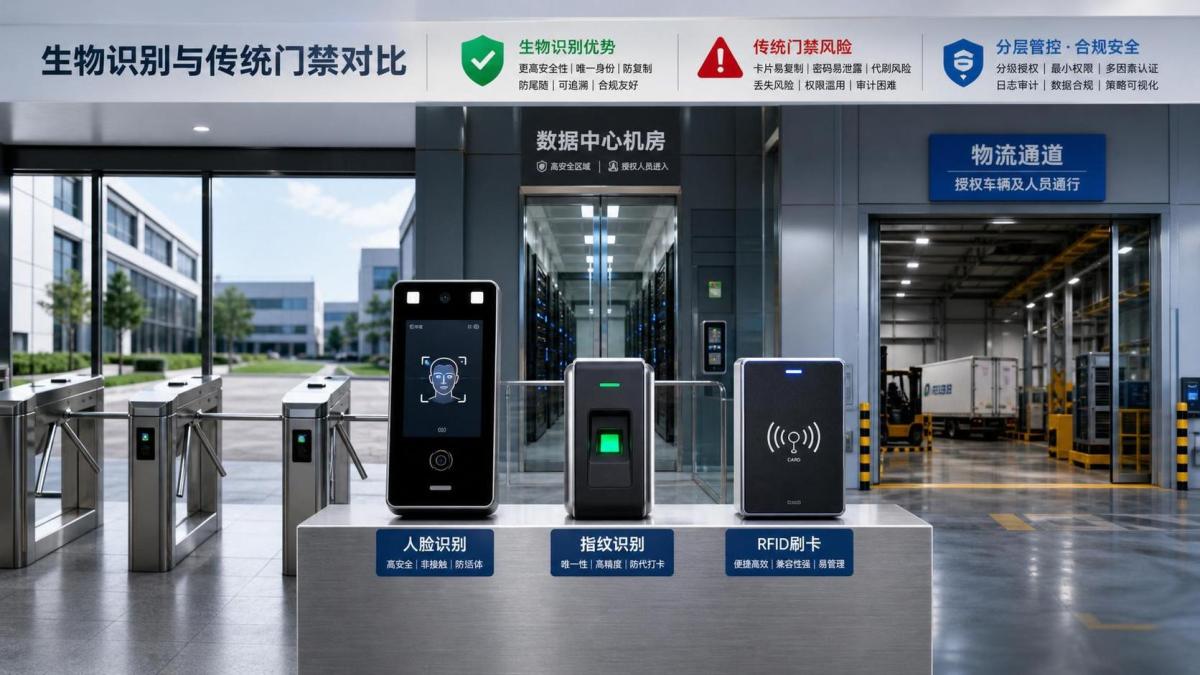
Choosing between biometric security systems and traditional access control is no longer a simple hardware decision.
It affects breach resistance, audit quality, compliance exposure, workforce convenience, and the total cost of keeping facilities secure.
For security programs in factories, offices, logistics hubs, and data-rich buildings, the tradeoff is now sharper than before.
Traditional badges, PINs, and mechanical keys still work well in many cases.
At the same time, biometric security systems promise faster verification, better identity assurance, and tighter accountability.
The real question is not which method sounds more advanced.
The real question is which control model best fits your risk profile, compliance obligations, and operating environment.
How the Two Models Work in Practice
Traditional access control relies on something a person has or knows.
That usually means keys, RFID cards, mobile credentials, or PIN codes.
Biometric security systems rely on something a person is.
That can include fingerprint, face, iris, palm vein, or multimodal biometric matching.
This difference sounds basic, but it changes the entire risk equation.
A lost card can be replaced.
A stolen biometric template creates a different class of long-term privacy and liability concern.
That is why deployment decisions should be based on operational facts, not marketing claims.
Security Strength: Identity Assurance vs Credential Exposure
The biggest advantage of biometric security systems is stronger proof of identity at the door.
A badge can be shared.
A PIN can be observed.
A physical key can be copied.
By contrast, modern biometric security systems make casual credential sharing much harder.
This is especially valuable in restricted zones, server rooms, labs, evidence storage, and critical production areas.
However, stronger identity assurance does not mean zero risk.
Presentation attacks remain a real issue.
Poorly designed facial systems may be fooled by photos, masks, or replay techniques.
Low-grade fingerprint readers may struggle with latent prints, fake fingers, or heavy surface wear.
In practical terms, the quality of liveness detection matters more than the word biometric on the product sheet.
- Traditional access control risks: loss, theft, cloning, tailgating, shared credentials.
- Biometric security systems risks: spoofing, template theft, sensor failure, enrollment errors.
- Highest assurance model: biometrics plus card, mobile credential, or supervised entry.
Compliance and Privacy: The Hardest Tradeoff
This is where many projects become more complicated than expected.
Biometric security systems process highly sensitive personal data.
That triggers stricter obligations under GDPR, local labor rules, sector standards, and internal privacy policies.
In many jurisdictions, consent alone is not enough.
Organizations also need lawful basis, proportionality, retention limits, purpose restriction, and secure storage controls.
Traditional access control usually carries less privacy complexity.
A badge number is sensitive operational data, but it is not the same as a faceprint or fingerprint template.
That also means the consequences of a database compromise are often more severe with biometric security systems.
From a governance perspective, this is the defining tradeoff.
- Use template-based storage, not raw image retention, whenever possible.
- Prefer on-device or edge matching for sensitive environments.
- Define deletion timelines before enrollment begins.
- Document fallback methods for employees who cannot enroll.
Operational Reality: Speed, Throughput, and Failure Modes
On paper, biometric security systems often look faster and cleaner.
In reality, performance depends on lighting, worker flow, PPE use, dust, moisture, and enrollment quality.
A facial reader may slow down when staff wear masks, helmets, or face shields.
A fingerprint terminal may struggle in dirty workshops or cold logistics sites.
Traditional card access often handles high-volume shift changes more predictably.
Yet it also creates blind spots when cards are borrowed or left at uncontrolled stations.
The better question is not which system is universally faster.
It is which system fails more safely under your actual conditions.
Cost Over Time: Upfront Savings Can Mislead
A narrow purchase-price comparison often leads to the wrong decision.
Biometric security systems may cost more at the start because of sensors, software, integration, and compliance work.
Traditional access control may look cheaper because cards and readers are familiar and easy to source.
But long-term costs tell a more nuanced story.
Card replacement, lock rekeying, badge administration, security guard intervention, and incident investigation all add up.
Meanwhile, biometric security systems may reduce buddy punching, unauthorized sharing, and manual audit burdens.
Still, those savings disappear quickly if false rejects disrupt operations or privacy controls are poorly designed.
The most accurate approach is lifecycle costing, not hardware-only comparison.
Where Each Approach Fits Best
Biometric security systems are strongest where identity certainty is more important than maximum simplicity.
That includes critical infrastructure, data centers, R&D spaces, pharmaceuticals, high-value storage, and controlled production zones.
Traditional access control remains effective for lower-risk doors, temporary staff flows, multi-tenant sites, and areas with heavy gloves or face coverings.
In many facilities, the best answer is not either-or.
It is a layered model.
- Use card or mobile entry at perimeter doors.
- Use biometric security systems at inner critical zones.
- Require dual-factor access for sensitive assets or regulated records.
- Keep mechanical override procedures for emergency continuity.
This layered design balances resilience, usability, and defensible governance.
A Practical Decision Framework
If you are evaluating biometric security systems, start with five questions.
- What is the consequence of wrong-person entry at this location?
- Can the selected biometric work reliably with PPE, lighting, dust, and traffic volume?
- What legal basis and data retention controls support deployment?
- How will the site handle failed matches, injured users, or non-enrollable individuals?
- Is the system integrated with audit logs, incident response, and access reviews?
These questions move the discussion from product features to measurable security outcomes.
They also help prevent a common mistake.
That mistake is deploying biometric security systems where a simpler control would have delivered similar protection with less legal exposure.
Final Takeaway
Biometric security systems are not automatically better than traditional access control.
They are better when identity assurance, traceability, and anti-sharing controls clearly outweigh privacy burden and recovery complexity.
Traditional methods still make sense where speed, flexibility, and easier administrative recovery matter most.
For most organizations, the strongest strategy is a risk-based hybrid architecture.
Match the access method to the asset value, threat model, compliance environment, and operating conditions.
That approach makes biometric security systems a precise control tool, not a fashionable default.
If your next review cycle includes access upgrades, start with a zone-by-zone risk map, then test controls against real operating friction before scaling sitewide.
Recommended News