
Search News
Industry Portal
Hot Articles
How to Choose Electrical Safety Equipment for Arc Flash and Shock Risk
Time
Click Count
How to Choose Electrical Safety Equipment for Arc Flash and Shock Risk
Most selection mistakes happen before anyone opens a catalog. People treat electrical safety equipment as a generic PPE purchase, when in practice it sits at the intersection of two different hazards: shock and arc flash. They are related, but they are not controlled in the same way. A glove that is suitable for voltage exposure is not automatically enough for thermal energy from an arc event. A face shield that stops flying debris may still be the wrong choice if it is not arc rated. If the job scope, nominal voltage, available fault current, and working distance are not understood first, the equipment list is already drifting away from the actual risk.
For safety managers and quality teams, that distinction matters because electrical incidents rarely become procurement problems alone. They become procedure, inspection, training, and uptime problems. The right electrical safety equipment is not simply what meets a standard on paper. It is what remains appropriate after repeated field use, cleaning, storage, testing, and supervision.
Start with the hazard, not the product category
Arc flash and electric shock are often discussed together because they may arise from the same task, especially when energized work cannot be avoided. But the equipment logic is different. Shock protection is tied to voltage exposure and insulation integrity. Arc flash protection is tied to incident energy, or to the arc flash PPE category method where that approach is permitted by the applicable electrical safety program. In North American practice, this usually leads teams back to NFPA 70E for work practices and PPE selection logic, while OSHA requirements shape employer obligations. Product performance may also reference ASTM and IEC test standards depending on the item and market.
That is why experienced buyers ask four questions before they ask about brand or price:
- Is the task de-energized, or is there justified energized work?
- What is the shock exposure based on nominal system voltage?
- What arc flash data is available: incident energy study, equipment label, or category method?
- What environmental conditions could degrade protection, such as moisture, contamination, cramped access, or outdoor weather?
Without those answers, electrical safety equipment selection turns into overbuying in some areas and blind spots in others. Overbuying sounds harmless, but it can reduce dexterity, discourage compliance, and create a false sense of coverage.
What a practical selection set usually includes
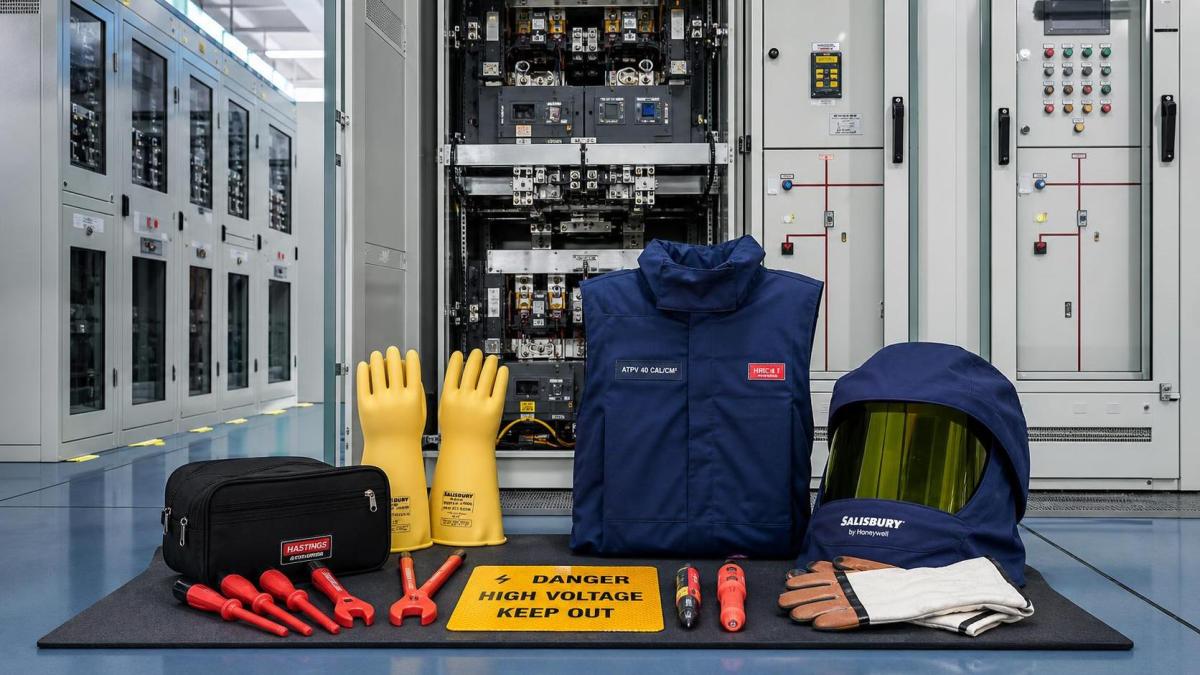
A workable kit for electrical tasks is usually layered rather than singular. Insulating gloves protect against shock when they are matched to the voltage class and maintained correctly. Leather protectors are typically worn over rubber insulating gloves to prevent mechanical damage, unless a specific glove design and task allow otherwise under the governing rules. Arc-rated clothing addresses burn injury from thermal exposure. Face shields, balaclavas, or arc flash suits may be needed depending on the task and incident energy. Voltage detectors, insulated hand tools, dielectric footwear, insulating mats, and lockout-tagout devices may also sit inside the same decision set, even though they serve different control functions.
This is where many purchasing lists become too generic. “Helmet, gloves, visor, coverall” is not a real specification. Each item has a selection variable. For gloves, it is not just size and comfort but voltage class, test interval, storage condition, and whether dexterity is good enough for the task. For clothing, the central question is not fabric weight alone but the arc rating and whether the garment system leaves unprotected gaps at the neck, wrists, and closure points.
Standards help, but only if you know what they are telling you
For arc flash garments, North American buyers often work with concepts such as ATPV or EBT, which appear in arc-rating test results. These values are used to express the protective performance of arc-rated fabrics and clothing systems under test conditions. They are not a prediction that no injury can occur below that number, nor do they replace a task-based hazard assessment. In Europe and many international procurement environments, IEC standards may be more prominent, and buyers need to confirm whether the garment is being evaluated for arc thermal performance, general flame resistance, or both. Those are not interchangeable claims.
The same caution applies to insulating gloves. A compliance statement matters, but the full chain matters more: correct class, date of dielectric test, field air test before use where required by procedure, and storage practices that protect the rubber from cuts, ozone, heat, and deformation. A glove that passed the right test months ago but was folded badly in a crowded toolbox is not a reliable control measure.
The job environment changes the answer
Two facilities with the same switchgear rating may still need different selection decisions. In a clean indoor assembly plant, visibility and dexterity may dominate. In mining, utilities, marine work, or heavy outdoor construction, contamination, moisture, UV exposure, and mechanical wear become selection drivers. Full compliance on day one does not guarantee the equipment will remain usable after weeks of field handling.
This is where quality control personnel often add more value than people expect. They are well placed to evaluate consistency across batches, stitching quality in garments, lens clarity, closure durability, glove thickness uniformity, and marking legibility after laundering or abrasion. For electrical safety equipment, long-term reliability is not a side issue. If labels wear off, test dates become hard to verify. If the face shield fogs quickly, workers start lifting it at the wrong moment. If arc-rated clothing is too heavy for ambient conditions, wear discipline drops.
Common buying mistakes that create hidden risk
One recurring mistake is treating flame-resistant and arc-rated as synonyms. They overlap in some garments, but they are not the same claim. Another is assuming the highest available rating is always the best choice. Very high-rated suits have their place, but if the task mainly requires lighter daily wear with better mobility, overbuilt PPE may undermine actual use. Selection should match the hazard profile and the work pattern.
Another weak point is separating PPE procurement from electrical maintenance practice. A well-specified glove program still fails if retesting intervals are not tracked. Good arc-rated clothing does not fix poor labeling, weak energized work permits, or missing verification of absence of voltage. Electrical safety equipment is the last line of defense, not a substitute for establishing an electrically safe work condition whenever feasible.
There is also a documentation trap. Buyers may collect declarations, certificates, and brochures but fail to connect them to the exact stock-keeping unit, revision level, and accessory combination actually issued in the field. For audited sites and regulated operations, that gap matters. It is worth confirming that the approved item list, receiving inspection criteria, user training materials, and replacement triggers all refer to the same configuration.
A selection process that holds up in real operations
The most defensible approach is to evaluate electrical safety equipment as part of a controlled work system rather than as isolated products. In practice, that means mapping each task family to its exposure profile, then checking whether the selected equipment remains compatible with tools, access space, climate, communication needs, and maintenance routines. A substation technician, an industrial electrician in a food plant, and a contractor working temporary power on a construction site may all need “electrical safety equipment,” but not the same ensemble or the same durability priorities.
For procurement reviews, a useful decision framework is simple:
- Confirm the hazard basis: voltage, task condition, arc flash study data, and site rules.
- Verify standards and ratings that apply to each item, not just the kit as a whole.
- Check usability in the actual work environment, especially visibility, dexterity, heat burden, and contamination resistance.
- Review lifecycle controls: inspection, retest, laundering, storage, traceability, and replacement criteria.
- Run field feedback through the same quality loop as any other critical industrial hardware.
That last point is often underestimated. Workers usually identify fit, fogging, restricted movement, and premature wear long before management sees a formal nonconformance. In a mature program, those observations are treated as safety data, not comfort complaints.
Choosing electrical safety equipment for arc flash and shock risk is therefore less about finding a universally “best” product and more about proving that each protective layer matches a specific exposure and can survive real use. When the selection process is disciplined, the result is not only better compliance. It is fewer workarounds, clearer inspections, and a stronger chance that the equipment will perform as intended on the one day it truly has to.
Recommended News