
Search News
Industry Portal
Hot Articles
What belongs on a personal safety equipment list for work at height?
Time
Click Count
A harness alone does not make work at height safe. For quality control teams and safety managers, a reliable personal safety equipment list must reflect the task, fall hazards, equipment compatibility, and applicable regulations—not just purchasing requirements. Equipment that looks complete in a storeroom may still leave serious gaps when a worker reaches a roof edge, climbs a structure, or steps onto an elevated platform.
The practical starting point is to separate what workers wear from the wider system that protects them. Harnesses, connecting devices, helmets, and footwear matter, but so do suitable anchorage, adequate fall clearance, competent inspection, and a workable rescue plan. This guide explains what belongs on the list and what must be verified before equipment reaches the worksite.
Start with the task, not the harness catalogue
Before selecting personal equipment, ask whether the work can be completed from the ground. If not, assess collective protection such as guardrails, suitable working platforms, or other engineered measures before relying on individual fall protection. PPE is not a substitute for making the work area safer.
“Work at height” is also broader than working on a tall building. Falls through fragile roofs, into floor openings, or from relatively low platforms can cause serious injury. Legal thresholds and requirements vary by jurisdiction, industry, and activity; a generic height rule should not determine the entire assessment.
Where personal fall protection is necessary, identify the intended system:
- Travel restraint: prevents the worker from reaching a position where a fall could occur.
- Work positioning: supports the worker in a working position. Additional fall protection may be necessary where a fall hazard remains.
- Fall arrest: stops a fall after it begins and requires sufficient clearance, controlled arrest forces, and rescue arrangements.
- Rope access: requires a specialist system, competence, supervision, and rescue provision beyond a general PPE checklist.
These functions are not interchangeable. A restraint lanyard is not automatically suitable for arresting a fall, and a positioning attachment point must not be treated as a fall-arrest attachment unless expressly designated for that purpose.
A practical personal safety equipment list for work at height
The following list provides a starting point for construction, industrial maintenance, facilities work, and similar activities. Not every item is required for every task, and some jobs need additional specialist protection.
Full-body harness: fit is a safety requirement
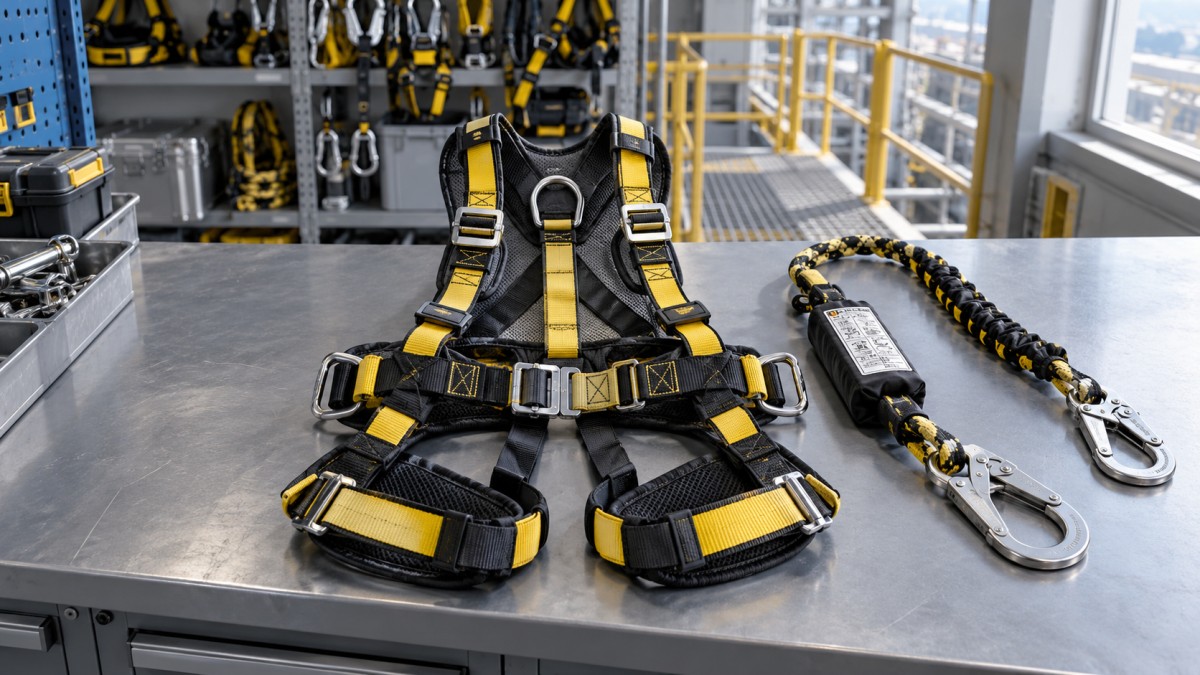
For personal fall arrest, specify a suitable full-body harness rather than a body belt. Selection should account for the worker’s body size, clothing, movement, and total mass as defined by the manufacturer, including carried tools and equipment.
Check that the required attachment points are clearly identified. Dorsal, sternal, positioning, and suspension points can serve different purposes. Their presence on the same harness does not make them interchangeable.
A fitting check should confirm that straps are adjusted, buckles are secured, and loose ends are managed. Workers should be able to perform the planned movements without the harness becoming displaced. Comfort matters because poorly fitted equipment is more likely to be loosened or worn incorrectly during a demanding shift.
Connecting devices: match performance to the fall scenario
Depending on the system, the connection may involve a restraint lanyard, an energy-absorbing lanyard, a self-retracting device, or a compatible guided fall arrester. Choose according to the work arrangement—not simply the shortest product description or lowest purchase price.
Available fall clearance is a decisive check. Required clearance depends on the selected equipment, possible free fall, deployment or stopping distance, worker position, system deflection, and the manufacturer’s specified allowances. Use the applicable instructions and system calculation rather than a universal clearance figure.
Edge exposure needs separate attention. A device approved for overhead use is not automatically suitable for horizontal use or a fall over an edge. Verify the precise application, edge limitations, anchor position, and compatibility. Also assess swing falls: a worker moving sideways from an anchor may strike a structure even if the device arrests the fall.
Connectors: small components with system-wide consequences
Hooks and carabiners must suit the attachment geometry and intended loading direction. Check locking mechanisms, gate operation, and the possibility of unintended gate loading or disengagement. A connector that physically fits is not necessarily compatible.
Do not assume that individually compliant components form an approved combination. Mixed-manufacturer systems require compatibility verification under applicable requirements and instructions; visual similarity is not enough.
Head, foot, and hand protection need their own assessment
A helmet for work at height should address the identified impact hazards and remain appropriately retained during the task. A suitable retention system may be necessary, but chinstrap performance and release characteristics vary between helmet types. Select the helmet and retention arrangement together rather than adding an unapproved accessory.
Check compatibility with eye protection, hearing protection, lighting, and respiratory equipment. Accessories should not compromise fit or protective performance. Where electrical hazards exist, verify the relevant electrical classification; a helmet’s appearance does not establish its suitability.
Footwear should reflect the surface underfoot. Wet steel, dusty concrete, ladders, and sloping roofs present different grip challenges. Consider toe protection, puncture resistance, chemical exposure, and electrical hazards where relevant. No outsole makes an unsafe surface safe, so cleaning, access arrangements, and weather restrictions remain important.
Gloves require a balance between protection and control. Heavy gloves may provide useful cut resistance but make connector operation difficult. Very thin gloves may improve dexterity while offering insufficient protection against sharp materials. Where safe and appropriate, evaluate glove performance during representative tasks before standardizing the purchase.
Add task-specific PPE without creating new conflicts
Height does not remove the hazards of the job itself. Drilling concrete may require dust controls and respiratory protection; grinding may require suitable eye and face protection; hot work introduces heat, spark, and potentially flame hazards.
- Eye and face protection: select for particles, splash, or radiation as applicable. A face shield does not automatically replace safety eyewear.
- Hearing protection: assess noise exposure and communication needs, including emergency instructions.
- Respiratory protection: select for the contaminant and exposure conditions. Tight-fitting respirators require appropriate fit testing and a suitable respiratory protection program.
- Protective clothing: consider visibility, weather, heat, chemicals, and flame or arc hazards where relevant.
Evaluate the complete combination. Clothing can restrict access to harness connections, earmuffs can interfere with helmet fit, and unsuitable webbing may be damaged by heat or chemicals. The safest-looking individual products may still create an unsuitable ensemble.
What sits outside the personal kit—but cannot be left out
Anchorage and rescue provisions may appear on separate procurement or site-control documents. They must still be linked to the personal equipment list, because the worker’s kit cannot function safely without them.
Anchorage and supporting structures
An anchor connector is not proof that the supporting structure is adequate. Anchor selection must address the application, loading direction, number of users, structural capacity, and applicable requirements. Horizontal lifelines also require system-level assessment because line deflection and anchor loads affect safety.
Never assume a handrail, pipe, cable tray, or convenient steel member is an approved anchorage. Record the authorized connection locations and communicate any movement restrictions.
Rescue equipment and arrangements
A worker suspended after a fall needs prompt rescue. The plan should identify who will act, how they will reach or recover the person, what equipment is available, and how rescuers will remain protected. Calling public emergency services alone may not provide a timely, workable solution.
Depending on the site, rescue equipment may include an appropriate retrieval, lowering, or raising system. Selection and practice require competent oversight. Suspension-relief accessories may help a conscious worker temporarily, but they do not replace rescue capability.
Dropped-object controls
Tools, batteries, and loose components can injure people below. Use suitable tool-retention arrangements, secure storage, and exclusion zones where required. Do not attach heavy tools to a harness unless the attachment is expressly intended and rated for that purpose.
Turn the list into a quality-control record
For safety managers and QC personnel, a list becomes useful when each item can be traced to evidence. A purchasing description such as “certified safety harness” is too vague to establish suitability.
Record the following information where applicable:
- Manufacturer, model, size, and unique identifier.
- Applicable standard and conformity documentation for the market and intended use.
- Manufacture date, first-use date where required, and service-life limits.
- Inspection history, current status, and next examination date.
- Assigned user or controlled issue location.
- Compatible components, approved uses, and important restrictions.
Standards depend on jurisdiction and component type. Examples include relevant OSHA requirements and ANSI/ASSP Z359 standards in the United States, and applicable European requirements with standards such as EN 361 for full-body harnesses or EN 355 for energy absorbers. These references are not interchangeable approvals. Verify the current requirements for the actual equipment and workplace.
Workers should perform pre-use checks in accordance with instructions. Formal examinations must follow manufacturer guidance, applicable law, and any additional requirements arising from conditions of use. Look for damaged webbing, cuts, burns, corrosion, deformation, malfunctioning gates, deployed indicators, and illegible identification.
Remove suspect equipment from service and quarantine it against accidental reuse. Equipment involved in a fall must be handled according to manufacturer instructions and applicable requirements, not returned to use merely because it appears undamaged.
The final check happens at the worksite
Before work starts, confirm that the worker can answer four questions: Where do I connect? Can this system prevent or safely arrest the foreseeable fall? Is there enough clearance throughout my movement? How will I be rescued?
A dependable personal safety equipment list makes those answers easier to verify. It connects each item to a real hazard, a compatible system, and an inspection record. That is the difference between having equipment available and having protection ready for the job.
Recommended News