
Search News
Industry Portal
Hot Articles
Industrial Safety Gear Checklist for High-Risk Work Areas
Time
Click Count
Industrial Safety Gear Checklist for High-Risk Work Areas
In high-risk work areas, the right industrial safety gear can mean the difference between routine productivity and serious injury.
From helmets and cut-resistant gloves to respirators, eye protection, and high-visibility clothing, every item supports safer daily operations.
This checklist helps reduce exposure, match equipment to hazards, and build more efficient workflows in demanding industrial settings.
Why an Industrial Safety Gear Checklist Matters
High-risk work areas change fast. Noise rises, dust spreads, sparks fly, and moving equipment creates new danger in seconds.
That is why industrial safety gear should never be treated as a fixed box-ticking exercise.
A practical checklist keeps attention on real exposure, not assumptions made during planning.
It also helps teams spot missing items before a shift starts, not after an incident.
In actual operations, the best industrial safety gear is the equipment that fits the task, the worker, and the environment.
The goal is simple: protect without slowing essential work more than necessary.
This matters even more in construction zones, fabrication lines, warehouses, utility sites, and confined industrial spaces.
Start with a Quick Hazard Review
Before choosing industrial safety gear, review the immediate risks around the task.
Look for falling objects, airborne particles, sharp edges, chemical contact, electrical exposure, heat, noise, and low visibility.
Also check for motion hazards such as forklifts, suspended loads, rotating tools, and pinch points.
This first review shapes the entire industrial safety gear checklist.
If conditions change during the shift, revisit the checklist and update gear requirements.
Fast pre-task questions
- Is there head injury risk from overhead work or falling materials?
- Will dust, fumes, mist, or gas affect breathing?
- Are eyes exposed to impact, splash, sparks, or intense light?
- Do hands face cuts, punctures, vibration, or chemicals?
- Is hearing protection needed for sustained loud equipment?
- Will footwear need slip, crush, puncture, or heat resistance?
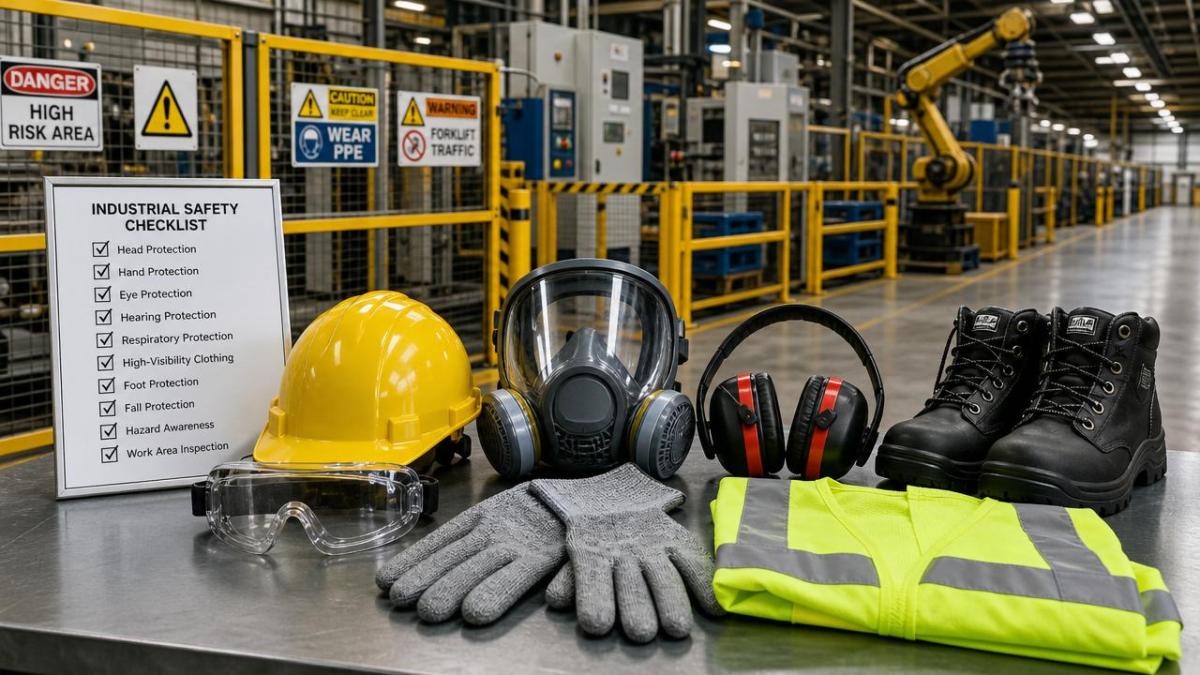
Core Industrial Safety Gear Checklist
A reliable industrial safety gear checklist should cover the whole body, not just the most visible risks.
The items below form the baseline for many high-risk work areas.
1. Head protection
Use helmets or hard hats rated for impact and, where needed, electrical protection.
Replace damaged shells, cracked suspension systems, or gear exposed to severe impact.
2. Eye and face protection
Safety glasses work for common debris, but many tasks need sealed goggles or face shields.
Grinding, cutting, chemical transfer, and hot work often require layered protection.
3. Respiratory protection
Choose respirators by hazard type, concentration, and ventilation conditions.
Dust masks are not enough for solvents, toxic fumes, or oxygen-deficient spaces.
4. Hearing protection
Earplugs or earmuffs reduce long-term hearing loss from compressors, cutting tools, and heavy machinery.
Comfort matters here. Poor fit usually means poor compliance.
5. Hand protection
Gloves should match the job, not just general site policy.
Cut-resistant gloves help around sheet metal and sharp hardware.
Chemical-resistant gloves are essential during cleaning, coating, and fluid handling.
6. Foot protection
Safety boots should address impact, puncture, slip, and electrical risks where relevant.
Wet floors, loose scrap, and uneven surfaces quickly expose weak footwear choices.
7. High-visibility clothing
Hi-vis vests, jackets, and trousers improve detection around vehicles and mobile equipment.
This is especially important in low light, bad weather, and mixed traffic zones.
8. Protective clothing and fall protection
Flame-resistant clothing, chemical suits, or cut-resistant sleeves may be required by process conditions.
For elevated work, harnesses, lanyards, and anchor systems belong on the checklist too.
How to Match Gear to Specific Work Areas
Not every industrial safety gear setup fits every environment.
The smarter approach is to build task-based combinations.
This kind of mapping makes industrial safety gear decisions faster and more defensible.
It also supports cleaner procurement, easier training, and fewer on-site mismatches.
Common Mistakes That Weaken Protection
Even good industrial safety gear fails when selection or use is careless.
- Using one glove type for every task
- Wearing scratched eye protection with reduced visibility
- Choosing respirators without fit checks
- Ignoring replacement schedules for worn helmets and boots
- Treating hi-vis clothing as optional near moving vehicles
- Storing gear in dirty, wet, or high-heat areas
Most of these problems are preventable with simple inspections and consistent shift-start routines.
A Practical Daily Inspection Routine
A checklist only works when it becomes part of the day, not just part of policy.
- Inspect each item before use for cracks, tears, broken straps, worn soles, or expired filters.
- Confirm the industrial safety gear matches the exact task and current site conditions.
- Check fit, movement, and comfort before entering the work area.
- Replace damaged items immediately instead of improvising temporary fixes.
- Clean and store reusable gear correctly after the shift.
This routine does more than reduce injuries.
It improves uptime, lowers waste, and helps equipment last longer.
Building Safer and More Efficient Workflows
The best industrial safety gear strategy supports both protection and performance.
When equipment fits well and matches the job, people move better, react faster, and make fewer risky adjustments.
That is where smart selection matters.
Advanced PPE, durable fasteners, reliable tools, and secure site systems all contribute to the same result: safer operations under pressure.
For teams working around heavy equipment, powered tools, dust, access-controlled zones, or harsh outdoor conditions, industrial safety gear should be reviewed as an active system.
Not as a pile of disconnected items.
Start with the hazards, build the checklist, train around real tasks, and update gear before small issues become serious ones.
That simple habit turns industrial safety gear into a practical frontline defense for high-risk work areas every day.
Recommended News