
Search News
Industry Portal
Hot Articles
BLDC Motor vs Brushed Motor: Efficiency, Heat, and Service Life
Time
Click Count
BLDC Motor vs Brushed Motor: Efficiency, Heat, and Service Life
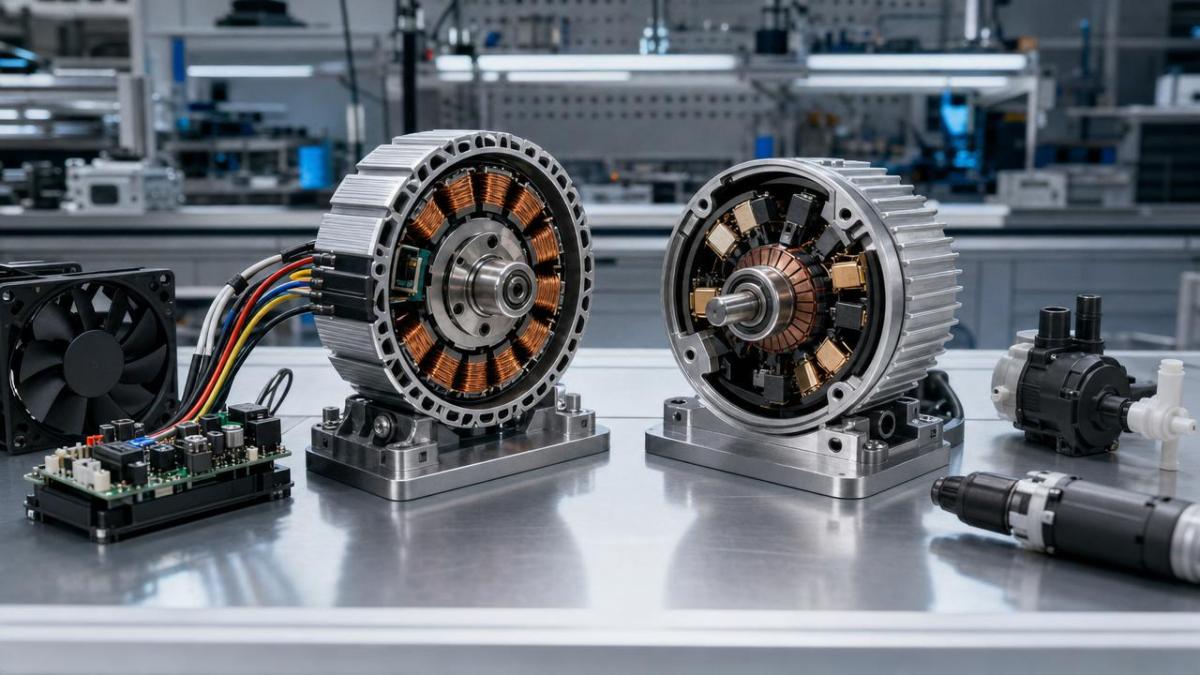
Choosing between a BLDC motor and a brushed motor shapes far more than layout.
It changes efficiency, heat rise, service intervals, noise, and long-term operating cost.
That matters in power tools, smart locks, access systems, fans, pumps, and compact industrial drives.
A BLDC motor uses electronic commutation instead of physical brushes.
A brushed motor relies on carbon brushes and a commutator to switch current mechanically.
On paper, the comparison seems simple.
In real evaluation work, it is more about duty cycle, thermal limits, power density, and maintenance exposure.
This guide breaks the decision into practical engineering factors.
The goal is not to crown one motor universally better.
The goal is to identify when a BLDC motor creates measurable value and when a brushed design still makes sense.
How the Two Motor Types Differ
The core difference is commutation.
In a brushed motor, brushes contact the rotating commutator and switch current by friction.
In a BLDC motor, a controller switches current electronically using rotor position feedback or sensorless logic.
That single change drives most downstream differences.
- A brushed motor has mechanical wear parts in the current path.
- A BLDC motor removes brush friction and sparking.
- A brushed motor is simpler to drive and often cheaper upfront.
- A BLDC motor usually needs control electronics, sensing logic, and tighter integration.
From a system perspective, the motor alone never tells the full story.
The controller, battery, enclosure, airflow, and load profile all affect the final result.
Efficiency: Where a BLDC Motor Usually Wins
Efficiency is often the first reason teams move toward a BLDC motor.
With no brush contact losses, electrical energy is converted more effectively into useful mechanical output.
That gain becomes more valuable in battery-powered products.
A higher-efficiency BLDC motor can extend runtime without increasing battery size.
It can also deliver more torque in the same thermal envelope.
That is why brushless architectures dominate premium cordless tools.
The same logic applies to smart hardware that must stay compact and efficient.
Still, efficiency should be judged at the system level.
A BLDC motor with a poor controller may underperform a well-matched brushed solution in a narrow operating window.
More clearly, part-load efficiency matters just as much as peak efficiency.
Many real products spend most of their time away from maximum load.
Practical Efficiency Checkpoints
- Compare efficiency at rated load and common partial loads.
- Check controller losses, not only motor datasheet values.
- Evaluate battery drain or power draw over an actual duty cycle.
- Review torque retention as voltage drops.
Heat Generation and Thermal Stability
Heat is where the BLDC motor often proves its value fastest.
A brushed motor creates heat through copper loss, friction, and arcing at the brushes.
That extra heat raises winding temperature and accelerates wear.
A BLDC motor still generates heat, but usually with fewer loss sources.
As a result, thermal rise is often lower under similar output conditions.
This becomes critical in sealed products.
Smart locks, biometric terminals, LED systems, and compact handheld tools have limited airflow.
In these designs, every degree of temperature rise affects electronics, plastics, magnets, and battery life.
Lower motor heat also supports more stable output over longer operating periods.
That means fewer thermal cutbacks and less performance drop during repeated cycles.
Why Thermal Behavior Matters Beyond the Motor
Thermal stress spreads through the whole product.
- High temperature shortens grease life in gear trains.
- Repeated hotspots weaken insulation systems.
- Heat near sensors can reduce measurement accuracy.
- Battery cells age faster under sustained thermal load.
For continuous-duty or enclosed applications, this system view usually favors the BLDC motor.
Service Life and Maintenance Reality
Service life is not only about bearings or winding insulation.
In a brushed motor, brush wear is the obvious life limiter.
Brush dust, commutator wear, and sparking gradually degrade performance.
This leads to periodic inspection, replacement, and downtime.
A BLDC motor removes that wear interface completely.
In many cases, bearings and electronics become the main lifetime considerations.
That usually translates into longer service intervals and more predictable maintenance planning.
For remote or high-access-cost sites, this is a major advantage.
The same is true when uptime targets are strict.
A longer-life BLDC motor often offsets its higher acquisition cost through reduced service disruption.
Situations Where Maintenance Risk Matters Most
- Cordless tools used in multi-shift operations.
- Security devices installed across large building portfolios.
- Smart city hardware in outdoor enclosures.
- Industrial equipment exposed to dust, vibration, or frequent starts.
Noise, Control Precision, and Operating Quality
The BLDC motor brings benefits beyond raw efficiency and life.
Electronic commutation supports finer speed control, smoother ramp-up, and tighter torque management.
That matters when output quality affects the user experience or the process result.
A brushed motor can still perform well, especially in simple fixed-speed tasks.
But brush noise, speed drift, and commutation wear may become visible over time.
A BLDC motor is often preferred in products that demand cleaner acoustics and more stable control.
This is especially true for premium tools, access systems, and compact automation hardware.
Cost Comparison: Upfront Price vs Lifecycle Value
The brushed motor usually wins on upfront simplicity.
It needs less complex control hardware and can reduce entry cost in basic products.
That is why it still appears in low-cost, short-duty, or disposable-adjacent applications.
However, purchase price alone can be misleading.
A BLDC motor often lowers energy consumption, maintenance events, and replacement frequency.
Once labor, downtime, service calls, and runtime efficiency are included, the economic picture changes.
In actual business cases, total cost of ownership is the better benchmark.
That is often where a BLDC motor proves easier to justify.
When to Choose a BLDC Motor
A BLDC motor is usually the better choice when performance and long-term value matter more than minimum entry cost.
It fits demanding duty cycles, compact thermal budgets, and products expected to run reliably for years.
- Choose a BLDC motor for high-efficiency cordless tools.
- Choose a BLDC motor for sealed or low-airflow enclosures.
- Choose a BLDC motor for products where maintenance access is expensive.
- Choose a BLDC motor for smart hardware needing quiet, precise, repeatable control.
A brushed motor still has a place.
It remains viable for short-duty, low-cost, and electrically simple applications.
But the moment efficiency, heat, and service life become strategic metrics, the BLDC motor moves ahead.
A Practical Evaluation Framework
A strong motor decision should follow a repeatable review process.
- Define the real duty cycle, including start-stop frequency and peak load duration.
- Measure thermal limits at the product level, not only at the motor bench.
- Estimate lifecycle cost across energy, maintenance, replacement, and downtime.
- Check noise, controllability, and output consistency under realistic operating conditions.
- Review environmental exposure such as dust, vibration, humidity, and enclosure sealing.
This approach makes the BLDC motor comparison more objective.
It also reduces the risk of selecting a lower-cost motor that creates hidden service burdens later.
From current market direction, the signal is clear.
As tools, security devices, and connected hardware demand higher efficiency and reliability, the BLDC motor keeps gaining ground.
That does not make brushed technology obsolete overnight.
It simply means the decision standard has changed.
Today, the best choice is the one that holds efficiency, thermal stability, and service life together.
If those three metrics drive the project, a BLDC motor is often the more future-ready answer.
Recommended News