
Search News
Industry Portal
Hot Articles
Smart Street Lighting Bids Surge as Middle East Sets New IoT Requirements
Time
Click Count
The timing of the underlying market shift is not explicitly stated in the available information, but a quarterly report released by Lighting Global Intelligence on June 16, 2026 shows a sharp rise in public tender activity for Smart Street Lighting IoT projects. What deserves closer attention is not only the increase in bid value, but also the procurement direction now visible in key Middle East markets: dual-protocol compatibility, self-calibrating light sensing, and traceable carbon-footprint features are emerging as practical tender requirements. This matters for manufacturers, exporters, procurement teams, certification-related service providers, and supply-chain operators because changes in technical specifications and documentation expectations can quickly affect bidding eligibility, delivery planning, and compliance preparation.
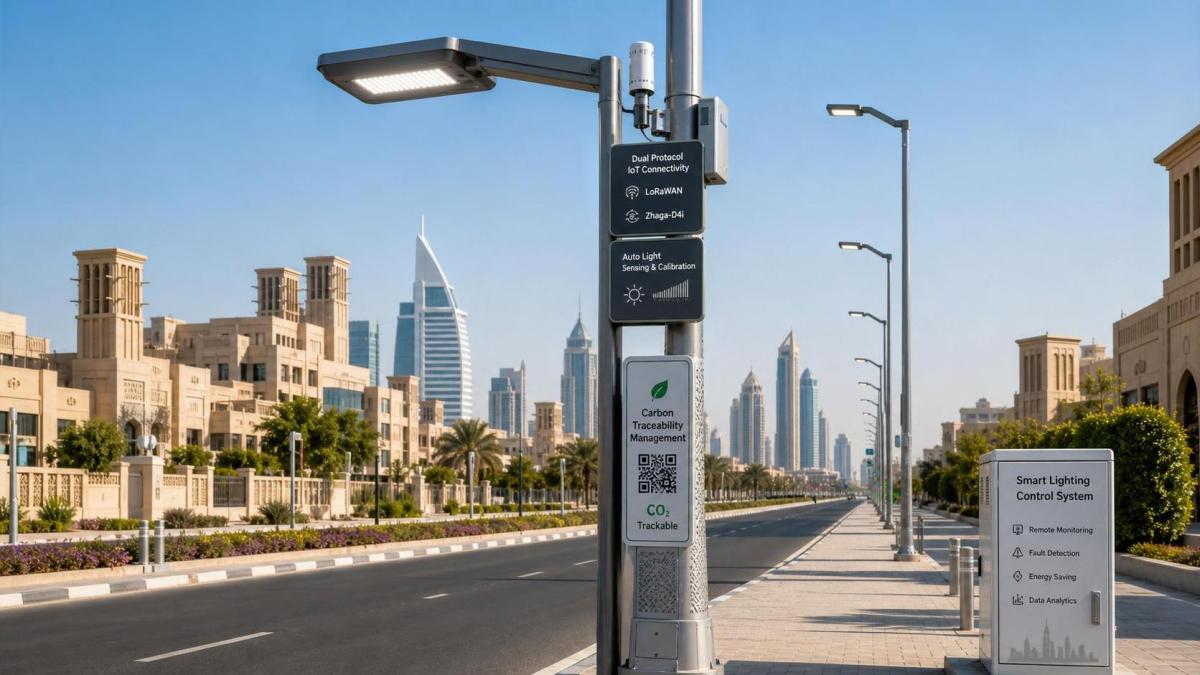
Tender signals now center on specification alignment
According to the latest quarterly report from Lighting Global Intelligence, released on June 16, 2026, the global value of public Smart Street Lighting IoT tenders reached USD 4.23 billion in Q2, up 68% year on year.
The report states that Saudi Arabia, the United Arab Emirates, and Qatar accounted for 41% of the total, making the Middle East the largest incremental market in this tender cycle.
It also indicates that these projects are mainly promoting compatibility with both DALI-2 and LoRaWAN, together with light-sensing self-calibration and carbon-footprint traceability functions.
In parallel, delivery cycles at leading Chinese manufacturers have extended to 14 to 18 weeks.
Where the pressure is likely to appear across the chain
Bid preparation is becoming more technical for project suppliers
From an industry perspective, suppliers and exporters involved in public tenders may feel the earliest impact in technical bid alignment. If tenders increasingly specify DALI-2+LoRaWAN dual compatibility, self-calibrating sensing, and traceability-related functions, suppliers will need to review whether existing product configurations, test documents, and technical files can support those requirements. The practical issue is not only product availability, but whether bid documents can clearly prove conformity with the requested features.
Procurement teams may face tighter planning windows
For buyers, contractors, and sourcing teams, the extension of lead times at major Chinese manufacturers points to a procurement and scheduling issue. Analysis shows that longer delivery cycles can affect order sequencing, component reservation, and project implementation timing, especially when tenders require function-specific configurations rather than standard catalog products. Businesses involved in project delivery should therefore watch for possible shifts in order confirmation timing, supplier selection criteria, and documentation readiness.
Compliance and testing-related services may see new demand
Certification-related firms, testing bodies, and documentation support providers may also be affected because the cited tender direction places greater weight on demonstrable technical compatibility and traceability. Observably, when procurement language becomes more detailed, the burden often moves toward verification materials, product declarations, technical datasheets, and bid-supporting evidence. At this stage, the available information does not confirm a unified mandatory certification change, but it does indicate that proof-oriented compliance preparation is becoming more relevant in competitive bidding.
What companies should track before tender requirements harden further
Check whether technical files match bid language
Companies targeting these projects should closely compare product documentation with the functional terms now appearing in the reported market direction, especially around DALI-2 and LoRaWAN compatibility, self-calibration capability, and carbon-footprint traceability. If technical descriptions are incomplete or inconsistent across brochures, declarations, and bid files, that gap could become a commercial risk during qualification review.
Prepare for more document-driven procurement reviews
What deserves closer attention is whether buyers begin asking for more structured technical evidence, testing materials, traceability records, or product-level supporting documents in tender files. The current information does not establish a new formal rulebook, but it does suggest that documentary readiness may matter more in future project screening and evaluation.
Reassess lead times and supplier commitments
Businesses relying on Chinese head suppliers should reassess procurement calendars against the reported 14 to 18 week delivery window. Analysis shows that this is relevant not only for manufacturers, but also for distributors, integrators, and after-sales planners that depend on synchronized project schedules. Where tenders involve customized protocol support or feature-specific configurations, internal planning assumptions may need updating.
Monitor market-by-market execution language
Because Saudi Arabia, the United Arab Emirates, and Qatar account for a large share of the current tender value, exporters and project teams should pay attention to how procurement language evolves in those markets. It is more appropriate to understand this as a signal to monitor tender documents, specification wording, and qualification criteria market by market, rather than assume all projects will apply the same interpretation immediately.
This looks more like an execution signal than a finished rulebook
Observably, this development is important less because it announces a single new regulation and more because it shows how procurement practice may be translating market and compliance expectations into technical tender terms. The combination of dual-protocol compatibility, self-calibrating sensing, and carbon-footprint traceability suggests that project owners are paying closer attention to interoperability, measurable performance, and documentation transparency.
At the same time, it would be premature to treat this as a fully settled global standard shift. The current information is better read as an execution signal from active tender markets, especially in the Middle East, that may influence how suppliers prepare products, documents, and delivery plans. Continued observation is still needed on how consistently these requirements appear in formal tender texts and how strictly they are evaluated in practice.
How this update is best understood for now
The reported surge in Smart Street Lighting IoT tender value points to more than demand growth alone. It also indicates that project access may increasingly depend on specification fit, document readiness, and supply reliability.
For the industry, the most balanced reading is that this is an actionable market signal tied to procurement and compliance execution, not yet a final and uniform rule change. Companies that participate in bidding, export supply, testing support, or project delivery should watch closely for changes in tender wording, evidence requirements, and lead-time expectations before treating the trend as fully standardized.
About the basis of this article
This article is generated from the user-provided news title, event timing, and event summary. The specific official source link was not provided in the input, so further verification is still needed.
For developments of this kind, commonly relevant source categories may include official procurement notices, regulator releases, trade or customs authority information, industry association updates, standard-setting documents, and reporting by established industry media.
Further observation should focus on whether more detailed procurement rules emerge, how certification or compliance interpretations are applied, whether tender documents adopt these specifications more broadly, and how suppliers and project participants respond in execution.
Recommended News