
Search News
Industry Portal
Hot Articles
OEM Hardware Solutions for Lighting: Key Specs That Prevent Fit and Finish Issues
Time
Click Count
Fit and finish issues in lighting projects rarely begin on site. They usually start earlier, inside drawings, sample approvals, hardware choices, and tolerance decisions that looked minor at the time.
That is why OEM hardware solutions for lighting deserve closer attention. When brackets, fasteners, housings, gaskets, coatings, and interface points are specified together, rework drops and installation quality becomes easier to control.
In commercial buildings, industrial facilities, and smart city programs, lighting is no longer an isolated fixture decision. It sits inside broader performance demands tied to durability, safety, energy management, and long-term maintenance.
From the SHSS perspective, smart lighting belongs to the same hard-performance ecosystem as high-strength hardware and intelligent access systems. A clean visual line still depends on mechanical precision, material discipline, and consistent manufacturing control.
Why hardware details shape visible quality
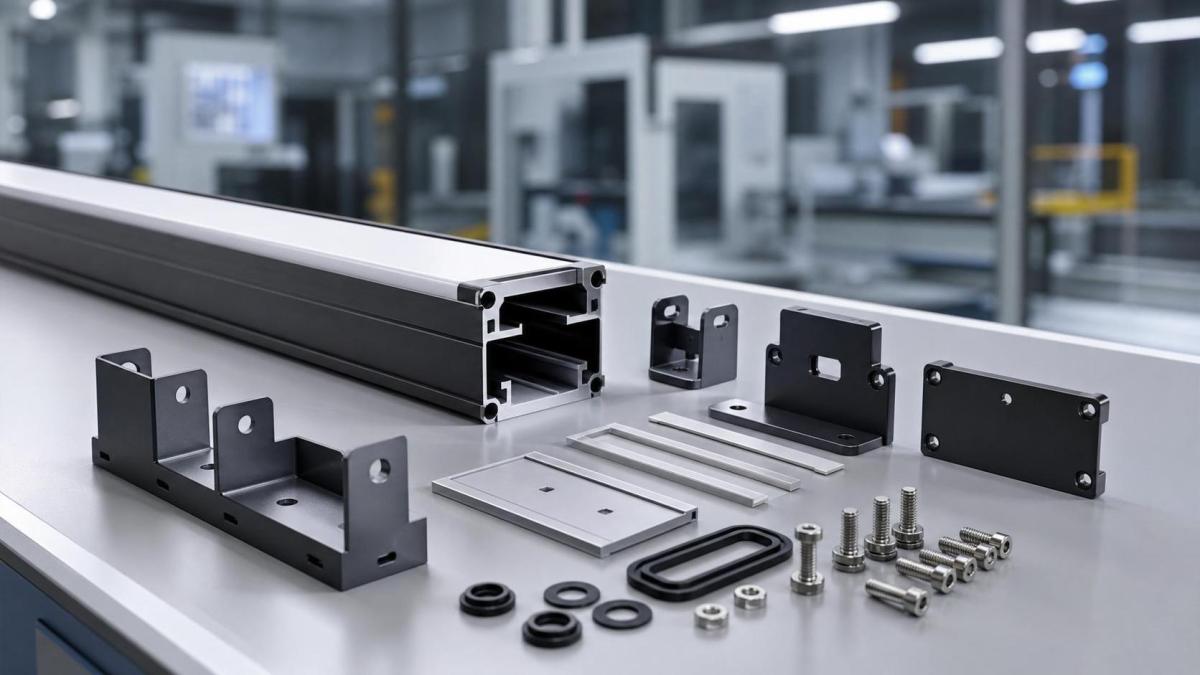
A lighting product may pass photometric targets and still fail the project visually. Gaps around trims, uneven surface color, unstable mounting, and misaligned joints are the defects people notice first.
OEM hardware solutions for lighting address these problems at the assembly level. The goal is not only structural support. The goal is repeatable fit, stable finish, and predictable site installation across volume production.
This matters more now because fixtures increasingly combine sheet metal, die-cast parts, plastics, optics, sensors, drivers, and smart controls. Each interface creates another chance for visible inconsistency if the hardware stack is underdefined.
What OEM hardware solutions for lighting actually include
The phrase covers more than screws and brackets. In practice, it includes every mechanical component that supports assembly accuracy, installation stability, enclosure integrity, and surface presentation.
- Mounting brackets, clips, rails, and suspension hardware
- Fasteners with defined head style, grade, finish, and torque range
- Housing interfaces, trim frames, bezels, and connection points
- Gaskets, seals, and compression elements for IP protection
- Surface treatments that affect corrosion resistance and appearance
- Tolerance schemes for mating parts and final assembly alignment
When these items are sourced and validated as a system, OEM hardware solutions for lighting support both factory efficiency and field reliability. When they are handled separately, coordination gaps usually appear later as punch-list work.
The key specs that prevent fit problems
Fit issues often come from tolerance stacking rather than one defective part. A housing can be within spec, a bracket can be within spec, and the final assembly can still sit crooked.
Tolerance and datum control
Critical dimensions need clear datums tied to real assembly references. Hole positions, slot lengths, bend angles, and flange flatness should relate to how the fixture is actually mounted and viewed.
For recessed and linear systems, small dimensional drift becomes obvious across long runs. That is where OEM hardware solutions for lighting should define cumulative tolerance limits, not only part-by-part acceptance.
Mounting interface geometry
Slot size, bracket travel, engagement depth, and access for tools directly affect installation speed. Hardware that looks flexible on paper can still be difficult once ceiling grids, conduits, or wall irregularities enter the picture.
A useful review asks three questions: can it self-locate, can it tolerate site variation, and can it be adjusted without damaging the finish?
Fastener selection
Thread type, head profile, hardness, and plating all matter. A poor match can strip sheet metal, distort housings, chip coatings, or create galvanic problems in humid environments.
SHSS often highlights the same lesson found in high-strength hardware sectors: fastener performance is never a minor detail when appearance and structural stability depend on repeated tightening accuracy.
The specs that protect finish quality
Finish problems are usually blamed on paint, but the root cause may sit underneath. Surface waviness, burrs, weld marks, clamp pressure, and coating compatibility can all break visual consistency.
Material pairing
Aluminum, stainless steel, mild steel, engineered plastics, and gasket materials expand, flex, and age differently. OEM hardware solutions for lighting should account for thermal movement and contact behavior over time.
This is especially relevant in smart lighting near facades, warehouses, transit areas, and outdoor corridors. Temperature swings can turn a neat assembly into a visibly stressed one.
Surface preparation and coating stack
Powder coating, anodizing, e-coating, and plated finishes each interact differently with base materials and joining methods. A spec should define not only color, but thickness range, adhesion expectations, and edge coverage.
If the part requires post-coating assembly, contact points and tool access should be reviewed early. Otherwise, the finish gets damaged exactly where installers need to handle it.
Visible-edge control
Edges around trims, reflectors, louvers, and covers need burr limits and cosmetic standards. Even slight edge irregularity becomes obvious under direct LED output and reflective architectural surfaces.
Where these issues show up most often
Not every project stresses hardware in the same way. The risk profile changes with environment, installation method, service access, and the level of visual scrutiny in the finished space.
This is one reason OEM hardware solutions for lighting matter across the broader industrial landscape. The same fixture family may need different hardware logic when moved from a dry office ceiling to a public transit canopy.
How to evaluate an OEM partner before approval
A capable supplier should be able to discuss hardware decisions in terms of assembly flow, risk prevention, and field conditions, not only unit cost. That conversation usually reveals maturity quickly.
- Ask for tolerance chain analysis on visible assemblies
- Review mounting prototypes under realistic substrate conditions
- Check coating and substrate compatibility reports
- Request torque guidance and fastener traceability
- Confirm salt spray, vibration, or ingress testing where relevant
- Inspect sample consistency across multiple production batches
For connected luminaires, it also helps to coordinate hardware review with control-system packaging. Sensors, drivers, antennas, and access panels can alter heat paths and enclosure dimensions in subtle ways.
That cross-disciplinary view aligns with the SHSS approach. Smart lighting performance depends on optics and controls, but also on fastening logic, enclosure discipline, and material behavior under real operating stress.
Using the specs to reduce schedule risk
The practical value of OEM hardware solutions for lighting is not limited to cleaner products. It also shows up in fewer installation delays, fewer replacement cycles, and fewer late-stage design corrections.
A useful process is to freeze the critical hardware criteria before mass production. That usually includes tolerance references, approved finishes, mounting adjustment range, fastener standards, and cosmetic acceptance rules.
After that, sample review should focus on repeatability rather than one perfect piece. A prototype can look excellent and still hide production instability if the hardware stack is too sensitive to normal variation.
The next step is straightforward: map the visible failure points in the intended lighting application, tie each one to a measurable hardware spec, and use that list to compare OEM options with more discipline.
That approach gives OEM hardware solutions for lighting their real value. They become a practical control framework for fit, finish, and delivery confidence, not just a line item inside a component bill.
Recommended News