
Search News
Industry Portal
Hot Articles
Zigbee for Smart Lighting: Range, Stability, and Device Limits
Time
Click Count
Zigbee for Smart Lighting: Range, Stability, and Device Limits
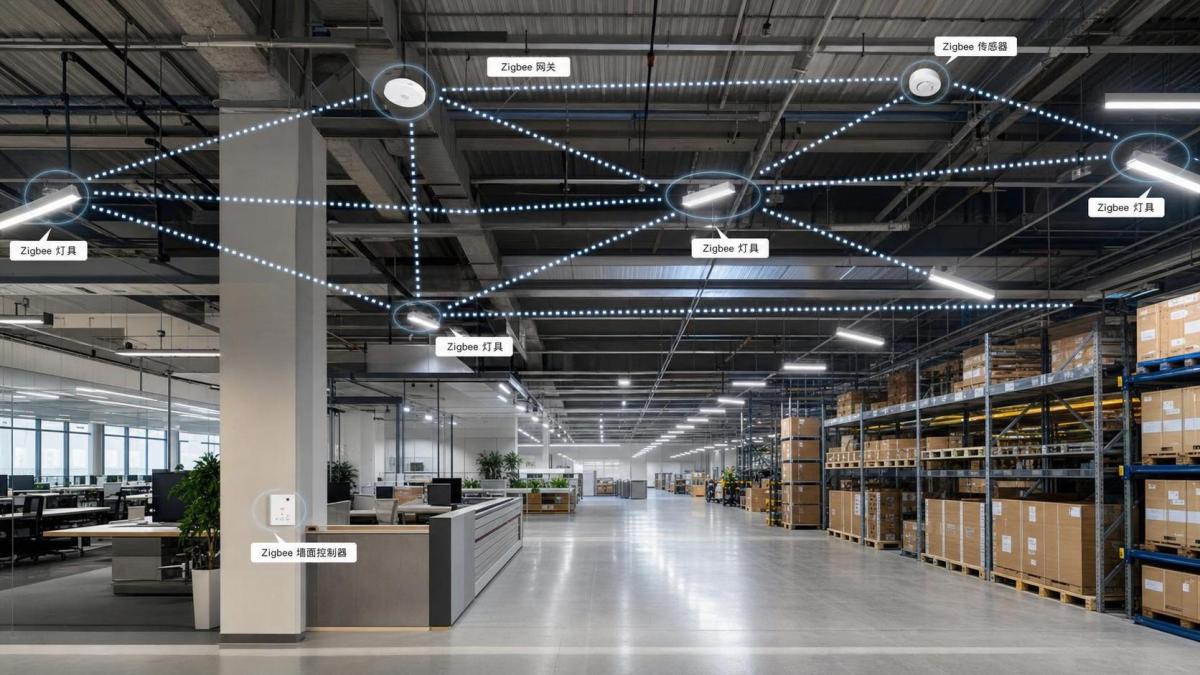
For technical evaluators, Zigbee for smart lighting stays relevant for a simple reason. It solves practical deployment problems without adding excessive system complexity.
Range, stability, and device scale are not abstract specifications. They shape installation density, commissioning time, fault rates, and long-term maintenance effort.
That is why Zigbee for smart lighting appears so often in commercial retrofits, office floors, warehouses, schools, and mixed-use buildings.
The protocol is not perfect. It has limits, especially in difficult RF environments. Still, its mesh behavior gives it a strong operational advantage.
This article looks at how Zigbee for smart lighting performs in the field, where it fails, and what thresholds matter before rollout.
Why Zigbee Fits Lighting Networks
Lighting systems have a different traffic profile from cameras, access control, or Wi-Fi endpoints. Most commands are short, repetitive, and latency-sensitive.
Lights also sit everywhere in a building. That physical distribution makes mesh networking especially useful. Each powered node can help relay packets.
This is where Zigbee for smart lighting earns attention. It was designed for low-power control tasks, not heavy multimedia transport.
In practical terms, that means lower bandwidth, lower energy demand, and better suitability for dimmers, sensors, wall controls, and grouped luminaires.
Another strength is ecosystem maturity. Many commercial drivers, controllers, gateways, and occupancy sensors already support Zigbee-based lighting integration.
Range: What the Datasheet Hides
Quoted wireless range can be misleading. Open-air figures rarely match indoor performance. Concrete, metal racks, fire doors, and elevator shafts change everything.
A single Zigbee hop indoors often works reliably across 10 to 20 meters. Some layouts do better. Dense industrial sites often do worse.
The real value of Zigbee for smart lighting is not maximum point-to-point range. It is repeatable coverage through many short, stable hops.
That changes network design. Instead of chasing long links, planners should create overlapping relay paths using permanently powered fixtures and control devices.
Ceiling-mounted luminaires help because they are elevated and evenly distributed. They often create cleaner propagation than low-mounted switches or cabinet controllers.
However, not every powered device is an equally strong router. Firmware quality, antenna design, enclosure material, and installation orientation all matter.
In metal-heavy facilities, link budget degrades quickly. This is especially true in logistics centers, workshops, and parking structures with reflective surfaces.
A better evaluation method is to measure packet success under expected mounting conditions. Paper range alone is not enough for Zigbee for smart lighting decisions.
Range Planning Checklist
- Count powered routers, not just endpoints.
- Map walls, shafts, panels, and metal obstructions early.
- Test at fixture height, not desktop height.
- Assume lower range near dense Wi-Fi zones.
- Keep redundant paths for critical areas.
Stability Depends More on Topology Than Brand Claims
When people discuss stability, they often mean command reliability, predictable response time, and graceful recovery after a node or path disappears.
Zigbee for smart lighting can be very stable, but only when the mesh is well formed. Sparse networks usually underperform, even with premium devices.
A strong mesh needs enough routers, balanced routing depth, and sensible grouping. Overloading a few relay nodes creates hidden bottlenecks.
Interference also matters. Zigbee typically operates in the 2.4 GHz band, where Wi-Fi, Bluetooth, and some industrial systems already compete for airtime.
In office buildings, the problem is usually channel overlap with Wi-Fi. In industrial settings, electrical noise and metal reflections complicate routing behavior further.
The good news is that Zigbee for smart lighting sends small data bursts. Proper channel planning often resolves most stability issues without redesigning the entire network.
Gateway placement is another overlooked factor. A gateway hidden inside a metal cabinet can weaken the whole network, even if endpoint density looks adequate.
Commissioning quality matters as well. Poor binding, rushed grouping, or unmanaged firmware versions can create instability that gets blamed on the protocol itself.
Common Stability Risks
- Too few powered routers in long corridors.
- Wi-Fi access points sharing overlapping channels.
- Mixed-vendor firmware with uneven routing behavior.
- Groups that are too large for time-sensitive scenes.
- Gateways installed in shielded locations.
Device Limits: Theoretical Capacity vs. Usable Capacity
Device count is often discussed using headline numbers. That is rarely enough for specification work. Practical capacity is shaped by architecture, not only protocol theory.
A Zigbee network can support many nodes, often well beyond small-building needs. But the usable limit depends on coordinator design, routing tables, and traffic patterns.
This distinction is important for Zigbee for smart lighting projects with occupancy sensing, daylight harvesting, scene control, and building management integration.
A network with 200 mostly quiet fixtures behaves differently from one with 200 devices sending frequent sensor updates and group change commands.
Battery-powered end devices add another variable. They reduce wiring effort, but they do not strengthen the mesh because they usually do not route traffic.
For that reason, node mix matters as much as node count. Fifty routers and two hundred sleepy endpoints perform differently from a flat endpoint-heavy design.
Large sites are often better served by segmented networks. Multiple coordinators or zones can improve resilience, simplify troubleshooting, and reduce broadcast stress.
A Practical Capacity View
Where Zigbee for Smart Lighting Works Best
Zigbee for smart lighting is strongest where fixtures are plentiful, wiring changes are expensive, and flexible zoning is a long-term requirement.
Open-plan offices are a good example. They usually have enough powered nodes to form a healthy mesh and enough layout changes to justify wireless control.
Schools and healthcare spaces also benefit. Lighting groups can be adapted room by room without major control rewiring.
Warehouses can work well too, but only with careful RF validation. Tall shelving, metal stock, and moving vehicles create a less predictable environment.
For campuses or large industrial compounds, Zigbee for smart lighting usually performs best as a zoned architecture under a higher-level management platform.
That approach keeps local meshes manageable while preserving central monitoring, scheduling, analytics, and maintenance workflows.
What to Verify Before Specification
The best way to assess Zigbee for smart lighting is through a controlled pilot. A small proof-of-performance reveals more than a polished datasheet.
Start with representative spaces. Include the hardest RF zone, the densest occupancy area, and at least one segment with heavy Wi-Fi traffic.
Then validate four things: command response, packet reliability, recovery after node loss, and maintenance simplicity during recommissioning.
- Measure scene activation time during peak business hours.
- Simulate a router failure and observe rerouting behavior.
- Review gateway tools for diagnostics and firmware control.
- Check interoperability with sensors, drivers, and BMS interfaces.
- Confirm channel strategy against existing Wi-Fi plans.
This process makes risk visible early. More importantly, it turns Zigbee for smart lighting from a protocol choice into a predictable engineering decision.
Final Assessment
Zigbee for smart lighting remains a strong option because it balances coverage, resilience, and scale better than many alternatives in control-focused environments.
Its real advantage comes from mesh architecture, not headline radio distance. Its real limitation comes from design shortcuts, not the protocol name itself.
For specification teams, the right question is not whether Zigbee works. The right question is whether the topology, channel plan, and device mix support the intended workload.
When those elements are aligned, Zigbee for smart lighting can deliver stable performance, scalable control, and lower lifecycle risk across demanding commercial deployments.
Recommended News