
Search News
Industry Portal
Hot Articles
DALI Lighting Control: Key Factors for System Selection
Time
Click Count
Choosing a DALI lighting control system is no longer a narrow protocol decision. In commercial buildings, factories, campuses, and urban projects, it affects energy performance, maintenance workload, user comfort, and digital integration.
That matters even more in an AIoT environment shaped by smart hardware, security systems, and resilient infrastructure. Lighting now sits beside access control, sensors, power tools, and building management as part of a connected operational layer.
For that reason, DALI lighting control should be evaluated as a long-life system. Technical fit, commissioning logic, interoperability, and lifecycle economics usually matter more than a short specification checklist.
Why DALI lighting control remains relevant
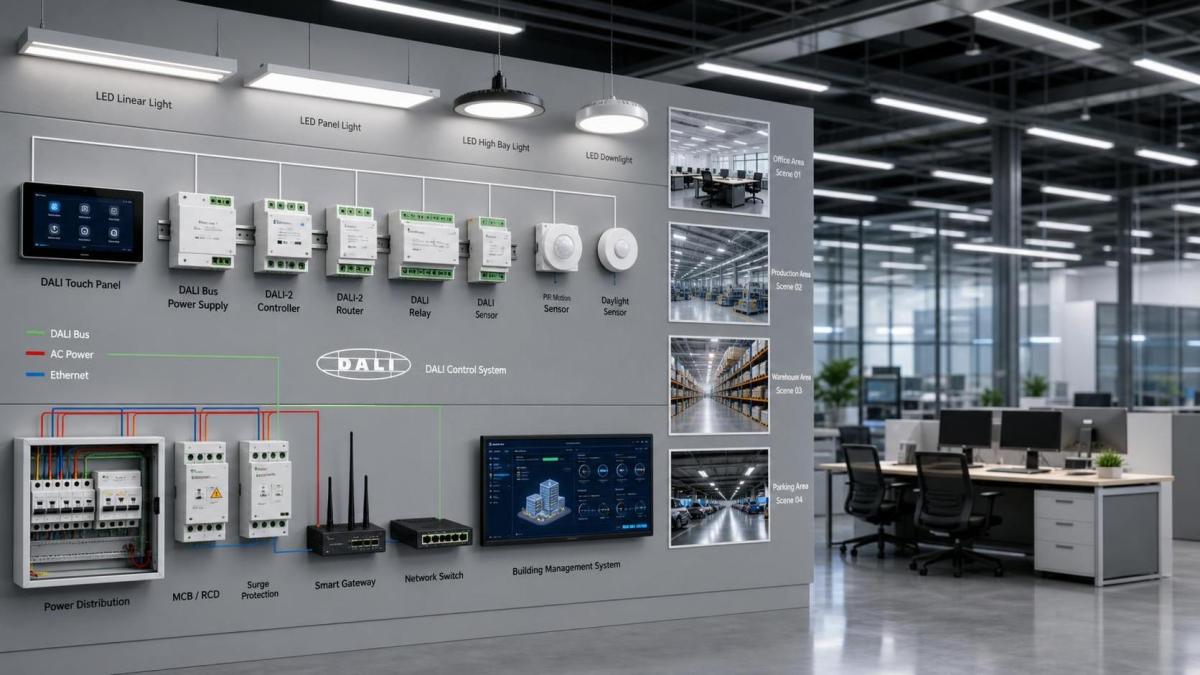
DALI, or Digital Addressable Lighting Interface, gives each luminaire or device a digital identity. Instead of treating lighting as one circuit, it allows individual or grouped control with two-way communication.
That two-way structure changes system behavior. Operators can dim by zone, schedule scenes, collect fault data, confirm device status, and adapt output to occupancy or daylight conditions.
In practice, DALI lighting control is most valuable where lighting is operational infrastructure rather than decoration. Warehouses, hospitals, transport hubs, offices, schools, and industrial plants fit that description.
The broader smart hardware market also reinforces its relevance. SHSS tracks lighting alongside biometric security, fasteners, industrial tools, and protective equipment because these systems all support safety, uptime, and controlled performance.
A lighting network that fails to scale or report faults clearly creates the same operational friction seen in poorly integrated security or automation systems. That is why system selection deserves close scrutiny.
The first question is not compatibility alone
Many evaluations begin with a simple question: does the product support DALI? That is necessary, but it is rarely enough to support a reliable project outcome.
A stronger starting point is to define what the system must actually do. That includes control granularity, reporting needs, integration targets, expansion plans, and the site conditions that shape installation and maintenance.
A small office retrofit and a municipal transport terminal may both require DALI lighting control, yet their decision criteria differ sharply. One may prioritize low disruption. The other may prioritize redundancy and remote diagnostics.
Selection becomes clearer when performance requirements are mapped before product comparison. Without that step, teams often overbuy features they never use or underestimate limits that appear during commissioning.
Core evaluation dimensions
- Addressing capacity and grouping flexibility across present and future zones
- Support for sensors, emergency testing, tunable white, or other required functions
- Integration with BMS, gateways, cloud dashboards, or other building platforms
- Commissioning workflow, software usability, and documentation quality
- Maintenance visibility, fault reporting, and availability of replacement components
Interoperability is where many projects succeed or fail
DALI lighting control is often chosen for openness, yet real interoperability depends on more than a logo on a datasheet. Devices may technically communicate while still creating functional limits in mixed-vendor systems.
This is especially important in projects linked to access control, security schedules, occupancy analytics, or smart city platforms. Lighting behavior may need to respond to data beyond the lighting domain.
For example, a commercial site may want lighting scenes tied to biometric entry events after business hours. A logistics hub may want occupancy-driven dimming linked to operational zones and emergency pathways.
In those cases, protocol support is only the surface layer. Gateway quality, API options, event logic, and supervisory software architecture become part of the selection decision.
A practical review should confirm not only what devices can connect, but also what behaviors can be configured without custom workarounds. Hidden integration costs often appear after procurement, not before it.
What to verify in mixed-system environments
Scalability should be judged over the system life, not the opening phase
Buildings rarely remain static. Tenants change, production lines move, security zones shift, and floor layouts are reworked. A DALI lighting control platform should support those changes without expensive rewiring or fragmented add-ons.
That means looking beyond current device counts. Expansion paths, controller architecture, segment design, and software maintainability all influence whether the system can grow cleanly.
This issue is especially visible in campuses, industrial estates, healthcare sites, and municipal lighting networks. Early decisions about topology often determine whether later phases remain manageable.
A scalable DALI lighting control system also supports phased upgrades. That is useful when capital budgets, tenant turnover, or energy retrofit programs require staged deployment rather than one complete replacement.
Energy savings are real, but only when controls match the use case
Energy reduction is a common reason for adopting DALI lighting control. The savings can be significant, but they depend on control logic, occupancy patterns, daylight access, and user override policy.
A corridor, an open-plan office, a clean room, and a vertical farm do not benefit from the same strategy. Uniform dimming rules often look efficient on paper but perform poorly in real operation.
Better results come from matching control functions to the environment. Daylight harvesting suits perimeter spaces. Presence-based scenes suit meeting rooms. Time-based reduction may suit low-traffic industrial areas.
SHSS follows this closely because smart lighting increasingly sits inside broader efficiency models. Long-life LED assets, responsive control, and measured consumption data strengthen the business case for infrastructure upgrades.
Even so, energy should not be the only metric. Excessively aggressive dimming can create complaints, safety concerns, or noncompliance in task-critical settings. Balanced design matters more than headline savings.
Useful questions before modeling savings
- How many hours are lights actually on at full output today?
- Which zones have stable occupancy, and which are variable?
- Are there compliance minimums for illuminance or emergency operation?
- Will occupants need local override, and how long should it persist?
Commissioning complexity often decides the real project cost
A sophisticated DALI lighting control design can lose value if commissioning is cumbersome. Addressing, grouping, scene creation, testing, labeling, and post-handover changes all affect delivery time and future service cost.
Some platforms are technically capable but operationally heavy. Others simplify workflows through clearer software, stronger templates, and better diagnostics. That difference becomes visible during site pressure, not brochure review.
Commissioning should therefore be reviewed as a system capability. Training burden, file export, backup methods, revision control, and remote support all influence long-term ownership quality.
Where multiple contractors are involved, documentation discipline becomes even more important. Ambiguous device naming and poor as-built records can make a healthy DALI lighting control installation difficult to manage later.
Maintenance, resilience, and lifecycle visibility
Lighting is expected to work every day, often in spaces where failure has operational consequences. That makes maintenance visibility one of the most practical selection factors.
A strong DALI lighting control solution should help identify failed drivers, communication faults, misconfigured groups, and abnormal behavior without lengthy manual tracing. Clear diagnostics reduce downtime and labor cost.
Resilience also includes supply continuity. Replacement parts, firmware support, software licensing continuity, and vendor stability deserve attention, especially in public projects and large commercial estates.
This lifecycle view aligns with the SHSS perspective on modern infrastructure. Durable hardware, controlled performance, and measurable reliability usually create more value than impressive features with weak service backing.
Where selection priorities change by application
Not every project should rank the same criteria in the same order. The application context changes what matters most in DALI lighting control.
- Offices and education spaces usually prioritize comfort, daylight response, and easy reconfiguration.
- Industrial facilities often focus on robustness, zoning logic, and maintenance access.
- Healthcare environments may require tighter scene control, compliance alignment, and reliable emergency interfaces.
- Retail and hospitality projects often value ambiance control, scheduling precision, and brand consistency.
- Smart city or campus deployments usually emphasize remote monitoring, phased expansion, and platform integration.
That is why system selection works best when technical, operational, and commercial criteria are reviewed together. A capable system in the wrong context is still the wrong system.
A practical path to a better decision
A useful evaluation process starts with the site, not the brochure. Map control zones, integration points, reporting needs, and expansion assumptions before comparing brands or architectures.
Then test the shortlist against real scenarios. Review mixed-vendor behavior, commissioning steps, fault visibility, and handover quality. Ask how the system will be modified two years after occupancy, not only at installation.
For projects tied to smart building, security, or energy programs, DALI lighting control should also be reviewed in relation to the wider infrastructure stack. Integration quality often determines whether promised intelligence becomes practical value.
A disciplined comparison matrix, supported by pilot testing where possible, usually reveals the strongest option. The goal is not just a compliant lighting network, but a controllable, maintainable, and scalable system with clear lifecycle logic.
Recommended News