
Search News
Industry Portal
Hot Articles
Smart LED Lighting App Control: Key Features, Setup Limits, and Security Risks
Time
Click Count
Smart LED lighting app control has moved far beyond residential convenience. In commercial buildings, factories, campuses, and smart city projects, the app layer now shapes commissioning speed, visibility, and risk exposure.
That shift matters because lighting no longer operates as a standalone utility. It sits inside broader AIoT environments, alongside access control, sensors, edge devices, and energy management platforms.
For SHSS, this fits a larger pattern. Physical infrastructure is becoming software-mediated, which means reliability, interoperability, and security have to be judged together rather than in separate technical silos.
What app control really means in smart LED systems
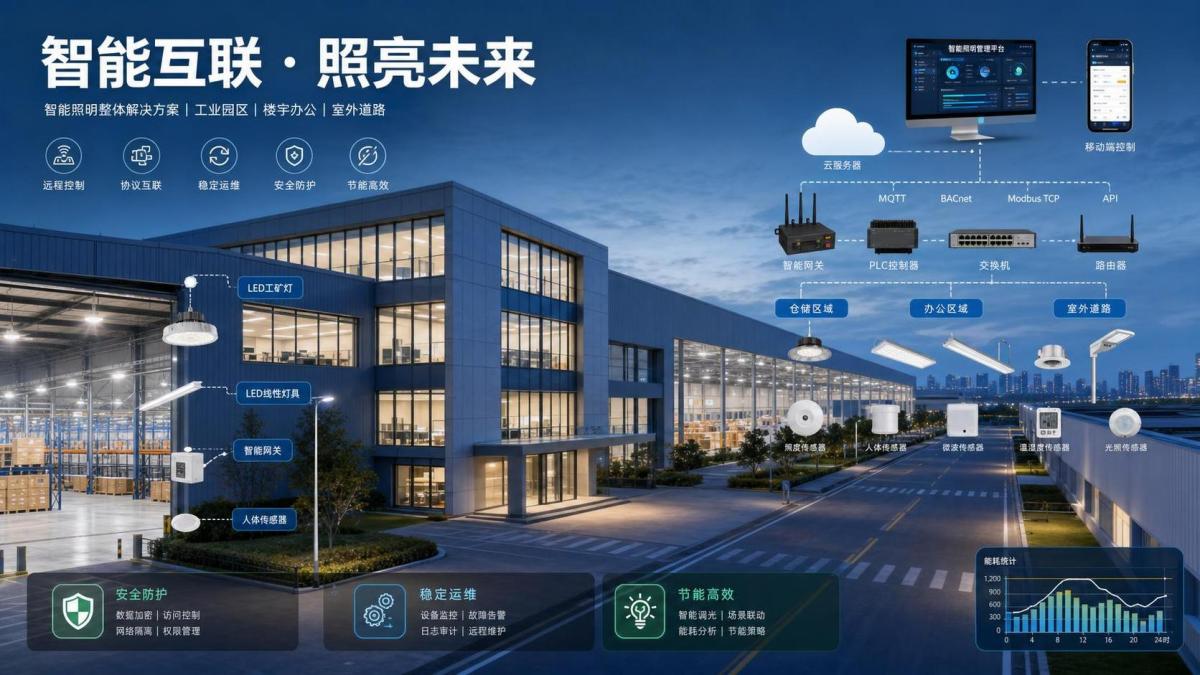
In practice, smart LED lighting app control is the management interface for connected luminaires, drivers, gateways, scenes, sensors, and user permissions.
A capable app does more than switch lights on and off. It connects device status, scheduling logic, dimming rules, occupancy response, daylight harvesting, and remote diagnostics into one operational layer.
This is especially relevant in mixed estates. Warehouses, office floors, parking decks, healthcare sites, and municipal corridors often need different lighting behaviors under one control architecture.
The core question is not whether an app exists. The real question is whether the app can support stable, scalable, secure control over the full lifecycle of the installation.
Why the market is paying closer attention
Energy pressure is one reason. Smart lighting promises measurable savings through dimming, occupancy-based automation, and better timing control across large sites.
Operational visibility is another. Facility teams increasingly expect fault alerts, power reporting, and asset identification without sending staff to inspect every zone physically.
There is also a convergence effect. Smart access systems, surveillance, biometric entry, and lighting are sharing networks, gateways, and cloud services more often.
That convergence creates value, but it also expands the attack surface. A lighting app that looks simple on the front end may depend on credentials, APIs, mobile permissions, and vendor cloud paths behind it.
Key features that deserve technical scrutiny
Not every feature carries the same weight. Some functions look attractive in demonstrations but add little operational value in demanding deployments.
Control depth and scene logic
Basic dimming is no longer enough. Strong smart LED lighting app control should support grouped fixtures, layered scenes, zone-based policies, and event-driven rules.
This matters where spaces change use. A production line, loading area, or flexible workspace often needs different illuminance profiles during shifts, maintenance windows, and emergency conditions.
Protocol awareness
The app should not hide protocol dependencies. DALI, Zigbee, Bluetooth Mesh, Wi-Fi, and proprietary RF stacks create very different behaviors in addressing, latency, fallback, and expansion.
A clean interface can mask a closed ecosystem. If the app depends on proprietary gateways or device enrollment rules, future retrofit flexibility may shrink quickly.
Monitoring and maintenance tools
Useful apps expose device health, firmware status, communication loss, driver failures, and historical logs. Without these, remote control exists, but operational intelligence remains weak.
The most practical systems also support role-based permissions, audit trails, and structured exports for maintenance documentation and compliance reviews.
Setup limits often appear after procurement
Many deployment problems are not caused by bad luminaires. They come from app-side limitations that were not tested early enough.
Device count ceilings are a common example. Some systems perform well at pilot scale, then slow down when hundreds of nodes, multiple floors, or outdoor segments are added.
Commissioning friction is another issue. QR scanning, manual pairing, gateway placement, and account provisioning can become labor-intensive across large estates.
Even routine onboarding raises hidden questions. Can devices be bulk imported? Can zones be templated? Can failed nodes be replaced without rebuilding scenes?
Security risks are no longer a secondary issue
Smart LED lighting app control may look low-risk compared with access or biometric systems, but that assumption is weak in connected environments.
Mobile credentials, cloud dashboards, remote access paths, and exposed APIs can create entry points for lateral movement or unauthorized control.
Data exposure is not limited to user names and passwords. Lighting schedules, occupancy patterns, floor maps, device IDs, and site topology can all reveal sensitive operational details.
This is where the SHSS perspective becomes useful. Physical protection and digital control are increasingly intertwined, so cybersecurity review has to sit inside hardware evaluation.
The most common weak points
- Default passwords or weak account setup during commissioning
- Unclear firmware update policy for gateways and controllers
- Cloud dependence without documented encryption or logging controls
- Over-privileged mobile users with full-site authority
- Remote vendor support channels left open after deployment
A lighting breach may not always cause dramatic immediate damage. More often, it creates stealth exposure, unreliable response, or a bridge into adjacent building systems.
Where app-controlled lighting creates real business value
The strongest use cases are operational, not cosmetic. Smart LED lighting app control is most valuable when it simplifies repeated decisions across many fixtures and locations.
In industrial facilities, that can mean zoning by task, shift, hazard level, or maintenance state. In logistics sites, it often means adaptive light levels for aisles, docks, and exterior perimeters.
Commercial buildings use it differently. Conference floors, open offices, stairwells, and parking structures benefit from occupancy logic, time scheduling, and energy reporting tied to tenant patterns.
Municipal and infrastructure projects add another dimension. Street lighting, transit corridors, and public spaces need centralized visibility, but also resilient local behavior when communications fail.
A practical framework for comparing systems
A useful assessment separates interface appeal from operational substance. Demo environments rarely expose the edge cases that matter most after rollout.
Check the control architecture
Confirm which functions run locally and which require cloud connectivity. This affects resilience, latency, and incident recovery.
Check the trust model
Review authentication, permission granularity, encryption methods, logging, and update cadence. Security claims should be documented, not implied by branding.
Check the expansion path
Look at gateway scaling, cross-site management, protocol support, and integration options. A closed app can limit future modernization even if the initial deployment works well.
Check the maintenance burden
The best systems reduce field visits, simplify replacements, and produce usable fault history. Smart LED lighting app control should lower complexity, not relocate it.
What to examine before moving forward
A short pilot still helps, but it should be structured around stress points. Test onboarding speed, communication recovery, permission changes, firmware handling, and reporting accuracy.
It is also worth mapping the lighting app into the wider building stack. Shared networks, identity systems, and cloud dependencies should be visible before procurement closes.
For teams following SHSS coverage, the broader lesson is clear. In connected hardware, app control is no longer a soft feature. It is part of system integrity.
The next step is to build a comparison matrix around protocol fit, scale limits, offline behavior, security controls, and lifecycle support. That produces a far better decision than judging the interface alone.
Recommended News