
Search News
Industry Portal
Hot Articles
Cut Resistant Clothing for Metal Work: How to Choose the Right Protection Level
Time
Click Count
Choosing cut resistant clothing for metal work is no longer a narrow PPE decision. It sits at the intersection of worker safety, production continuity, tool performance, and stricter compliance across fabrication, construction, maintenance, and smart industrial sites.
Sharp sheet edges, burrs, stamped parts, scrap handling, and repetitive contact create a constant injury pattern. The right protection level reduces laceration risk, limits fatigue, and helps maintain precise handling during long shifts around demanding metalworking processes.
Why this choice matters on today’s metalworking floor
Metal work has changed. Brushless portable tools are more powerful, cutting cycles are faster, and handling tasks often happen beside automated equipment, conveyor systems, and densely scheduled production cells.
That means contact with sharp metal is rarely a single dramatic event. More often, it is repeated exposure: lifting cut blanks, guiding profiles, sorting scrap, cleaning edges, or moving unfinished components between stations.
In this environment, cut resistant clothing for metal work supports the same goal that drives broader industrial safety systems: protecting physical operations without slowing them down.
From the SHSS perspective, PPE is part of a larger safety chain. High-torque tools, high-strength fasteners, controlled lighting, and protective apparel all influence whether a task stays accurate, stable, and incident-free.
What cut resistant clothing actually protects against
The phrase often sounds straightforward, but protection needs differ sharply by task. Some garments are built for incidental edge contact. Others are designed for repeated abrasion, snagging, and sliding contact against unfinished metal surfaces.
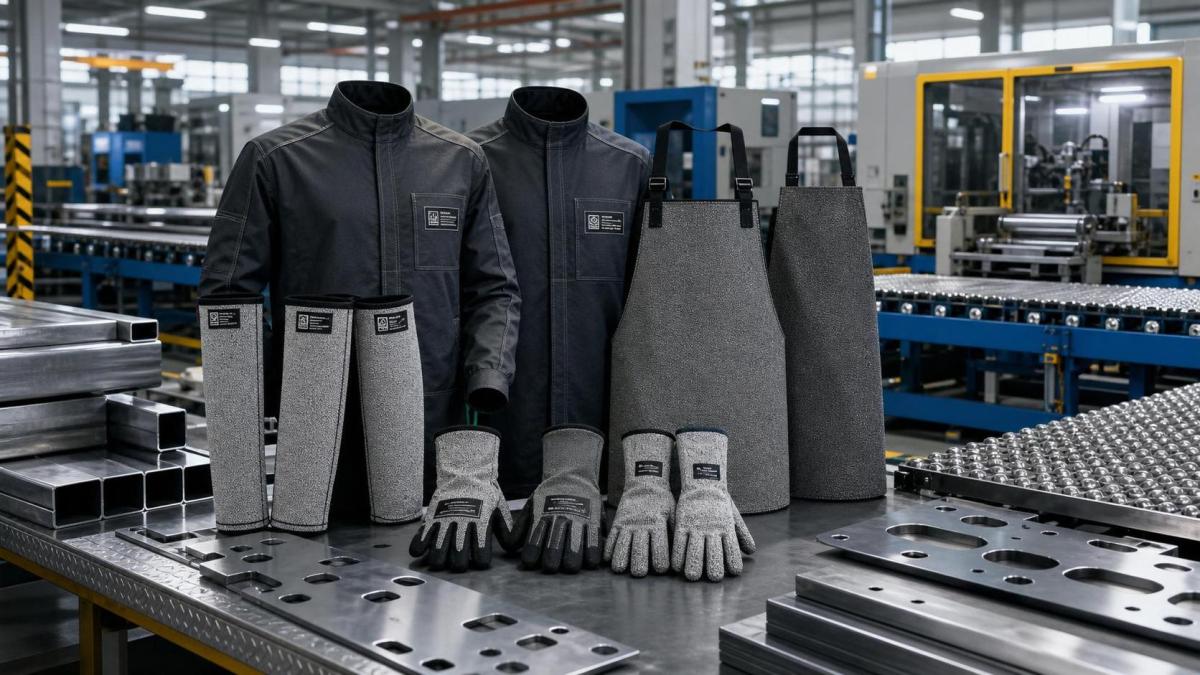
Cut resistant clothing for metal work may include sleeves, jackets, aprons, arm guards, pants, and full-body solutions. The point is not only to stop a blade. It is to reduce tissue injury from sharp, moving, or irregular metal edges.
Still, cut resistance is only one part of real protection. Metalworking settings may also involve sparks, heat, oil, grime, restricted movement, and the need for high visibility around machinery or vehicle traffic.
A garment with a strong cut score can still be a poor choice if it traps heat, catches on fixtures, or wears out quickly at the shoulders and forearms.
Understanding protection levels without overcomplicating them
Most decisions begin with cut ratings, especially ANSI/ISEA 105 and EN 388 references. These ratings are useful, but they only become meaningful when matched to the exact contact pattern in the job.
A higher rating does not automatically mean a better purchase. Heavier materials can reduce dexterity, create heat stress, or interfere with movement in welding bays, assembly areas, or overhead tasks.
A practical way to read protection levels is to compare the hazard source, contact frequency, force, and body area exposed. That gives a more reliable basis than choosing the highest number available.
Fabric performance matters as much as the rating
Materials such as aramid blends, HPPE, engineered glass fiber blends, and steel-core yarns can all appear in cut resistant clothing for metal work. Their behavior differs under heat, moisture, laundering, and repeated friction.
This is where many selections go wrong. Buyers compare a rating chart, but the operator experiences stiffness, hot spots, sleeve slip, or seam irritation. Those issues reduce wear compliance faster than expected.
Look closely at how protection is built into the garment:
- Fiber blend and whether it stays stable after washing
- Seam construction at elbows, shoulders, and cuffs
- Breathability in enclosed or hot production areas
- Compatibility with gloves, aprons, and harnesses
- Resistance to oil pickup and surface contamination
In practice, the best garment often balances moderate bulk with stable protection across the specific motion pattern of the task.
Matching clothing to real metalworking scenarios
Not every metal operation needs full-body protection. Coverage should follow exposure points. Arm sleeves may be enough in one station, while another requires reinforced torso panels or lower-body coverage.
Sheet metal fabrication
Large panels create long sliding contact along the forearm and rib area. Cut resistant clothing for metal work should prioritize sleeves that stay in place and tops that do not ride up during reaching.
CNC and machining support
The main hazard is often part handling after cutting, not machine contact itself. Lightweight arm protection and fitted garments help avoid snagging near workholding, carts, and coolant-wet surfaces.
Scrap, offcut, and recycling tasks
This is usually harsher than primary production. Edges are unpredictable, and body contact can occur from multiple angles. Durability and coverage become more important than minimal weight.
Installation and field maintenance
Confined spaces, ladders, and mixed hazards require streamlined protection. Clothing should move cleanly with the body and avoid loose fabric near rotating tools or anchored structures.
Where operators should look before approving a garment
The label matters, but the trial matters more. A short wear test under actual conditions often reveals fit and durability problems that a specification sheet will never show.
Focus on a few decision points:
- Does the clothing protect the body zones that actually contact sharp metal?
- Can it be worn with gloves, face protection, and existing workwear?
- Does it stay comfortable through a full shift, not just a ten-minute fitting?
- Will laundering, contamination, or abrasion degrade performance too quickly?
- Does the garment interfere with visibility, range of motion, or tool handling?
These checks are especially important in facilities combining smart lighting, mobile power tools, and fast-paced assembly. Protective clothing should support accuracy, not create secondary hazards.
How cut protection fits into a broader safety system
Cut resistant clothing for metal work performs best when treated as one layer in a coordinated control strategy. It does not replace deburring, guarded handling methods, proper lighting, or safer material flow.
That wider view reflects the SHSS approach to industrial protection. Safer operations come from connected decisions across tools, hardware, site intelligence, and PPE, rather than from any single product category.
A well-lit workstation helps detect burrs earlier. Stable fasteners reduce loose fixture risks. Better tool control reduces sudden slips. Proper clothing then adds the last physical barrier where exposure still remains.
A practical next step for choosing the right level
Start with a simple map of tasks, body exposure zones, edge severity, and wear duration. Then compare candidate garments by cut rating, heat burden, mobility, and expected service life.
For most sites, the strongest decision process is not to ask for the toughest garment available. It is to identify the cut resistant clothing for metal work that matches the real hazard pattern with the least compromise in movement and consistency.
That approach produces better compliance, fewer avoidable injuries, and more stable output. It also gives a clearer basis for future upgrades as metalworking lines, tools, and safety expectations continue to evolve.
Recommended News