
Search News
Industry Portal
Hot Articles
ECHA SVHC Update Tightens Respirator Filter Compliance
Time
Click Count
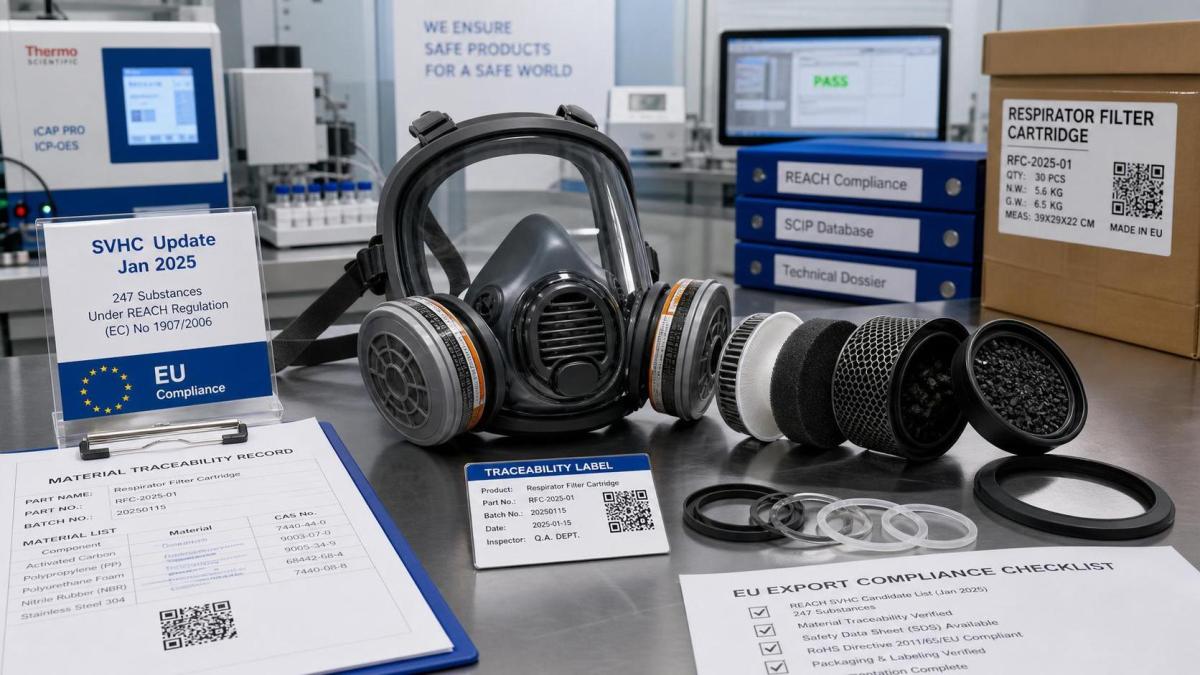
On July 13, 2026, the European Chemicals Agency (ECHA) updated the SVHC list by adding 12 substances, including fluoropolymer degradation products and metal complexing agents. According to the provided event summary, three of these substances are directly used in adsorption layers and sealing gasket materials for industrial respirator and gas mask filters. For companies exporting respiratory protective equipment to the EU, the key issue is no longer only material selection, but whether supplier communication, compliance documentation, and CE technical files can be updated within the stated deadlines. This is why the change deserves close attention across manufacturing, certification, import, and delivery workflows.
What the July 13 Update Confirmed
The confirmed facts are limited to the information provided in the event summary. ECHA updated the SVHC list on July 13, 2026, and added 12 new substances. These include fluoropolymer degradation products and metal complexing agents. Among them, three are directly linked to materials used in industrial gas mask and respirator filter adsorption layers and sealing gaskets.
The same summary states that supply chain notification must be completed within 60 days from publication, and CE technical documentation must be updated by October 15, 2026. The adjustment directly affects the compliance pathway for Chinese manufacturers exporting respiratory protective equipment to the EU, and it also affects customs access for importers.
Where the Compliance Pressure Will Appear First
Material and component sourcing will move to the front of the review process
From an industry perspective, manufacturers and procurement teams are likely to feel the impact first at the raw material and component level. Because the confirmed change involves substances used in filter adsorption media and sealing materials, companies will need to check whether current formulations, purchased parts, or upstream declarations are still aligned with the new SVHC status. The practical pressure point is not only product design, but also whether supplier notifications and supporting material disclosures can be gathered in time.
Export documentation and CE files become a near-term delivery issue
For exporters and compliance teams, the stated October 15, 2026 deadline makes technical documentation an immediate operational matter. Analysis shows that any shipment plan tied to CE documentation, product files, or importer review may face added scrutiny if the material information in the technical file is outdated. The issue is especially relevant where documentation, declarations, and product specifications are prepared by different parties across the supply chain.
EU importers and customs-facing parties will need cleaner file alignment
Importers and supply chain service providers are also exposed because the event summary explicitly links the change to customs access in the EU. What deserves closer attention is whether importer-side records, supplier notifications, and technical file references remain consistent once the SVHC update has taken effect. Even without further execution detail in the input, the business implication is clear: document mismatch can become a trade access problem rather than a purely internal compliance matter.
Testing, certification, and after-sales support may face follow-on requests
Certification-related service providers and after-sales teams may also see additional workload. Observably, where a listed substance is tied to a filter material or sealing part, downstream customers may request refreshed declarations, revised technical descriptions, or supporting compliance evidence before accepting deliveries or continuing procurement. The input does not confirm any new testing protocol, so this should be understood as a possible workflow consequence rather than an established requirement.
What Companies Should Watch in the Next 60 Days
Check substance exposure in filter media and sealing materials
Analysis shows that the first practical step is to identify whether any affected filter adsorption layers or sealing gasket materials are connected to the newly added SVHC substances referenced in the event summary. For manufacturers, this is a materials traceability task before it becomes a certification task.
Prepare supply chain notifications without waiting for downstream pressure
The 60-day notification requirement stated in the provided summary makes supplier communication a time-critical issue. Companies involved in export, OEM production, or component supply should closely track whether existing declarations, material disclosures, and customer notification records are complete enough for this update. The input does not provide a detailed notification format, so the main point at this stage is readiness and traceability.
Review whether CE technical files need immediate revision
Because the event summary gives a firm date for CE technical documentation updates, certification and regulatory teams should examine whether current files still accurately describe affected materials, component composition, and related compliance statements. This is particularly important for products already in export circulation or scheduled for near-term delivery to EU customers.
Watch for changes in procurement terms and importer requirements
It is more appropriate to understand this as a rule change that may quickly pass into commercial execution. Buyers, importers, and channel partners may begin asking for updated declarations, revised technical files, or additional supplier confirmations. The input does not confirm how uniformly the market will respond, so companies should treat this as an area requiring active monitoring rather than a settled outcome.
How This Should Be Read at This Stage
Observably, this development is more than a routine chemical list update for the respiratory protection segment because the provided summary directly links three newly listed substances to core filter and sealing materials. Analysis shows that the immediate significance lies in execution deadlines: one for supply chain notification and another for CE document revision. That gives the change the character of an active compliance signal rather than a distant policy discussion.
At the same time, it would be premature to treat every downstream consequence as already fixed. The input does not provide detailed enforcement practice, importer review criteria, tender wording, or customs operating guidance. For that reason, this is better understood as a confirmed rule-triggering event with several execution details still worth watching.
The More Practical Reading for the Market
The industry significance of this update lies in its timing and its material specificity. The confirmed facts point to a short compliance window for supply chain notification and a defined deadline for CE technical file updates, both of which can affect exports of respirators and gas masks to the EU. For manufacturers, importers, and compliance service providers, the immediate issue is file alignment and material traceability rather than broad strategic repositioning.
Current observation suggests that this news is best read as a landed compliance change with direct operational consequences, while the precise market response still requires continued attention. That includes how certification reviews, importer expectations, procurement documentation, and delivery screening may evolve in practice.
Basis of This Article and What Still Needs Verification
This article is based on the user-provided news title, event date, and event summary. For developments of this kind, commonly relevant source categories include official notices, regulatory agency releases, customs or trade authority information, industry association updates, standard-setting documents, and reporting from established professional media. A specific official source link was not provided in the input, so that part still requires further verification.
What still needs ongoing observation includes any detailed implementation language, certification interpretation, importer-side documentation expectations, tender file changes, market feedback, and the pace of company-level execution after the stated deadlines begin to apply.
Recommended News