
Search News
Industry Portal
Hot Articles
India BIS Expands Mandatory Scope for Cut-Resistant Kevlar Gloves
Time
Click Count
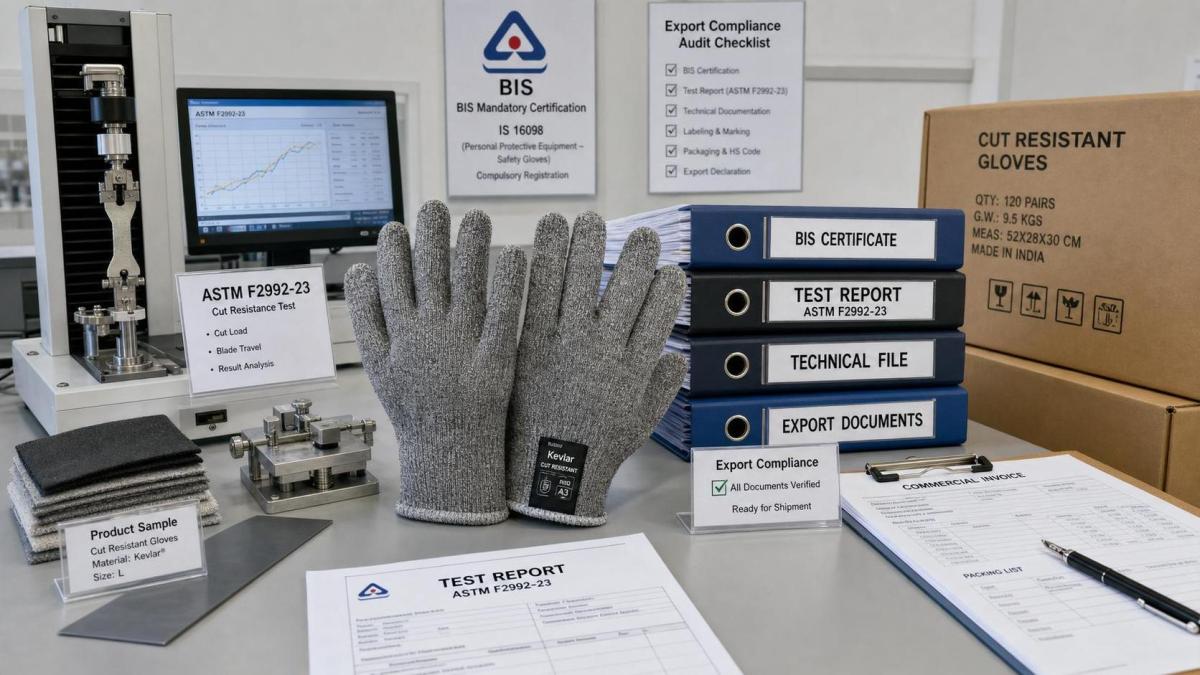
On July 4, 2026, the Bureau of Indian Standards (BIS) introduced an immediate compliance change for cut-resistant Kevlar gloves by bringing the product into the mandatory certification scope of IS 17867:2023 and requiring each imported batch to carry a third-party ASTM F2992-23 cut resistance report from a BIS-recognized laboratory. For importers, exporters, manufacturers, testing parties, and procurement teams handling protective gloves, this is not just a standards update; it directly affects product qualification, shipment readiness, documentation review, and delivery planning.
What the July 4 Notice Actually Requires
According to the provided event summary, BIS issued notice Ref: BIS/CMTR/2026/0742 on July 4, 2026. The notice formally places Cut-resistant Kevlar Gloves within the mandatory certification scope under IS 17867:2023.
The same notice also requires all imported batches to be supported by an ASTM F2992-23 cut index test report showing the TDM value, and that report must be issued by a BIS-recognized laboratory.
The minimum acceptable level stated in the provided information is Level F, defined as at least 2500g. The rule takes effect immediately, and the provided summary states that there is no transition period.
Where the Pressure Will Show Up First
Import-side shipment clearance and document control
From an industry perspective, import-facing businesses are likely to feel the change first because the new requirement is tied to every imported batch. That means compliance is no longer limited to broad product qualification; batch-level paperwork becomes a direct operational checkpoint. What deserves closer attention is whether internal document review processes, supplier submissions, and shipment release checks are already structured to verify a BIS-recognized laboratory report under ASTM F2992-23 before dispatch or entry procedures begin.
Manufacturing and export preparation before goods move
For manufacturers and export suppliers serving the Indian market, the rule change raises the practical threshold for market access. Analysis shows that product claims around cut resistance now need to align not only with commercial specifications but also with the required test pathway and minimum Level F threshold. This can affect pre-shipment testing arrangements, technical file preparation, and the handoff between production, quality, and export documentation teams.
Procurement and buyer-side specification management
Procurement teams and industrial buyers may also need to tighten specification language for cut-resistant Kevlar gloves intended for India-bound supply. Observably, the new rule changes what counts as an acceptable procurement package: a glove that meets a buyer's functional expectation may still face compliance issues if the required ASTM F2992-23 report from a BIS-recognized laboratory is missing or the declared cut performance falls below Level F. This creates a closer link between sourcing decisions and regulatory screening.
Testing and certification support functions
Certification-related service providers and testing support parties are likely to see immediate operational relevance because the notice explicitly names both the test standard and the laboratory recognition condition. From a workflow standpoint, this shifts attention to report validity, laboratory eligibility, and whether supporting compliance files are assembled early enough to avoid delaying shipments or acceptance procedures.
What Companies Should Check Now
Review whether current glove models are matched to the new threshold
Analysis shows that companies supplying Cut-resistant Kevlar Gloves into India should first confirm whether the products they intend to ship can be supported by an ASTM F2992-23 report meeting at least Level F (>=2500g). This is a basic eligibility question under the provided summary, especially because the rule is described as taking effect immediately.
Recheck batch documentation before shipment scheduling
What deserves closer attention is the batch-specific nature of the import requirement. Businesses should examine whether their existing shipping files, commercial handover documents, and compliance review steps are designed to capture the required third-party report for each imported batch. Where this is not yet built into the process, delivery timing may become more sensitive to documentation readiness.
Align supplier qualification with laboratory recognition requirements
Observably, supplier management now involves more than confirming product type and claimed performance. The provided information makes the BIS-recognized laboratory condition a central part of compliance. Companies should therefore pay attention to whether suppliers can consistently obtain reports from the required testing channel rather than relying on generic or previously accepted testing materials.
Track follow-up wording and market-side implementation
The event summary does not provide further execution detail beyond the immediate effective date and no-transition approach. For that reason, it is more appropriate to treat downstream enforcement practice, documentation review intensity, and market-side acceptance handling as areas that still require close monitoring rather than settled outcomes.
Why This Looks More Like an Execution Signal Than a Draft Policy
Analysis shows that this development is better understood as a rule already entering the operational stage, not as an early policy discussion. Two details in the provided information support that reading: the gloves are formally brought into a mandatory certification scope, and the notice applies immediately without a transition period. At the same time, observably, the market still needs to watch how consistently the testing, certification, and shipment review expectations are applied in practice. That is why the current priority is less about debating policy direction and more about checking readiness across product qualification, test documentation, and trade execution.
How the Market May Need to Read This Change
In practical terms, this update signals a higher compliance threshold for Cut-resistant Kevlar Gloves entering India, with the strongest immediate effects likely to appear in certification files, testing arrangements, import documentation, and shipment planning. It is more appropriate to understand this as a landed regulatory change with immediate operational consequences, while still recognizing that specific enforcement patterns and market feedback remain areas for continued observation.
Basis of This Article and What Still Needs Verification
This article is based on the user-provided news title, event date, and event summary concerning the BIS notice issued on July 4, 2026. For developments of this kind, commonly relevant source types may include official regulatory notices, publications from supervisory authorities, customs or trade administration updates, industry association notices, standards organization documents, and reporting by authoritative trade media.
No specific official source link was provided in the input, so the exact official publication link remains to be verified on an ongoing basis. Observably, the areas that still warrant continued checking include any further policy detail, certification enforcement interpretation, changes in tender or procurement documentation, industry feedback, and how companies implement the requirement in actual trade and delivery workflows.
Recommended News