
Search News
Industry Portal
Hot Articles
DALI Protocol Basics for Smarter Lighting Control
Time
Click Count
Why DALI matters in smarter lighting control
Understanding the DALI protocol starts with a simple shift in perspective. Lighting is no longer only about turning fixtures on and off.
In commercial and industrial spaces, lighting now supports efficiency, safety, comfort, and data-driven building operations.
That is why the DALI protocol has become a practical foundation for smarter lighting control, especially in projects that expect long-term flexibility.
Within the broader SHSS view of smart hardware and urban resilience, lighting sits beside security, structural hardware, and protective systems.
It is one of the physical layers that quietly keeps buildings usable, efficient, and dependable every day.
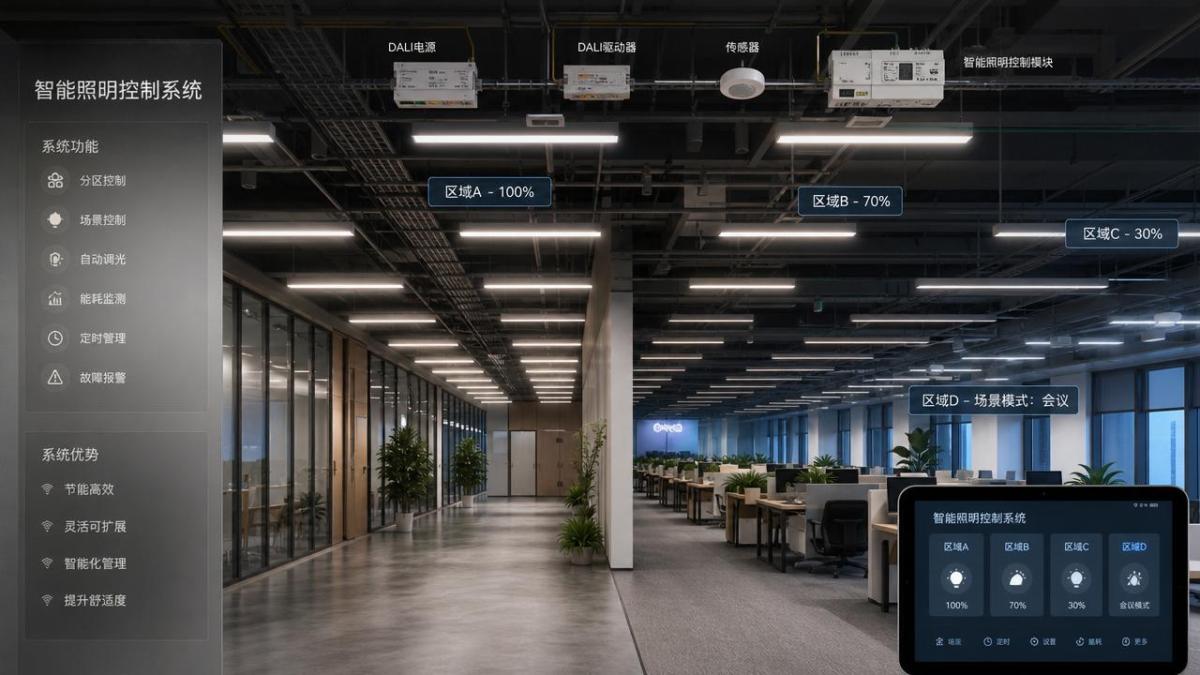
For research, planning, or system comparison, DALI is worth attention because it links ordinary LED equipment with intelligent control logic.
That connection supports dimming, grouping, scene setting, fault feedback, and future expansion without rebuilding the entire lighting network.
A practical definition of the DALI protocol
The DALI protocol, short for Digital Addressable Lighting Interface, is a communication standard for lighting control systems.
Instead of sending only a basic power signal, it allows controllers and luminaires to exchange digital commands and status information.
Each compatible device can be addressed individually, assigned to groups, or included in preconfigured scenes.
In practical terms, this means one office floor does not need to behave as one fixed lighting block.
Different zones can respond to occupancy, daylight levels, schedules, or operating hours with much finer control.
The DALI protocol is often used with LED drivers, sensors, gateways, application controllers, and building management systems.
It does not replace every building protocol, but it provides a dedicated language for lighting devices to work together more intelligently.
What makes it different from simple switching
Traditional switching treats fixtures like one-way electrical loads. Commands are limited, and feedback is usually absent.
The DALI protocol adds two-way communication. A system can dim lights precisely and also report lamp or driver status.
That extra visibility matters in large facilities where maintenance time, uptime, and operating costs all need tighter control.
Why the industry keeps focusing on DALI
Interest in the DALI protocol is growing because lighting has moved into the center of AIoT and smart building strategies.
Energy targets are stricter. Occupants expect comfort. Facility teams want actionable data instead of isolated equipment.
At the same time, smart cities and industrial sites need infrastructure that can evolve without constant rewiring.
This fits closely with the SHSS perspective on connected physical systems, where lighting is not separate from safety or operational discipline.
A well-designed lighting network supports security visibility, shift productivity, emergency readiness, and lifecycle cost control.
In other words, DALI remains relevant because it solves both technical and operational problems at the same time.
Where the DALI protocol creates business value
The value of the DALI protocol is rarely limited to one energy report or one dimming function.
Its real strength appears over time, when buildings need to adapt without losing control quality.
In offices, the DALI protocol helps align lighting with occupancy and daylight, reducing unnecessary consumption.
In warehouses, it improves visibility by zone while avoiding full-output lighting in low-activity aisles.
In hospitals, schools, and public buildings, scene control supports comfort, task changes, and more predictable operating conditions.
For municipal or campus-scale lighting, the DALI protocol also supports lifecycle thinking.
That matters when decision-making depends on durability, maintenance intervals, and return on infrastructure investment.
This is consistent with the SHSS focus on systems that combine resilience with efficient empowerment, not only headline innovation.
Value beyond the fixture itself
- Improves control precision across open offices, corridors, production lines, and mixed-use spaces
- Supports easier adjustments when layouts, tenancy, or operating schedules change
- Creates cleaner maintenance workflows through fault reporting and device-level visibility
- Strengthens long-term compatibility with smart building and AIoT strategies
Typical applications across buildings and infrastructure
The DALI protocol appears in many settings because lighting requirements vary sharply between environments.
A retail floor needs visual consistency. A factory needs task clarity and reliability. A data center prioritizes operational discipline.
Those differences are exactly where addressable lighting control becomes useful.
Common deployment contexts
- Commercial offices with daylight harvesting, meeting room scenes, and after-hours zoning
- Industrial facilities requiring durable, consistent illumination and lower waste during partial occupancy
- Healthcare and education spaces where comfort, scheduling, and room function change frequently
- Hospitality and retail environments where atmosphere and energy control must coexist
- Urban projects and smart campuses that need scalable lighting infrastructure with centralized oversight
In many of these cases, DALI works best when paired with sensors, gateways, and careful commissioning.
The protocol is not magic by itself. Results depend on how clearly the control strategy matches the site.
What to check before choosing a DALI-based system
A useful review goes beyond asking whether a product is DALI-compatible.
The better question is whether the full lighting architecture can deliver the intended outcome with manageable complexity.
Key evaluation points
- Control scope: confirm whether the goal is fixture-level control, group control, scenes, or building-wide integration
- Device compatibility: verify drivers, sensors, controllers, and software can communicate reliably on the same system
- Commissioning needs: check how devices are addressed, tested, and reconfigured during future space changes
- Maintenance visibility: review what status data can be reported and how faults are presented
- Expansion path: assess whether the DALI protocol setup can connect with larger automation or IoT platforms later
It is also worth separating marketing language from control reality.
Some systems promise intelligence, but offer limited flexibility once the site actually changes.
A stronger DALI protocol strategy keeps future reconfiguration in mind from the start.
How to use this knowledge in the next evaluation step
A good next step is to map lighting goals before comparing brands or components.
That includes identifying zones, occupancy patterns, daylight conditions, maintenance expectations, and integration priorities.
From there, the DALI protocol can be assessed as part of a wider smart hardware strategy rather than a standalone feature.
This approach is especially useful in the SHSS context, where lighting must often align with access control, safety planning, and long-life infrastructure decisions.
When the research process stays grounded in actual operating needs, the DALI protocol becomes easier to judge on real value.
Not every site needs the same control depth, but most modern projects benefit from clearer visibility, better flexibility, and scalable performance.
That is the most practical reason to keep DALI on the shortlist when planning future-ready lighting control.
Recommended News