
Search News
Industry Portal
Hot Articles
BLDC Motor vs Brushed Motor: Key Performance Differences
Time
Click Count
Choosing between a BLDC motor and a brushed motor affects far more than a spec sheet. It shapes runtime, heat, noise, maintenance intervals, control accuracy, and long-term ownership cost.
That matters across industrial tools, access control devices, smart lighting systems, and compact safety equipment. In these categories, motor choice often determines whether a product feels merely functional or truly reliable.
For platforms like SHSS, where performance, durability, and operational security intersect, the BLDC motor has become a recurring benchmark. The comparison with brushed designs is no longer academic; it is a practical decision point.
Why this comparison now carries more weight
Electrified tools and connected hardware now work under tighter energy budgets and higher duty cycles. Small efficiency gains can translate into meaningful improvements in uptime and thermal stability.
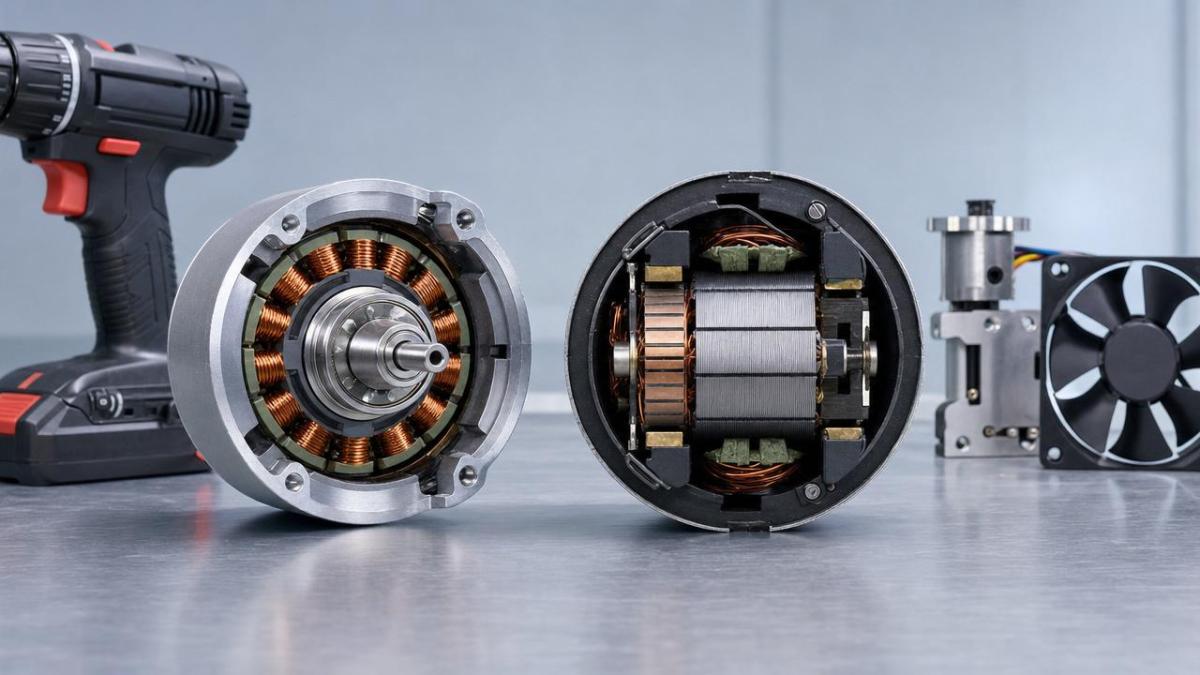
In handheld fastening tools, a BLDC motor helps deliver strong torque without excessive weight. In biometric terminals, it can support precise, quiet motion in cooling fans, shutters, or compact actuators.
The same logic appears in smart lighting and urban infrastructure. When systems must run longer, stay cooler, and require fewer service visits, motor architecture becomes a strategic design variable.
The essential difference in motor design
A brushed motor uses mechanical brushes and a commutator to switch current. The contact is simple and proven, but friction and wear are built into normal operation.
A BLDC motor removes that mechanical switching process. Electronic commutation takes over, usually supported by controllers, sensors, or sensorless algorithms.
This design shift changes the whole performance profile. Less friction usually means higher efficiency, lower wear, reduced sparking, and better control at variable speeds.
Brushed motors still have value. They remain attractive where simplicity, low upfront cost, and easy replacement matter more than lifespan or control precision.
Key performance differences that influence real systems
The most useful comparison is not abstract. It should connect motor behavior to the conditions a product will actually face.
In practice, the BLDC motor often wins when lifetime performance matters. The brushed option remains viable when duty cycles are light and budget pressure dominates the decision.
Efficiency and battery impact
Higher efficiency is one of the strongest reasons to choose a BLDC motor. More input energy reaches the shaft instead of turning into waste heat.
That difference is especially visible in cordless tools and mobile security hardware. Better efficiency can extend battery runtime, reduce charging frequency, and improve sustained output under load.
Torque behavior and controllability
Brushed motors can provide useful starting torque, but control quality is usually less sophisticated. A BLDC motor is generally better when output must be stable across varying speeds.
That matters in fastening tools where torque consistency affects joint quality. It also matters in systems where motion precision supports sensing accuracy or user experience.
Heat, wear, and duty cycle
Mechanical brush contact creates wear and heat. Under repeated operation, that can shorten maintenance cycles and limit how aggressively a product can be used.
A BLDC motor usually handles demanding duty cycles better. This is one reason brushless architecture continues to spread across power tools and intelligent infrastructure.
Where each motor type fits best
The right answer depends on the application environment, not on trend alone. Motor selection should reflect operating hours, load variation, service access, and failure consequences.
- Use a BLDC motor for cordless industrial tools with frequent starts, heavy torque demand, and strict thermal limits.
- Use a BLDC motor in smart devices where quiet operation, compact size, and digital control integration improve product value.
- Use brushed motors in simpler products with intermittent use, limited electronic complexity, or short replacement cycles.
- Use brushed designs where purchase cost must stay low and performance penalties are acceptable.
From the broader SHSS perspective, this distinction aligns with product mission. Tools, secure entry systems, and smart city assets increasingly favor brushless architectures because service interruption carries operational cost.
Cost is not only the purchase price
A brushed motor often looks attractive on the first quotation. Yet technical evaluation should include controller requirements, energy use, maintenance labor, downtime, and replacement frequency.
The BLDC motor usually needs a more advanced control stage. That raises initial system cost, but the tradeoff may be favorable when products operate daily or in hard-to-service locations.
This is similar to how smart lighting projects are assessed. A higher upfront investment can make sense when lower operating cost and longer lifespan produce a better total return.
Practical checks before making a selection
A useful evaluation process begins with the workload, not the motor label. Several questions quickly clarify whether a BLDC motor is justified.
- How many operating hours will the unit accumulate each day or each year?
- Does torque need to remain consistent across different materials, loads, or environmental conditions?
- Will maintenance access be easy, expensive, or disruptive to site operations?
- Are battery runtime, thermal management, or acoustic limits central to product acceptance?
- Does the application require cleaner electrical behavior near sensors, communications modules, or biometric components?
If several answers point toward durability, efficiency, and control, the BLDC motor usually deserves serious priority. If not, a brushed motor may still be the more rational fit.
A grounded way to move forward
The BLDC motor is not automatically the right answer for every product. It is, however, increasingly the right answer for systems expected to run longer, smarter, and with fewer interruptions.
For any comparison between BLDC motor and brushed motor options, start with duty cycle, control needs, service conditions, and life-cycle cost. Then test those assumptions against real operating scenarios.
That approach creates clearer decisions for industrial tools, secure hardware, and connected infrastructure alike. It also builds a more durable basis for future product planning, specification reviews, and supplier discussions.
Recommended News