
Search News
Industry Portal
Hot Articles
Saudi SASO Tightens Smart Street Lighting IoT Rule
Time
Click Count
On July 2, 2026, Saudi Arabia’s Standards, Metrology and Quality Organization (SASO) issued a revision that raises the compliance threshold for imported smart street lighting systems. From August 1, 2026, affected products will need to arrive with a pre-integrated DALI-2 bidirectional gateway aligned with IEC 62386-102:2025 and complete type testing through a SASO-recognized local laboratory. For exporters, manufacturers, firmware teams, and shipment compliance functions, this is worth close attention because the change connects product architecture directly to customs clearance.
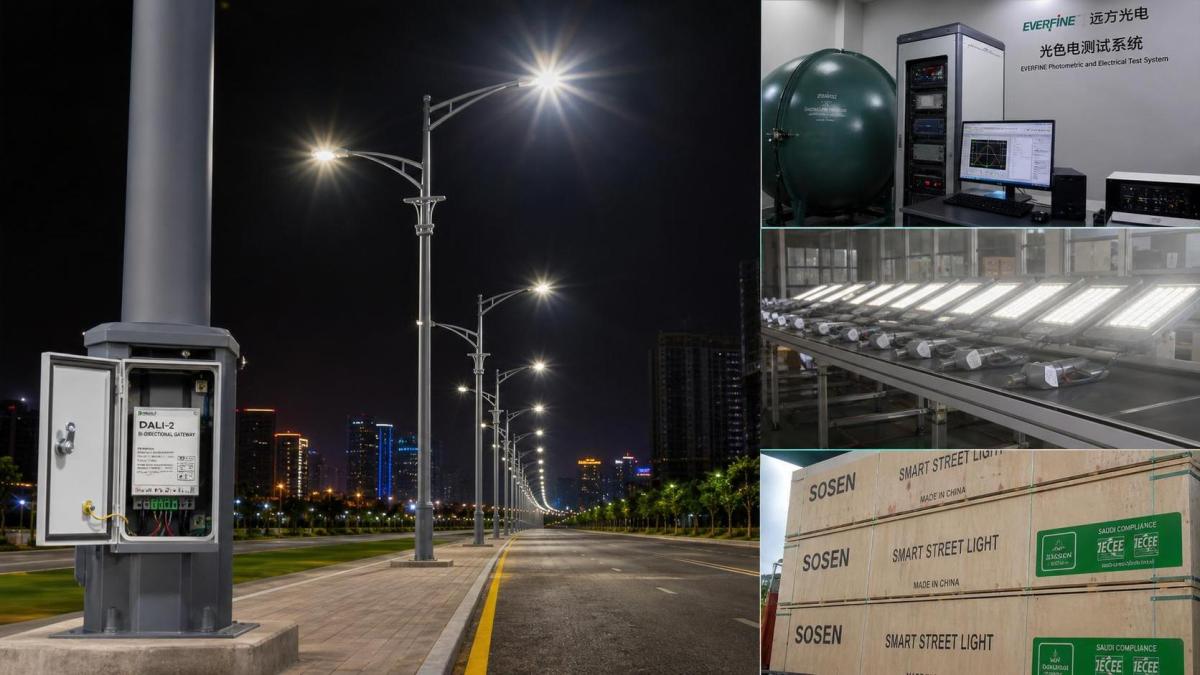
What the revised requirement confirms
The confirmed facts are limited but commercially significant. SASO released the SASO-SG-LED-2026 revision notice on July 2, 2026. The notice states that all imported smart street lighting systems will, from August 1, 2026, be required to include a pre-installed DALI-2 bidirectional gateway that complies with IEC 62386-102:2025. It also requires type testing to be completed by a local laboratory recognized by SASO. The provided information further indicates that non-compliant equipment will not be able to clear customs.
Where the operational pressure is likely to appear
Export-facing product suppliers
From an industry perspective, exporters selling smart street lighting systems into Saudi Arabia are likely to feel the most immediate effect because the new rule is tied to import eligibility. The pressure point is not only documentation; it also reaches product configuration, shipment readiness, and order acceptance for products intended for the Saudi market.
Manufacturing and engineering teams
Analysis shows that the revision may affect design and production workflows because the gateway must be pre-integrated rather than added later in the channel. The provided information also points directly to firmware upgrades and factory testing processes, which means engineering validation and production release controls are likely to require review before shipment.
Testing and compliance functions
Observably, laboratory access and certification sequencing become a more important business step under this rule because type testing must be carried out by a SASO-recognized local laboratory. For compliance managers and trade operations teams, the key issue is whether current product files, test plans, and shipment schedules still align with the revised entry requirement.
Procurement and project delivery counterparts
Buyers, contractors, and downstream delivery partners may also need to pay attention where imported systems are already scheduled for delivery. The likely impact is concentrated in specification matching, acceptance conditions, and shipment timing, especially when products were designed or ordered under earlier assumptions.
What companies should review now
Check whether Saudi-bound models require design changes
What deserves closer attention is whether each smart street lighting system intended for Saudi Arabia already includes a compliant DALI-2 bidirectional gateway at the product level. This is a practical review point because the requirement is framed around pre-integration, not a later retrofit at the import stage.
Reassess firmware and factory test readiness
The provided information explicitly mentions firmware upgrades and ex-factory testing. Companies should therefore review whether existing firmware versions, validation records, and final inspection procedures remain suitable for Saudi-bound shipments after August 1, 2026.
Verify certification path and shipment timing
Analysis shows that the rule change is not only technical but procedural. Businesses should track whether the required type testing through a SASO-recognized local laboratory can be completed within delivery commitments, and whether current shipment plans expose goods to customs risk if compliance work is incomplete.
Align customer and supplier communication
For sales, sourcing, and delivery teams, a practical focus is to make sure product specifications, lead times, and compliance responsibilities are clearly communicated across suppliers and customers. This matters because the consequence described in the provided information is a customs clearance barrier, not merely a paperwork correction.
How this update is best interpreted at this stage
Observably, this is more than a routine wording adjustment because it links a specific technical component requirement with local type testing and an immediate trade consequence. At the same time, it is more appropriate to understand this as a concrete compliance change rather than a broad market forecast. The facts provided do not support wider conclusions about market size, procurement direction, or future policy expansion. What they do support is a clear signal that product-level interoperability and certification readiness now matter directly in Saudi import execution for smart street lighting systems.
Why the market should keep watching
The near-term significance lies in execution. The effective date is close to the announcement date, and the requirement touches product design, firmware preparation, testing arrangements, and shipment release. From an industry perspective, this is best understood as an immediate compliance adjustment with possible longer-term implications if similar technical and testing requirements become more tightly embedded in market access rules. For now, the most rational reading is that companies involved in Saudi-bound smart street lighting should treat it as an active operational requirement rather than a distant policy signal.
Basis of this article
This article is based on the user-provided news title, event date, and event summary. For this type of industry update, relevant source categories typically include official regulatory notices, company announcements, industry association releases, authoritative media reports, and standard organization documents. No specific official source link was provided in the input, so the exact document path still requires ongoing verification. Continued attention should be given to any further SASO wording updates, implementation clarifications, and related laboratory testing requirements connected to this revision.
Recommended News