
Search News
Industry Portal
Hot Articles
How to choose a facial recognition access control reader
Time
Click Count
Choosing a facial recognition access control reader involves more than comparing recognition speed and price. Technical evaluators must assess accuracy across lighting conditions and user populations, presentation attack detection, integration with existing access control systems, and performance at expected traffic volumes.
Data protection, cybersecurity, and deployment requirements are equally important, particularly where biometric processing is subject to strict regulations. This guide outlines the key criteria for evaluating readers, validating vendor claims, and selecting a solution that fits your facility’s security and operational needs.
The strongest choice is a reader that meets documented security and throughput requirements during an on-site pilot, integrates safely with the existing system, and supports a defensible approach to biometric data.
Start with the door, the threat, and the user journey
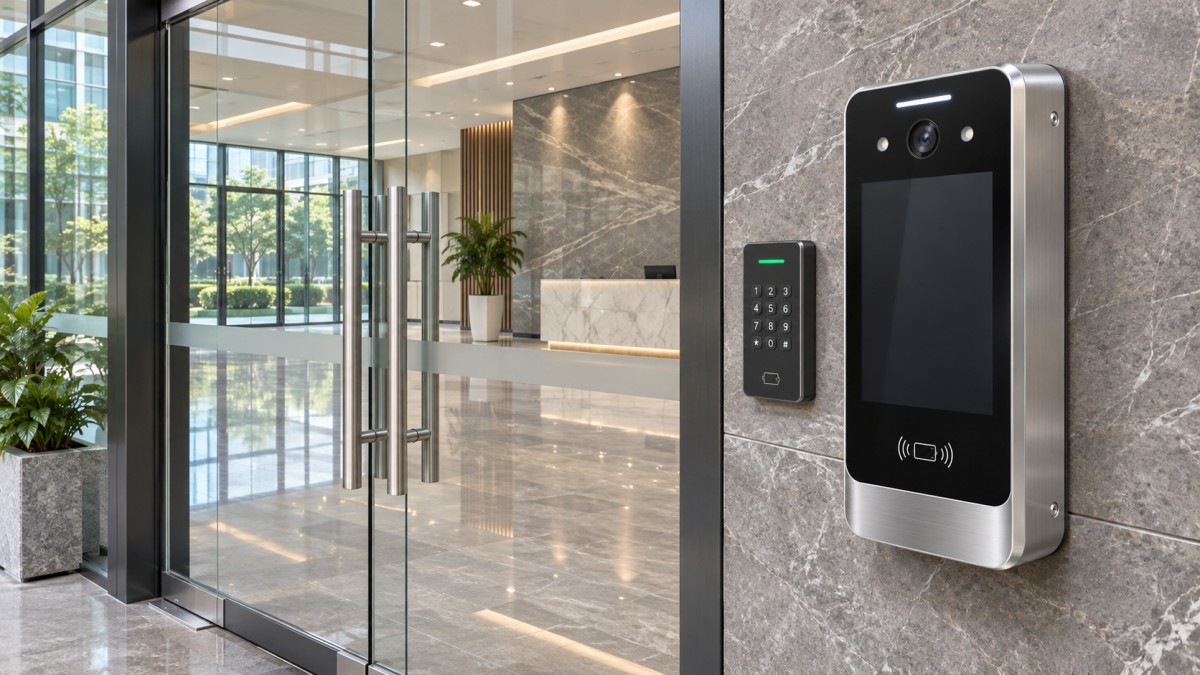
Define the access point before comparing products. A busy office lobby, an industrial entrance, and a data center portal differ in traffic, environmental exposure, and consequences of unauthorized entry.
Record who needs access, when they arrive, how exceptions are handled, and whether the reader controls entry, exit, or both. Include contractors, visitors, and people who cannot enroll.
Specify the threats that matter: an unauthorized person using a photograph, a stolen credential combined with someone else’s face, tailgating, or an attacker manipulating network traffic.
Face recognition addresses only part of that threat model. Door monitoring, anti-tailgating measures, credential management, and appropriate physical barriers may be equally important to the outcome.
Decide whether users will present a card or mobile credential before facial verification. This one-to-one comparison can reduce search requirements and support a clearer user experience.
Alternatively, one-to-many identification searches enrolled records without a presented identity. It can simplify entry, but requires careful evaluation of search accuracy, database size, privacy, and applicable law.
How accurate is the access control reader in your environment?
Request performance figures for both false matches and false non-matches, including the operating threshold, test population, sample size, and capture conditions behind each result.
A false match occurs when the system accepts the wrong person. A false non-match occurs when it rejects the correct person, creating delays and potentially increasing help-desk workload.
These outcomes trade off against each other as thresholds change. A vendor’s best false-match figure and best false-non-match figure may come from different settings.
For one-to-many identification, ask for identification-specific metrics and the size of the enrolled gallery. Results from a small verification test do not establish performance at scale.
Also request failure-to-acquire and failure-to-enroll rates. A reader that produces accurate comparisons after capture may still frustrate users if it struggles to obtain usable images.
Review independent evaluations where available, including relevant results from the U.S. National Institute of Standards and Technology. Confirm that the tested algorithm version matches the proposed product.
Algorithm benchmarks do not validate an entire installed reader. Camera placement, image quality, lighting, software configuration, and user behavior can materially change field performance.
During a pilot, include representative users and ordinary conditions: glasses, changes in facial hair, different heights, backlighting, low light, and the protective equipment your site requires.
Assess performance across relevant demographic groups, subject to lawful and appropriate data handling. Ask vendors how they measure differences and what corrective options exist if gaps appear.
Can it resist presentation attacks and other bypasses?
Presentation attack detection, often called liveness detection, aims to distinguish a live person from an attack presented to the sensor, such as a printed image or replayed video.
Ask which attack types were tested, which sensor configuration was used, and whether testing covered masks or other artifacts relevant to your threat model.
Request independent evidence against applicable standards, such as ISO/IEC 30107-3, including the test scope and results. A statement that a product is “compliant” is insufficient without context.
Examine attack presentation classification error and bona fide presentation classification error together. The first concerns attacks incorrectly accepted as genuine; the second concerns genuine presentations incorrectly classified as attacks.
No sensor technology guarantees detection of every spoof. Infrared, depth sensing, and other methods can add useful signals, but their effectiveness depends on implementation and testing.
Presentation attack detection also does not automatically address injected camera feeds, compromised firmware, or a person following an authorized user through an open door.
For sensitive areas, consider a second factor such as a card or PIN, together with supervised entry or a portal designed to limit tailgating.
Will it integrate securely with your existing access system?
Map the entire decision path: image capture, biometric comparison, access policy evaluation, controller authorization, door relay operation, and event logging. Identify the owner of each component.
Determine whether the reader makes the access decision locally or sends a result to a controller or server. Confirm behavior when connectivity or the central platform fails.
Check supported interfaces, protocol versions, credential formats, and compatibility with the exact controller and software release already deployed. Request a tested integration matrix.
Where supported by both devices, OSDP Secure Channel can protect reader-to-controller communications. Verify configuration, key management, and interoperability rather than assuming encryption is enabled.
Legacy Wiegand connections may be present, but typically lack built-in encryption and authentication. If they are unavoidable, assess exposure and compensating physical and system controls.
Confirm how enrollment, revocation, schedule changes, and access events synchronize. Measure propagation time, particularly when an employee leaves or a credential must be disabled.
Ask whether logs distinguish successful recognition, denied access, failed capture, device faults, and administrative changes. Define how events reach the organization’s monitoring platform.
What happens during outages, peak traffic, and emergencies?
Recognition speed alone does not determine door throughput. Measure the full transaction from approach to door release, including user positioning, retries, controller response, and physical passage.
Test arrival surges at shift changes and record queue length, successful passages per minute, and the proportion of people requiring assistance. Include realistic enrollment and access rules.
Define acceptable outcomes before testing. For example, set a maximum queue time and a minimum successful-entry rate based on the site’s staffing and operational constraints.
Check local capacity for enrolled users and event storage, including what happens when either limit is reached. Confirm synchronization behavior after a network interruption.
Document offline access rules, backup power requirements, and recovery procedures. A reader that works offline still needs an explicit policy for revoked users and stale permissions.
Coordinate locking behavior and emergency release with the building’s fire and life-safety requirements. The appropriate fail-safe or fail-secure design depends on the door and applicable codes.
Provide an accessible, non-biometric alternative with a clear escalation process. Test the alternative during normal operations so that users are not stranded when recognition fails.
Can you justify and govern biometric data processing?
Determine what the system captures and stores: raw images, biometric templates, identifiers, access events, and diagnostic data. Ask where each item resides and who can access it.
A template is still sensitive biometric information in many contexts. Encryption and local processing can reduce exposure, but neither automatically removes legal or governance obligations.
For deployments subject to the EU GDPR, assess the applicable lawful basis under Article 6 and, where facial data is processed for unique identification, an appropriate Article 9 condition.
Do not assume employee consent is sufficient: it may not be freely given where an imbalance of power exists. Obtain jurisdiction-specific legal advice before committing to the design.
Assess necessity and proportionality against less intrusive alternatives, and determine whether a data protection impact assessment is required. Local employment and biometric laws may add obligations.
Set retention periods for templates and logs, define deletion triggers, and verify how backups, replicas, and vendor systems are handled when a person leaves.
Review processor contracts, subprocessor access, support access, and international transfers where relevant. Ensure the organization can respond to applicable individual rights requests and incidents.
Which cybersecurity and maintenance details deserve scrutiny?
Ask for a current software bill of materials or equivalent component information, a vulnerability disclosure process, patch timelines, and a documented product support period.
Verify secure boot, signed firmware updates, administrative access controls, and encryption in transit and at rest. Request configuration guidance and evidence appropriate to the deployment.
Test whether default credentials must be changed, whether administrative actions are logged, and whether unnecessary services can be disabled. Place devices on an appropriately controlled network.
Clarify who manages certificates, encryption keys, firmware updates, and remote support. A secure feature is less useful if the organization cannot operate it consistently.
Inspect tamper detection and the placement of relays. If an exposed reader directly controls a lock, assess whether someone could bypass the door by attacking the device or wiring.
For outdoor or industrial installations, confirm environmental ratings, operating temperature, ingress protection, mounting height, and cleaning requirements against actual site conditions.
How should you run a meaningful vendor pilot?
Use the same requirements and scenarios for each shortlisted access control reader. Include security staff, facilities, IT, privacy specialists, and a representative group of users.
Agree on the test plan, measurement method, pass criteria, and remediation process before installation. Record the firmware, algorithm version, threshold, and configuration used.
- Accuracy: Measure successful entries, false rejections, failed captures, and exceptions across the conditions and user groups relevant to the site.
- Attack resistance: Review independent test reports and conduct authorized, scoped checks using attack types appropriate to the facility.
- Integration: Test enrollment, permission changes, revocation, event delivery, controller failures, and restoration after an outage.
- Operations: Observe queues at peak times, alternative access, accessibility, cleaning, and the workload created by retries.
- Security and privacy: Verify administrative controls, update procedures, data flows, retention settings, and contractual commitments.
Record both rates and counts. A pilot with few participants or attempts can reveal practical problems, but it cannot substantiate extremely low false-match claims.
Investigate failures before scoring vendors. A mounting adjustment may resolve a capture problem, while a persistent integration limitation may require a different product or architecture.
How do you compare total cost and make the final decision?
Compare the installed cost per door, including controllers, cabling, power, network upgrades, licenses, integration, enrollment, and any changes to the entrance itself.
Add recurring costs for software, support, replacement hardware, security updates, privacy administration, and staff time spent handling rejected entries or alternative credentials.
Ask how pricing changes as users, doors, sites, or integrations increase. Confirm data export options and the practical cost of replacing the platform later.
Weight mandatory security, legal, accessibility, and integration requirements before scoring convenience or price. A low-cost reader that fails a mandatory requirement should not advance.
Choose the solution that meets those requirements in your environment and remains manageable throughout its support life. Preserve pilot evidence and revisit settings as conditions change.
- Last One:No more articles
- Next Article:How to select bridge fasteners for corrosion-prone environmentsNov 22, 2026
Recommended News