
Search News
Industry Portal
Hot Articles
How does 3D structured light depth sensing detect facial depth?
Time
Click Count
How can a security system tell the difference between a real face and a flat photograph? The answer often lies in 3D structured light depth sensing.
This technique projects a known pattern onto the face and analyzes how the pattern changes across its contours. Those changes provide information about facial depth.
The resulting three-dimensional representation can support facial recognition and presentation attack detection. However, depth alone does not guarantee that a face is live or that an access system is secure.
Understanding the measurement process helps researchers evaluate what these systems can detect, where they can fail, and which evidence matters when comparing products.
How does structured light measure the depth of a face?
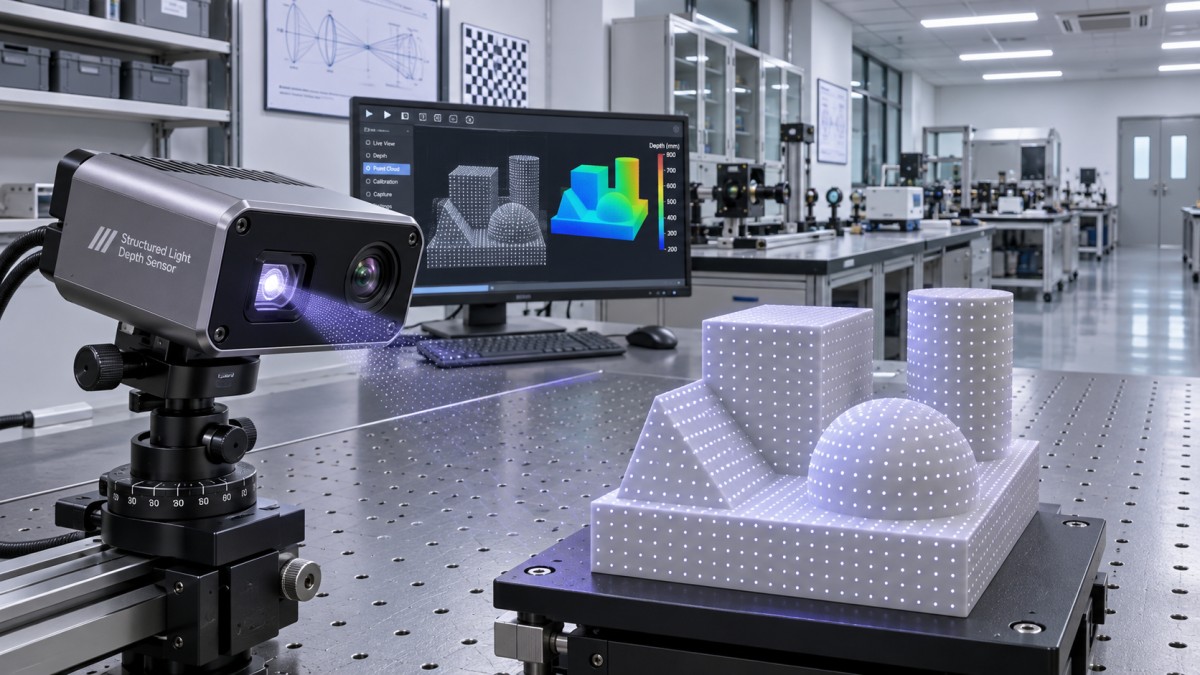
A structured light system projects a known pattern, often infrared dots or stripes, onto a face. An infrared camera captures the pattern from a different position.
Because the projector and camera view the face from different angles, facial contours change where pattern features appear in the camera image. The system uses those changes to estimate depth.
A nose, for example, is closer to the sensor than the ears. Its projected dots therefore appear in positions consistent with a shorter distance from the device.
Software combines many such measurements into a depth map: an image in which each valid pixel or sampled point represents an estimated distance from the sensor.
The resulting map captures the broad shape of the face and, depending on the device, smaller surface details. It is then available to recognition and security algorithms.
The key principle is geometric triangulation. If the system knows the camera and projector positions and can identify corresponding pattern features, it can calculate where those features meet in space.
What happens during a facial depth scan?
A typical scan starts when a person stands within the device’s operating range. The system detects a face and activates an infrared projector and compatible camera.
The projector casts a pattern designed to make locations distinguishable. Some devices use a fixed dot pattern; others use sequences of patterns or different coding methods.
The camera records how the pattern appears on the face. Dedicated processing identifies pattern features or compares the captured image with a calibrated reference.
The processor then estimates correspondence: which observed feature relates to which projected feature. This step is essential because a depth calculation depends on matching the right locations.
Calibration supplies the geometric relationship between projector and camera, along with optical characteristics such as lens distortion. Poor calibration can turn otherwise clear images into inaccurate measurements.
Using these inputs, the system computes depth for valid points. It may filter noisy measurements, reject unreliable regions, and align the face before creating a usable representation.
Finally, separate algorithms can assess whether the sample resembles a live presentation and compare facial features with an enrolled template. The exact order varies between products.
Why does the projected pattern reveal facial shape?
Imagine a projector and camera mounted a short distance apart. A point on the face lies along one camera viewing direction and one projector illumination direction.
When the system establishes the corresponding directions, their geometric intersection gives an estimated three-dimensional position. In practice, calibration and measurement noise make this an approximation.
The apparent shift of a pattern feature is often called disparity. For a given arrangement, points at different distances generally produce different disparities in the captured image.
A simplified relationship is depth approximately equals focal length multiplied by the camera-projector separation, divided by disparity. Real devices also account for calibration and coordinate conventions.
This relationship explains an important trade-off: small disparity errors can produce larger depth errors at greater distances. A device’s useful range therefore depends on its design and accuracy requirements.
Pattern choice matters too. Features must be recognizable enough to match reliably, while remaining dense enough to capture useful detail across cheeks, eyes, nose, and mouth.
Dark, reflective, or partially covered surfaces can reduce usable measurements. The resulting depth map may contain gaps rather than a complete model of every facial feature.
Can a depth map distinguish a real face from a photograph?
A flat photograph usually produces a nearly flat depth surface, even if its printed shading looks convincingly three-dimensional to a normal camera or a person.
A depth-based presentation attack detection algorithm can look for facial contours that a flat image lacks. This makes depth useful evidence against some photo and screen attacks.
However, a depth map measures the presented surface; it does not automatically establish that the surface belongs to a living person. Three-dimensional attacks require further assessment.
A shaped mask, sculpted replica, or other physical model may present face-like contours. Whether a particular attack succeeds depends on the device, materials, and detection methods.
Systems may combine depth with infrared reflectance, texture, motion, or other signals. Each additional signal needs its own validation; combining sensors does not guarantee resistance to every attack.
Some products also ask users to perform an action, such as turning their head. Such checks can provide extra evidence, although their effectiveness depends on implementation.
For a meaningful security claim, ask which attack instruments were tested and under what conditions. A statement that a device detects “spoofs” is too broad to evaluate.
How is depth sensing different from facial recognition?
Depth sensing estimates the shape and distance of a presented face. Facial recognition uses selected features to compare that face with an enrolled identity or a database.
Presentation attack detection addresses another question: whether the sample is an acceptable live presentation rather than an attempt to deceive the biometric capture process.
These functions can share sensor data, but they have different goals and failure measures. A system can estimate depth accurately and still make an incorrect identity decision.
Likewise, a system can reject a known mask while struggling with legitimate users because of poor enrollment, difficult lighting, positioning, or an unsuitable matching threshold.
It helps to think of access as a chain: capture a usable sample, assess the presentation, compare identity, and apply the organization’s authorization rules.
A successful face match does not by itself establish that a person is permitted to enter a particular door. That decision belongs to the access control system.
Does structured light work in darkness and sunlight?
Many facial depth sensors use near-infrared illumination, so they can capture a projected pattern without visible room lighting. This makes darkness practical for suitably designed devices.
Darkness alone does not ensure reliable operation. The face must still be within range and oriented so the camera can see enough of the illuminated surface.
Strong sunlight can be more challenging because it contains infrared radiation. Background infrared may reduce the contrast between the projected pattern and its surroundings.
Optical filters, sensor design, projector power, and processing can improve performance, but outdoor capability varies. Check the manufacturer’s stated conditions and test the intended installation.
Glasses, hair, hats, medical masks, and facial hair can also obscure useful regions or change infrared reflections. The impact depends on the product and coverage.
Movement during capture may blur or misalign measurements, especially when a device uses multiple exposures. A fast scan helps, but published timing should specify test conditions.
Distance and angle matter as well. A reader optimized for a person standing directly in front of a doorway may perform differently with side approaches.
How accurate is 3D structured light depth sensing?
There is no single accuracy figure for all structured light systems. Depth precision depends on distance, calibration, optics, pattern design, surface properties, and environmental conditions.
When reviewing a depth specification, look for the measurement distance, field of view, and whether the reported value describes precision, absolute error, or another metric.
Precision describes how consistently repeated measurements agree. Absolute accuracy describes how close a measurement is to the true distance, often established using a reference target.
Neither figure alone predicts recognition performance. A depth sensor can measure a surface consistently while the complete biometric system still produces false matches or false rejections.
For identity matching, false match rate describes how often different identities are incorrectly matched under specified conditions. False non-match rate describes how often matching samples are rejected.
For presentation attack detection, commonly reported measures include attack presentation classification error rate and bona fide presentation classification error rate, often abbreviated APCER and BPCER.
APCER concerns attacks incorrectly classified as bona fide; BPCER concerns bona fide presentations incorrectly classified as attacks. Both depend on the tested instruments and operating conditions.
Compare results only when thresholds, populations, attack types, and test protocols are clear. A low error rate in one laboratory setup may not transfer to every deployment.
How does structured light compare with other depth methods?
Structured light actively projects a pattern and estimates depth from its observed deformation. It can provide detailed facial shape at short range when conditions suit the device.
Time-of-flight sensing estimates distance from the travel time or phase behavior of emitted and reflected light. Its performance depends on implementation, distance, and environmental interference.
Stereo vision estimates depth from differences between images captured by two cameras. Passive stereo relies on visible scene features and may struggle with low texture or poor lighting.
A conventional two-dimensional camera records appearance rather than directly measuring physical depth. Algorithms can infer shape from images, but inferred depth is not the same measurement.
The best choice depends on the application, operating environment, cost, and independently demonstrated performance. No sensing method alone proves resistance to every presentation attack.
What should researchers check when evaluating a system?
Start with the intended use: device unlock, staffed reception, or unattended access to a sensitive facility. Each setting has different consequences when a system fails.
Ask for the operating distance, permitted face angles, lighting limits, capture time, and behavior when the face is partially obscured. Verify them in representative conditions.
Review recognition performance at the proposed threshold, including both false matches and false non-matches. Request results across relevant user groups and capture conditions where available.
For attack resistance, seek independent testing that identifies the presentation attack instruments, test protocol, error rates, and device configuration. ISO/IEC 30107-3 provides a framework for such testing.
Check whether the report covers the product version and operating mode being considered. A result for one configuration should not automatically be applied to another.
Examine the full system architecture too: sensor integrity, communications, enrollment, template storage, software updates, and administrative access can all affect security beyond the facial scan.
Consider fallback procedures for people who cannot enroll or be recognized reliably. An accessible alternative and a clear process for resolving failures support practical deployment.
Finally, examine how biometric information is collected, retained, accessed, and deleted. Applicable privacy requirements depend on jurisdiction and purpose; technical capability alone does not establish lawful use.
What should you remember about facial depth sensing?
3D structured light depth sensing measures facial shape by projecting a known pattern and using its observed position, together with calibration, to estimate distances.
That depth information can help distinguish a flat image from a three-dimensional face and strengthen presentation attack detection. It cannot independently prove liveness or identity.
The most useful evaluation considers the complete system: tested attack resistance, recognition errors, environmental limits, privacy practices, and the fallback available when a scan fails.
Recommended News