
Search News
Industry Portal
Hot Articles
How to select bridge fasteners for corrosion-prone environments
Time
Click Count
Selecting bridge fasteners for a corrosion-prone environment is not simply a matter of finding the most corrosion-resistant bolt. A connection exposed to deicing salts, marine spray, persistent moisture, or industrial deposits still has to meet its structural strength, fatigue, installation, and inspection requirements. A material or coating that performs well in one respect may introduce a problem elsewhere, such as incompatible thread fit or unreliable pretension.
The most defensible choice is a qualified fastening assembly matched to the connection detail, the local exposure, and the bridge owner’s maintenance strategy. The evaluation below helps technical reviewers compare those choices without treating corrosion protection as a substitute for structural design.
Start with the connection, not the catalog
Before comparing coatings, establish what the joint requires. A pretensioned or slip-critical connection has different installation and verification needs from a snug-tight connection. Fatigue-sensitive details, existing member thicknesses, hole condition, and access for replacement can narrow the field further.
Record these requirements in a connection schedule:
- Structural demand: Required bolt strength, diameter, connection type, applicable load combinations, and fatigue assessment.
- Assembly details: Bolt, nut, washer, thread length, grip length, and any specified coating or lubrication.
- Installation method: Approved pretensioning method, access for tools, and inspection hold points.
- Service constraints: Expected exposure, drainage, inspection access, and consequences of future replacement.
- Governing documents: Bridge owner specifications, design code, referenced fastener standards, and approved deviations.
For US structural steel connections, the Research Council on Structural Connections (RCSC) Specification for Structural Joints Using High-Strength Bolts addresses connection design, installation, and inspection. The applicable edition is the one adopted by the project, not automatically the newest available edition. Source: RCSC, Specification for Structural Joints Using High-Strength Bolts, available at https://www.boltcouncil.org/.
Map corrosion exposure at the joint
A bridge can contain several exposure zones. Bolts beneath a leaking deck joint may remain wet and collect salt even when nearby steelwork looks comparatively clean. Evaluate the individual detail, not just the bridge’s distance from the coast or its regional climate.
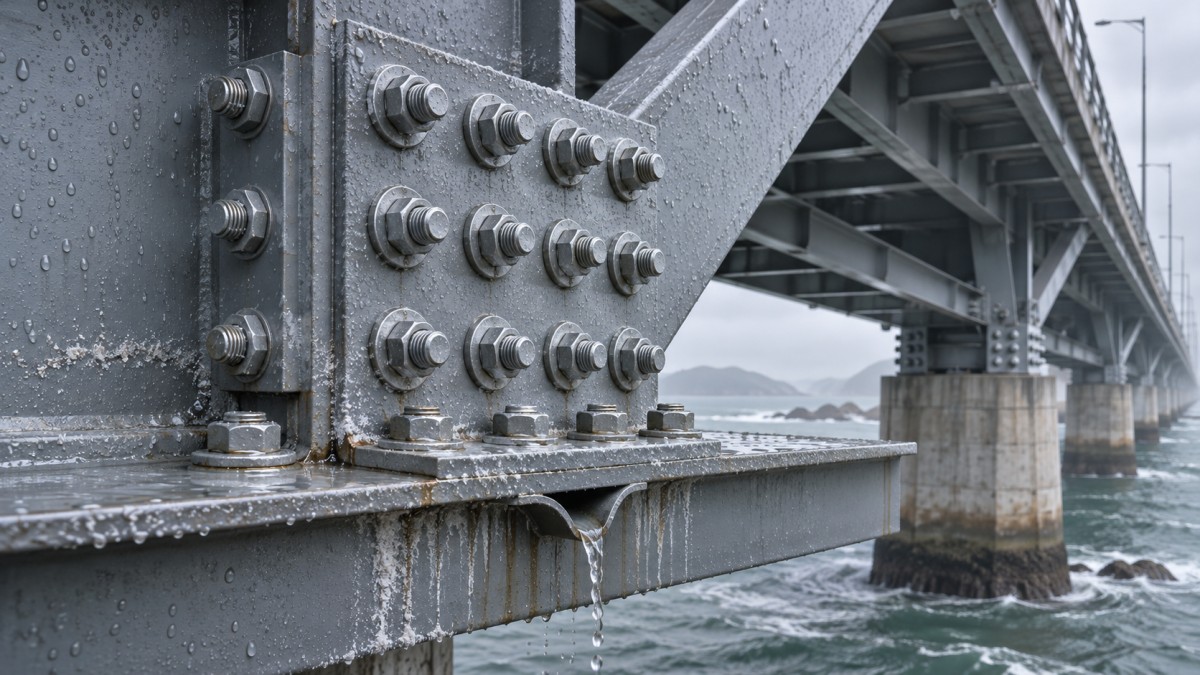
ISO 9223 provides a framework for classifying atmospheric corrosivity; ISO 9224 offers guidance on estimating corrosion effects using such categories. These standards support exposure assessment, but a category alone does not predict the life of a particular bolted assembly in a water-trapping detail. Sources: ISO 9223, https://www.iso.org/standard/53499.html; ISO 9224, https://www.iso.org/standard/53500.html.
Compare bridge fastener systems as complete assemblies
The following comparison is a screening tool, not an approval list. Structural capacity, pretensioning requirements, and the governing specifications decide whether a candidate can be used.
In US procurement, ASTM F3125/F3125M covers several grades of high-strength structural bolts, including grades commonly designated A325 and A490. The project must specify the appropriate grade and permitted coating rather than treating all bolts under the standard as interchangeable. Source: ASTM International, ASTM F3125/F3125M, https://www.astm.org/f3125_f3125m.html.
Do not select stainless steel by corrosion resistance alone
Stainless steel can be a strong candidate in chloride-bearing environments, but “stainless” is a family of alloys, not a single performance class. Chloride concentration, temperature, deposits, and oxygen availability affect the risk of localized corrosion. Confirm the alloy and fastener property class against the actual exposure and design; a general-purpose grade is not automatically suitable for every marine detail.
Stainless threads can also gall during tightening. A lubricant or assembly procedure may reduce that risk, but it can change tightening behavior. Use only a procedure accepted for the specified assembly, especially where pretension is required. ISO 3506-1 addresses mechanical properties of stainless steel bolts, screws, and studs; it does not by itself establish their suitability for a particular bridge connection. Source: ISO 3506-1, https://www.iso.org/standard/76429.html.
Check galvanic and crevice conditions together
When dissimilar metals are electrically connected in the presence of an electrolyte, galvanic corrosion can accelerate attack on the less noble metal. Relative exposed areas, wetness, electrolyte conductivity, and the continuity of protective coatings all matter. A corrosion-resistant fastener in a less noble connected member is not automatically a safe combination.
Isolation may be an option, but insulating sleeves or washers must also satisfy bearing, creep, slip, installation, and durability requirements. Have the connection designer approve the detail rather than adding isolation components in the field. For general galvanic corrosion principles, see the US National Park Service, Galvanic Corrosion, https://www.nps.gov/articles/galvaniccorrosion.htm.
Coating choice affects installation performance
A coating protects the surface, but it also changes the threaded assembly. Coating thickness and nut overtapping affect fit; coating and lubricant influence friction and the relationship between applied torque and bolt tension. Consequently, torque values from an uncoated assembly should not be transferred to a coated assembly without an approved basis.
For a pretensioned connection, ask the supplier and installer to identify the exact bolt, nut, washer, coating, lubrication, and installation method used in qualification. Carry out the project-required preinstallation verification using representative assemblies and equipment. RCSC specifies requirements for installation and preinstallation verification of high-strength bolting assemblies; follow the adopted edition and the bridge owner’s requirements.
Also distinguish protection of the fastener from performance of the faying surfaces. In a slip-critical joint, the condition and treatment of the surfaces between connected plies affect slip resistance. A coating approved for bolts does not automatically qualify a coated faying surface. Confirm the specified surface class and any required coating qualification with the designer.
Screen evidence before approving a substitution
A substitution request should demonstrate equivalence for the whole connection, not merely claim a longer corrosion life. Ask for documentation that can be traced to the supplied assembly and the project’s acceptance criteria.
- Verify identity and mechanical properties. Check grade, dimensions, markings, test reports, and traceability for bolts, nuts, and washers against the purchase specification.
- Confirm the protective system. Identify the coating standard, application process, inspection requirements, and any approved touch-up procedure. Check the relevant component specifications as well as the bolt specification.
- Review assembly and installation evidence. Confirm compatibility, lubrication, thread engagement, and required preinstallation verification for the proposed method.
- Assess corrosion evidence in context. Ask whether testing represents the intended exposure and assembly. Salt-spray results can support quality control or comparison under a defined method, but should not be converted directly into bridge service life.
- Obtain design and owner approval. Resolve structural, fatigue, faying-surface, inspection, and maintenance implications before procurement or installation.
ASTM B117 describes a standardized salt-spray apparatus; its results must be interpreted within the limits of the applicable product specification and test purpose. Source: ASTM International, ASTM B117, https://www.astm.org/b0117.html.
Inspectability can decide between two viable options
If two assemblies satisfy the structural and corrosion requirements, assess what happens after installation. A bolt hidden above a bearing shelf or behind a utility line may be difficult to inspect, clean, or replace. A more accessible detail with controlled drainage can be more manageable than relying solely on a more resistant material in a permanently wet crevice.
Define an inspection baseline at handover. Record the assembly designation, coating, installation method, locations, and any accepted repairs. Future inspectors can then distinguish coating damage, rust staining, loose or missing components, and surrounding steel deterioration from the original condition. Any suspected loss of section or connection distress should be assessed under the owner’s inspection procedures; visible staining alone does not establish remaining capacity.
Frequently asked questions
Can a galvanized bolt replace an uncoated high-strength bridge bolt?
Not without review. The proposed assembly must meet the specified strength, dimensions, coating, nut and washer compatibility, installation, and inspection requirements. Confirm that the grade permits the proposed coating and obtain the required designer and owner approvals.
Is stainless steel always the best choice near the sea?
No. The alloy must resist the actual chloride exposure, and the assembly must also meet structural and installation requirements. Crevice conditions, galling, galvanic interaction, cost of replacement, and approval status can make another qualified system more appropriate.
How should evaluators compare service life claims?
Request the exposure assumptions, test method, acceptance criteria, and inspection history behind each claim. Compare systems at the same connection detail and include cleaning, access, inspection, and replacement in the assessment. Treat unsupported conversions from accelerated test hours to years in service with caution.
- Last One:No more articles
- Next Article:US Treasury Proposes Adding Immigration Status to Financial Identity ChecksNov 21, 2026
Recommended News