
Search News
Industry Portal
Hot Articles
What drives facial recognition access control pricing for offices?
Time
Click Count
Office facial recognition access control pricing is shaped by the full doorway system, the biometric decision process, and the cost of operating that system over time. A low terminal price can conceal substantial work in cabling, door hardware, software licensing, identity enrollment, privacy controls, and integration. Conversely, a higher-priced terminal may reduce recurring infrastructure costs when it processes identities locally and works with the access control environment already installed.
The useful comparison is therefore not a single device quote. It is the cost of securing a defined set of doors, at a defined traffic level, with an agreed response when recognition fails, the network is unavailable, or an enrolled person must be removed from the system.
Terminal hardware reflects the recognition task
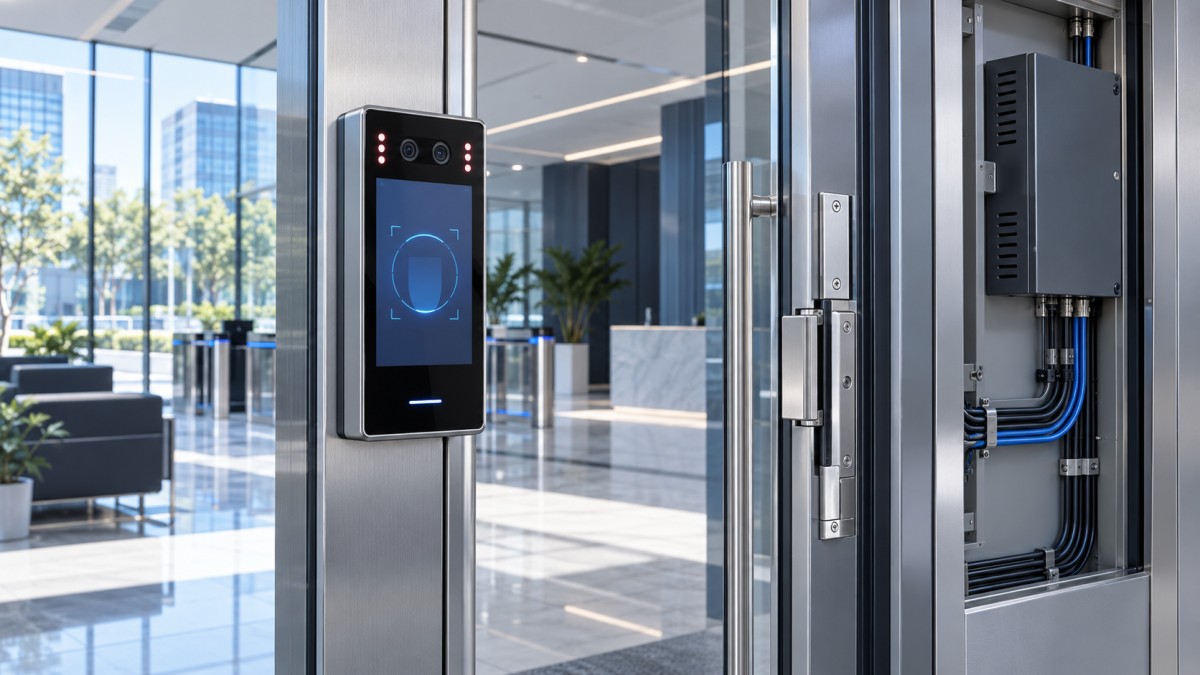
Facial terminals range from basic indoor readers to units designed for difficult entrances, high traffic, or higher-security areas. The visible camera is only part of the hardware. Price changes with the imaging sensors, processing hardware, enclosure, display, illumination, and interfaces fitted behind the faceplate.
A reader placed at a quiet internal office door faces a different operating environment from one installed at a sunlit lobby entrance. Backlight through glass, reflections from polished floors, low ambient light, people approaching at different angles, and queues at shift changes all affect the imaging task. Hardware with controlled infrared illumination, a wider capture range, and faster local processing generally carries a higher cost because it is intended to maintain recognition performance in those conditions.
Enclosure construction also matters. An indoor reader mounted beside a protected reception door does not need the same resistance to rain, dust, temperature variation, or deliberate tampering as a reader at an exposed perimeter entrance. The installation location should determine the enclosure requirement. Specifying an outdoor-grade unit throughout a fully conditioned office can inflate the hardware budget without solving an actual risk; using an indoor unit at an exposed doorway creates replacement and service costs later.
Anti-spoofing is a separate cost driver
A terminal that simply compares a camera image with an enrolled face is less complex than one that evaluates whether a live person is present. Anti-spoofing, often described as liveness detection, may use depth sensing, infrared imaging, structured light, or algorithmic analysis of several image signals. The underlying method affects both unit price and the reliability of access decisions under local lighting conditions.
The specification should describe the threat being addressed. Blocking a printed photograph is different from resisting a replayed screen image or a realistic presentation attack. A generic claim of “anti-spoofing” leaves room for unequal quotes. It is more useful to request the detection method, the operating conditions in which it is expected to work, how failures are reported, and whether the feature requires a particular terminal model or a recurring software entitlement.
Higher assurance can also alter user flow. If a device requires a person to pause at a narrow distance or face directly toward the sensor, an entrance with heavy morning traffic may need an additional lane or a different reader location. The purchase price then becomes only one part of the capacity decision.
Architecture changes where costs appear
Facial recognition access control can perform matching at the edge, in a local server environment, or through a cloud service. These approaches do not merely change technical design. They move spending between devices, servers, subscriptions, bandwidth, and support.
With edge matching, a terminal holds or securely receives the biometric reference needed to compare a live capture locally. This approach can support fast passage and can continue making local recognition decisions during a temporary connection outage, subject to the selected access rules. The hardware and enrollment design may be more demanding, particularly where identities must be distributed across many devices and promptly removed when access changes.
A server-based design centralizes more of the matching logic and biometric data management. It may suit sites that already maintain suitable infrastructure and need common administration across several locations. Costs can arise from server capacity, redundancy, operating-system management, database maintenance, secure network segmentation, and specialist support. Those expenses should be compared with the device-side cost rather than treated as unrelated IT spending.
Cloud-managed systems often replace some initial infrastructure with recurring charges. The quote should distinguish device management, identity storage, biometric matching, mobile credentials, reporting, and technical support. A low entry quote may cover only a basic management tier. Adding more doors, longer event retention, multi-site administration, or advanced integration later can change the recurring total materially.
Network resilience deserves explicit treatment. A facial terminal needs a defined behavior when it loses connectivity: it may use a cached authorization list, restrict entry, allow free passage through a designated door, or rely on another credential. The chosen behavior affects storage requirements, controller configuration, backup credentials, and operational continuity. It should be priced as part of the design, not left for field technicians to decide during commissioning.
The door often costs more to adapt than the reader
Facial terminals do not unlock a door by themselves. They signal a controller or locking circuit that must be compatible with the opening, fire and life-safety arrangements, exit hardware, and existing access control architecture. The amount of adaptation depends heavily on the current doorway condition.
A modern controlled door with available power, a nearby network route, a compatible controller, and documented wiring may need limited work. A retrofit at an older office entrance can require new cable routes, power supplies, relays, replacement readers, controller expansion, lock changes, or repairs to poorly labeled circuits. Concealed cabling inside finished walls, glass partitions, heritage finishes, and occupied reception areas all increase labor and scheduling complexity.
Physical mounting also requires attention. A terminal must sit at an appropriate height and approach angle for the expected population and traffic pattern. Mounting it too close to the door swing, directly opposite a bright window, or beside a reflective wall can create recognition failures that are wrongly attributed to the algorithm. The cost of relocating a device after finishes are complete is far higher than confirming sightlines and cable paths before installation.
Door hardware compatibility should be documented rather than assumed. A request-to-exit device, door contact, emergency release, electric strike, electromagnetic lock, or powered operator may impose different wiring and control requirements. The facial reader must never be treated as a substitute for properly designed egress and fail-safe or fail-secure behavior. Those choices are building and security design decisions, with direct implications for controller modules and installation labor.
Integration scope determines software and engineering effort
Many offices already use cards, mobile credentials, visitor management tools, directory services, turnstiles, elevators, or video systems. A facial reader may be deployed as an additional credential, a replacement at selected entrances, or the primary verification method for restricted zones. Each scope creates a different integration bill.
Native support for the current controller platform is usually simpler than a custom interface, but “supported” should be defined carefully. A reader might pass a simple grant or deny signal while leaving enrollment, event logs, schedules, and anti-passback outside the existing system. Another integration may synchronize identities, access groups, door events, and credential revocation. These are not equivalent outcomes, even though both can be described as integration.
Integration cost is especially easy to underestimate when a project begins with a pilot. A single-door pilot can validate recognition at a location, yet it does not prove that identity synchronization, exception handling, reporting, and lifecycle administration will scale across a portfolio. The pilot scope should identify which functions are demonstrations and which functions are intended for production use.
Enrollment quality and population size affect the operating model
Pricing is influenced by the number of enrolled identities, but raw headcount is an incomplete measure. A site may have a modest permanent workforce yet frequently add contractors, visitors, temporary staff, or personnel from other offices. The resulting enrollment and deletion volume can drive administrative time, license tiers, and data retention requirements.
The enrollment method changes this burden. Some deployments capture a face at the terminal; others use supervised enrollment, an existing approved image source, or an enrollment station. Self-service reduces appointments but needs clear quality controls, especially where a poor capture produces repeated recognition attempts at the door. Supervised enrollment adds labor but can confirm identity, image quality, and consent records in one process.
Recognition performance should be assessed against the real appearance conditions of the office. Glasses, masks where permitted, head coverings, variable hairstyles, bright outdoor-to-indoor transitions, and the use of safety equipment near service areas can affect capture. A system that performs smoothly at a calm reception desk may behave differently at a loading-adjacent entrance where people arrive in protective headwear or move quickly.
False rejections and false acceptances should not be treated as interchangeable quality measures. Tightening a match threshold can reduce unwanted acceptance while increasing the number of legitimate people asked to retry or use a fallback credential. The commercial consequence includes helpdesk calls, reception delays, and the need for another access method. A quote should state how thresholds are configured, who can change them, and whether adjustments apply globally or per door.
Compliance and data governance create real project work
Biometric data requires a more deliberate governance model than a conventional proximity card number. Applicable privacy, employment, labor, and surveillance requirements vary by location and organizational context. Rather than assuming a single legal outcome, the implementation should establish the lawful basis and local restrictions before enrollment begins.
Cost items commonly include data-flow mapping, privacy review, notices, consent or alternative-access arrangements where required, retention rules, access controls, vendor documentation review, incident procedures, and secure deletion processes. A facial template is not necessarily the same as a stored photograph, but both the technical format and the vendor’s processing role need to be understood. Claims that a system stores “only templates” do not remove the need to examine where those templates reside, whether they can be exported, how backups are handled, and how deletion is verified.
Alternative access methods may be necessary for people who cannot or do not use facial recognition under the applicable policy. This is a design requirement with cost implications: cards, mobile credentials, staffed verification, or another fallback route may need to remain available. Removing every legacy reader before this process is settled can create an avoidable access and service problem.
Compare lifecycle cost using a door-level scope
Useful quotations separate one-time and recurring elements. Hardware should identify terminal model, controller interfaces, mounting accessories, power equipment, and any required replacement of existing readers. Installation should state cable assumptions, access equipment, out-of-hours work, testing, commissioning, and remedial work exclusions. Software should show recurring charges by device, identity, site, module, or service tier rather than presenting one undifferentiated annual figure.
Maintenance deserves the same scrutiny. Terminals at busy entrances accumulate fingerprints, dust, and environmental wear; camera windows and illumination surfaces need appropriate cleaning. Firmware updates may address security issues or recognition behavior, but the service arrangement should state who approves updates, how compatibility is tested, and what happens if an update affects a door’s normal operation. Replacement lead time, spare-device availability, remote diagnostics, and warranty boundaries all influence the long-term cost of downtime.
Acceptance testing should reflect the stated scope. It should cover recognition under expected lighting, liveness checks where included, valid and invalid access responses, network-loss behavior, emergency door behavior, event reporting, identity removal, and fallback credentials. Resolving these points before final handover prevents disputes caused by a system that is electrically installed but operationally incomplete.
The most defensible price comparison puts every bidder against the same door schedule, integration boundary, user population, retention approach, resilience requirement, and service period. When those assumptions differ, a cheaper facial recognition access control quote may simply be omitting work that another quote has made visible.
- Last One:No more articles
- Next Article:How to set office lighting specifications that reduce screen glareOct 02, 2026
Recommended News