
Search News
Industry Portal
Hot Articles
2026 Shenzhen AI Terminal Expo Opens; Smart Glasses & Humanoid Robots Drive Global Sourcing Surge
Time
Click Count
The 2026 Shenzhen AI Terminal Expo, held from May 14 to 16, marked a pivotal moment for the global intelligent hardware supply chain—particularly as regulatory expectations around AI-integrated personal protective equipment (AI-PPE) and embodied intelligence devices intensify across key export markets including Germany, the UAE, and Mexico.
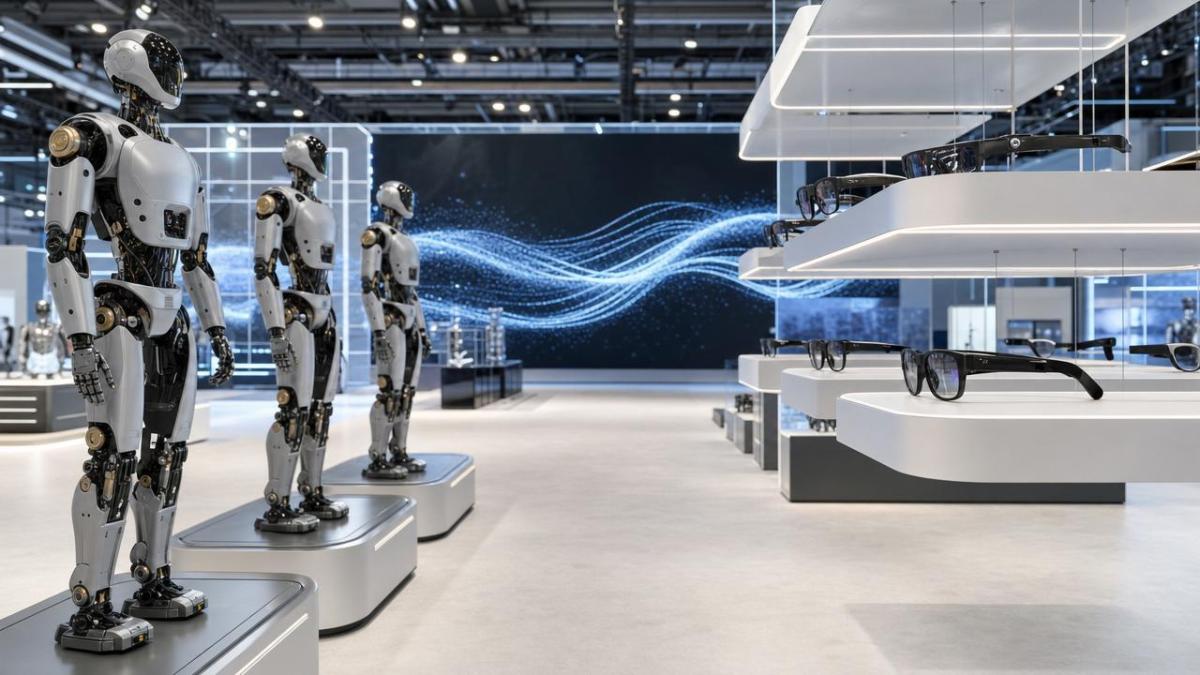
Exhibition Highlights and Verified Facts
From May 14–16, 2026, over 400 companies participated in the Shenzhen AI Terminal Expo. Native AI terminal products—including the Honor Robot Phone, OpenClaw embodied AI hardware platforms, and non-invasive health screening robots—were showcased collectively for the first time at scale. Exhibition data confirmed that procurement inquiries from buyers in Germany, the United Arab Emirates, and Mexico for embodied intelligent hardware—specifically units incorporating Kevlar-reinforced joint modules and 3D facial recognition modules—rose by 217% year-on-year.
Supply Chain Impacts Across Key Business Roles
Direct Exporters and Trading Firms
These firms face heightened scrutiny on conformity documentation for AI-PPE hybrids entering regulated markets. The surge in inquiries signals accelerated demand for pre-certified configurations—especially where functional safety (e.g., ISO 13849), biometric data handling (e.g., GDPR-aligned architecture), and mechanical durability (e.g., EN 149:2001+A1:2009 for structural integration) intersect.
Raw Material and Component Suppliers
Suppliers of Kevlar composites, active stereo vision modules, and low-latency edge AI SoCs are seeing revised forecast signals. Demand is shifting from generic specs toward application-specific validation—such as joint-module fatigue testing under cyclic load conditions or facial recognition performance under variable ambient lighting per IEC 62676-4.
Contract Manufacturers and OEMs
OEMs must now align production planning with dual-track compliance: standard electronics manufacturing requirements (e.g., IPC-A-610) plus emerging AI-device-specific protocols—including firmware update traceability (per UNECE R156), embedded AI model versioning, and fail-safe behavioral logging for embodied systems.
Logistics and Certification Support Providers
Third-party service providers are adapting to increased requests for bundled support—combining CE/UKCA marking coordination, GCC Conformity Assessment (G-Mark) preparation for UAE-bound shipments, and NOM-037-SCFI-2023 readiness assessments for Mexican distribution channels.
Strategic Priorities for Enterprises
Accelerated Certification Pathway Review
Firms supplying to German, UAE, or Mexican buyers should verify whether their embodied hardware qualifies under newly interpreted scopes of Machinery Directive 2006/42/EC Annex IV (high-risk categories) or UAE’s ESMA AI Device Guidance (v2.1, issued Q1 2026). Pre-assessment against ISO/IEC 42001 (AI management systems) is increasingly requested during technical bid alignment.
Component-Level Compliance Documentation
Kevlar joint modules and 3D facial recognition subsystems require granular technical files—not just final-product declarations. Buyers now routinely request test reports verifying mechanical integrity (ASTM D3822), optical accuracy (ISO 10993-10 for skin-contact interfaces), and inference latency under thermal stress (per JEDEC JESD22-A104).
Export Documentation Alignment with AI-PPE Hybrid Classifications
Customs classification and origin labeling must reflect dual-functionality: e.g., HS code 8543.70 (AI processing units) + 6307.90 (PPE components) may trigger split tariff and regulatory treatment. Harmonized interpretation remains pending—but early adopters are proactively engaging with EU Commission’s AI Office and UAE’s AI Office on classification guidance.
Industry Observation: Beyond the Show Floor
Analysis shows this sourcing surge reflects more than short-term trade momentum—it signals an inflection point in how international regulators define ‘intelligent PPE’. What deserves closer attention is the convergence of functional safety standards (e.g., ISO 13849), AI system governance (e.g., EU AI Act high-risk annex), and occupational health frameworks (e.g., ISO 45001)—all now applying concurrently to embodied hardware. Observably, manufacturers who treat certification as a post-design add-on risk extended time-to-market; those embedding compliance-by-design into development workflows gain measurable advantage in tender responsiveness and audit resilience.
Key Takeaway for Industry Stakeholders
This event underscores that AI hardware is no longer evaluated solely on computational capability—but on its integrated compliance posture across mechanical, electrical, software, and human factors domains. A rational conclusion is that competitive differentiation will increasingly hinge on verifiable, auditable, and jurisdictionally adaptive conformity infrastructure—not just product innovation alone.
Source Attribution and Verification Notes
This article was generated exclusively from the provided title, event date (May 14, 2026), and summary text. Specific official source links were not provided in the input and should be verified continuously. Stakeholders are advised to monitor upcoming updates from the European Commission’s AI Office, UAE Ministry of Industry and Advanced Technology (MOIAT), and Mexico’s Secretariat of Economy (SE) regarding AI-PPE classification guidelines, technical implementation rules, and conformity assessment roadmaps—none of which have been finalized as of May 2026.
Recommended News