
Search News
Industry Portal
Hot Articles
How much torque do heavy-duty brushless impact drivers need?
Time
Click Count
How much torque do heavy duty brushless impact drivers really need? The answer depends on the fastener, material, and task—not simply the highest number on the tool’s label. Too little torque can leave long screws unfinished or slow down repetitive work. Too much, applied without control, can strip threads, break fasteners, or crush the material under the head.
For most operators, the useful question is whether a driver can complete the intended fastening cycle consistently while remaining controllable. A tool rated around 150–250 N·m can cover many demanding screwdriving jobs, but that range is a starting point for evaluation, not a guarantee of performance or a recommended tightening torque. Large bolts and specified-torque joints may call for a different tool and a separate verification step.
Start with the job, not the maximum torque rating
An impact driver’s published maximum torque describes a peak capability under a manufacturer’s test conditions. It does not tell you that every screw needs that torque, or that the tool will deliver the same torque to every fastener. Joint stiffness, screw geometry, material density, battery condition, and the time spent impacting all affect the result.
Before comparing models, collect a small sample of the work you actually do. Record the fastener diameter and length, drive type, base material, presence of pilot holes, and whether the joint has a specified tightening torque. Include the hardest routine application, not just the easiest demonstration screw.
The same driver may handle several of these jobs, but the best setting and technique can change with every fastener. A long screw driven into dense hardwood, for example, may demand more from the tool than a larger-looking screw driven into softwood with a suitable pilot hole.
How to read torque ratings without overbuying
Separate tool capability from joint requirements
Maximum tool torque is not a target for the fastener. A driver advertised at 200 N·m can still overdrive a screw that requires far less torque. Conversely, a 200 N·m label does not prove that the tool will reliably complete every joint that appears to need that amount.
For comparison, 1 N·m is approximately 8.85 in-lb. A rating of 1,800 in-lb is therefore about 203 N·m. Convert units before comparing tools, and check whether each manufacturer describes the figure as maximum fastening torque, breakaway torque, or another measurement. Those figures serve different purposes and should not be treated as interchangeable.
Where the test method, battery, or accessory is stated, compare those details too. A published peak is useful for narrowing a shortlist, but it is a poor substitute for a trial on the intended joint. Treat a large difference in advertised torque as a reason to investigate, not as a precise prediction of the time saved on site.
Understand why speed and impacts matter
Torque is only one part of the driving cycle. Free speed affects how quickly the screw advances before resistance rises; impact rate and the hammer mechanism affect how the tool responds under load. Faster specifications do not necessarily produce a faster finished joint if the operator must slow down to avoid cam-out or damaged material.
Brushless motors can offer efficient electronic control and avoid brush replacement, but the motor type alone does not establish torque, durability, or runtime. Battery capacity, tool electronics, gearing, cooling, and workload all contribute to performance.
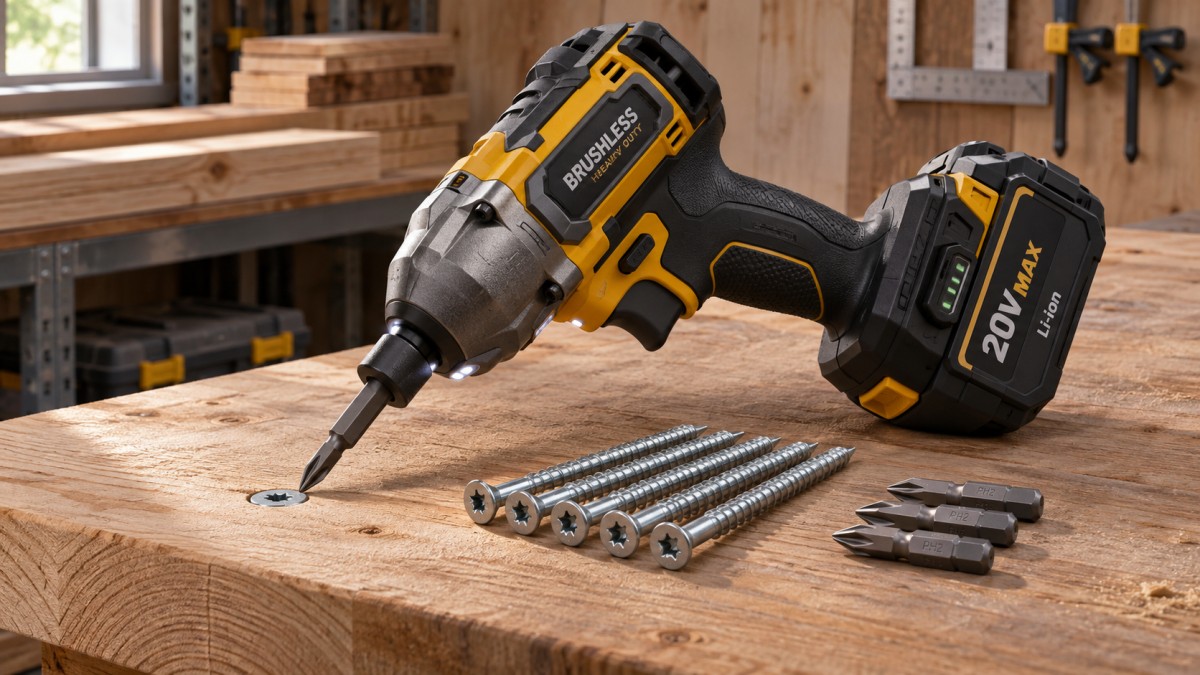
Match heavy duty brushless impact drivers to the fastening task
For timber and long construction screws
Long screws can encounter substantial resistance along the shank and threads. Dense timber, knots, dry material, and deep embedment can all increase the load. Start with the fastener manufacturer’s guidance on pilot holes, edge distances, and compatible materials; a more powerful driver cannot correct an unsuitable installation.
Choose a tool that completes representative screws without repeated stalling, excessive impact time, or damaged drive recesses. If a driver succeeds only with a freshly charged battery and ideal access, it may lack practical headroom for a full shift. Use the specified bit, keep it square to the screw, and replace worn bits before they start damaging heads.
For sheet metal and self-drilling screws
Here, the limiting factor is often control rather than peak power. Once a self-drilling screw breaks through and the threads engage, the remaining travel can be short. Continuing to impact can strip the sheet or damage a sealing washer.
Look for a responsive variable-speed trigger and, where available, a mode intended for self-drilling screws. Test that mode on the actual material thickness and screw. Automated slow-down or stop functions vary by manufacturer and do not remove the need to inspect the finished fastening.
For bolts and torque-controlled joints
Impact drivers are convenient for running down compatible small bolts, but their output is not a dependable measurement of installed bolt torque. Lubrication, thread condition, joint stiffness, and impact duration can change the result. A torque specification also may depend on whether the threads are dry or lubricated.
Follow the assembly procedure for the joint. If it calls for a calibrated torque wrench or another controlled tightening method, leave enough margin during rundown to complete that operation. Applying an impact driver until it stops and then checking the bolt can conceal an over-tightened joint; a click from a torque wrench does not by itself prove that the fastener was not already above the target.
When an impact wrench is the better choice
A typical impact driver uses a 1/4-inch hex accessory interface and is designed primarily around screwdriving and lighter fastening. Impact wrenches commonly use a square drive for sockets and are available across a broad range of sizes and torque outputs. The boundary is not absolute, but the distinction matters when bolts dominate the workload.
If the job regularly involves large fasteners, seized nuts, or high specified torque, assess a wrench designed for that work. Check the manufacturer’s guidance for the socket, retaining mechanism, and intended use. Use impact-rated sockets and adapters; an adapter does not turn a driver into a tool with the capacity or control of a correctly sized wrench.
Also distinguish removal from installation. Breakaway ratings describe a manufacturer-defined loosening capability, not a tightening setting. A tool able to remove a bolt is not automatically suitable for installing it to a specified preload.
Run a practical selection trial
A short, structured trial tells operators more than a catalog comparison alone. Use normal workpieces and consumables, follow site safety procedures, and keep the battery and setup recorded so that results can be compared fairly.
- Define the acceptance criteria. Specify the fastener and material, acceptable finish, target cycle, and any final torque or inspection requirement. Identify the hardest recurring job separately from an occasional extreme task.
- Prepare comparable samples. Use the same screw batch, bit type, material condition, pilot-hole method, and battery charge condition for each tool. Replace damaged bits rather than carrying their effects into the comparison.
- Begin with a controlled setting. Use a lower mode where appropriate, then increase power only if needed. Record whether the tool completes the drive, how long it impacts, and whether the operator can stop at the correct depth.
- Inspect the result. Check for stripped recesses, broken screws, crushed surfaces, damaged washers, and incomplete seating. For a specified-torque joint, use the required installation and verification procedure.
- Repeat across a realistic workload. Observe performance as the battery discharges and the tool warms during normal use. Stop and follow the manufacturer’s instructions if protection activates or the tool overheats.
Record failures as well as average speed. A model that drives quickly but damages occasional fasteners can create rework that outweighs its time advantage. If two tools both complete the job cleanly, the lighter or more controllable option may be the better fit for repetitive overhead work.
Look beyond torque when comparing total operating cost
The purchase price is only one part of the decision. Batteries, chargers, compatible bits, repairs, downtime, and operator fatigue all affect the cost of keeping a crew productive. Compare tools as complete working kits, including the battery configuration used in the trial.
- Battery availability: Check whether the existing battery platform covers the required shift pattern and whether spare packs and chargers are readily available.
- Ergonomics and access: Assess tool length, grip, weight with battery, and visibility at the fastener. A compact tool that fits squarely onto the screw can prevent damaged heads.
- Controls: Compare usable low-speed behavior, mode selection, lighting, and direction-switch placement while wearing the gloves normally used for the task.
- Service support: Check warranty terms, local repair access, replacement parts, and expected turnaround before standardizing a fleet.
- Exposure: Review manufacturer information and workplace requirements for noise and vibration, and use the protection and work practices specified for the task.
For mixed crews, standardizing on one battery platform can simplify charging and spares. It should not force every operator to use the largest driver: a compact tool and a higher-output model on the same platform may cover the work more effectively.
Choose the lowest capability that passes the real job
Shortlist heavy duty brushless impact drivers with enough rated capacity for the demanding work, then make the final choice on a representative trial. Require clean fastener seating, acceptable cycle time, controllable operation, and reliable performance over the expected workload. For torque-controlled joints, keep the specified final tightening and verification process separate from the driver’s advertised maximum.
Before purchase, have operators test the actual fasteners and materials they will encounter. The right tool is the one that finishes those joints consistently, fits the work area, and can be supported throughout its working life.
Recommended News