
Search News
Industry Portal
Hot Articles
What drives the total cost of smart streetlights in Europe
Time
Click Count
It usually starts with a simple budgeting question: one supplier quotes a lower fixture price, another offers a more complete package, and suddenly the internal discussion shifts from “Which light should we buy?” to “Why are these proposals so hard to compare?” That confusion is common in smart streetlights Europe projects. On paper, two offers may look close. In practice, one may require a different communication network, a more complex installation method, added software fees, or a maintenance model that changes the real cost over the next several years.
This becomes a problem when the purchase decision is made too early around luminaire price alone. A team may approve a vendor assuming energy savings will balance the investment, only to later discover that gateway placement, civil works, interoperability, data hosting, or spare parts access were never properly costed. If you are trying to compare bids for municipal roads, campuses, industrial parks, or mixed-use developments, the real task is not to find the cheapest unit. It is to understand what drives total cost, where hidden expense tends to appear, and which items deserve the closest review before a contract is signed.
Why fixture price rarely tells the full story
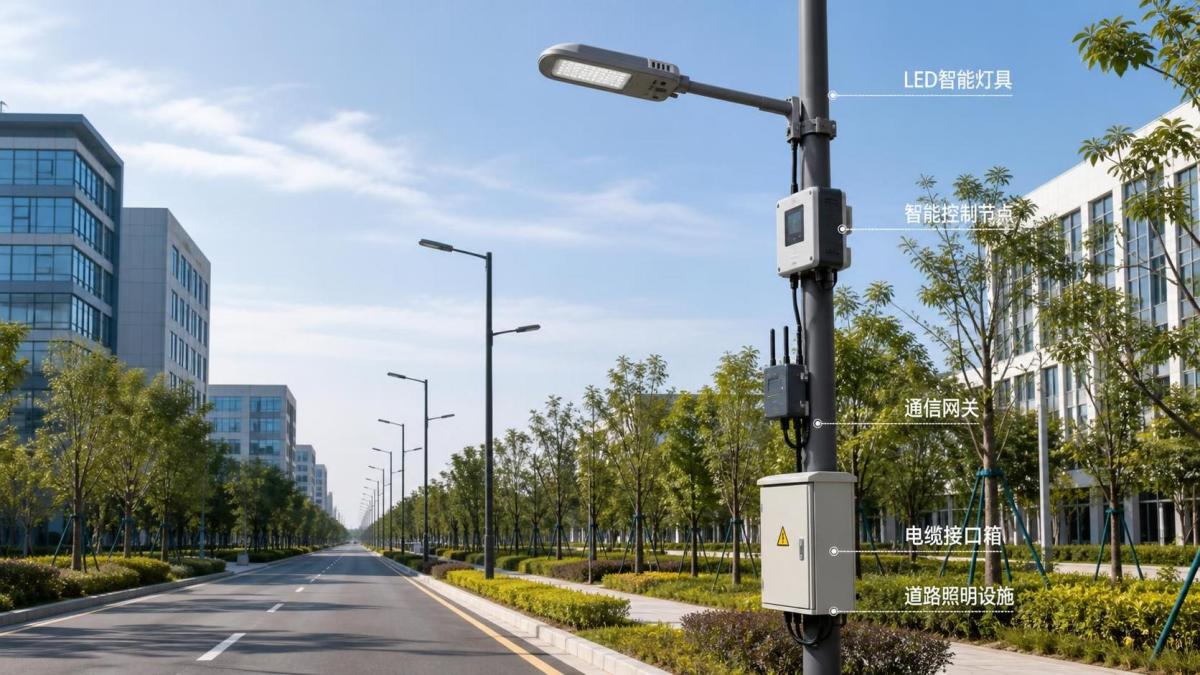
A smart streetlight is not just a light source with a pole bracket. It sits inside a wider system that can include LED modules, drivers, sensors, control nodes, communication devices, management software, mounting hardware, commissioning services, and long-term support. Once a project moves beyond a small pilot, each of those elements starts affecting budget in a different way.
Many buying teams run into the same early mistake: they compare luminaire wattage, optics, and unit cost, but leave system architecture for later. That approach works poorly because architecture decides many downstream costs. A standalone dimmable streetlight, a segment-controlled network, and a citywide connected platform may all use similar LED fixtures while producing very different installation, operations, and support expenses.
In other words, the total cost is shaped by the interaction between hardware, site conditions, control strategy, and lifecycle assumptions. When those pieces are reviewed together, proposals become much easier to judge.
Where budgets begin to move: the seven cost drivers that matter most
The most useful way to assess smart streetlights Europe procurement is to follow the cost from planning to operation instead of looking only at purchase price.
1. Control architecture and network choice
The first major driver is how each light communicates. Some projects rely on point-to-point node control, while others use grouped control, centralized cabinets, wireless mesh, cellular communication, or hybrid setups. Network design affects hardware count, coverage planning, installation labor, software integration, and future scalability.
A low-cost fixture can become expensive if it depends on a communication method that needs extra gateways, recurring data subscriptions, or specialist commissioning tools. On the other hand, a more expensive control node may reduce future maintenance visits if fault reporting is clearer and remote updates are easier.
This is also where compatibility matters. In commercial and smart LED lighting, protocols such as DALI or Zigbee are often discussed because they influence how well devices work together, how flexible dimming and sensing can be, and how hard later expansion will become. For streetlighting, the procurement question is less about trendy terminology and more about practical fit: Can the network operate reliably in your site conditions, and will future additions force a partial redesign?
2. Pole, bracket, and electrical condition on site
One of the most overlooked drivers is the existing infrastructure. A smart luminaire may fit mechanically but still require electrical upgrades, surge protection changes, rewiring in access doors, or bracket replacement due to load or mounting differences. Where poles are old, unevenly spaced, or inconsistent across districts, installation planning becomes slower and more expensive.
In refurbishments, costs often rise not because of the luminaire itself, but because teams discover late that the installed base is not standardized. A project that assumes plug-and-play replacement may turn into a segmented rollout with different accessories, lifting equipment schedules, and testing procedures for each street type.
Before comparing supplier quotes, it helps to check whether each offer clearly states assumptions about pole condition, cabling, protection devices, and installation height. If those assumptions differ, the quoted prices are not truly comparable.
3. Installation logistics and commissioning time
Labor cost is not only about mounting a fitting. In connected lighting, commissioning can absorb more time than expected. Device addressing, group creation, sensor mapping, testing, and software validation all add labor. If the platform is difficult to configure, every pole visit becomes more expensive.
This matters even more in urban areas where road closures, traffic management, night work rules, and coordination with utilities increase the cost of each installation hour. A technically advanced system may still be the right choice, but only if the rollout method is realistic. Procurement reviews should ask not just “What is the device cost?” but “How many steps are needed before the light is actually operating as intended?”
Some offers include factory pre-configuration or clearer commissioning workflows. These may not look dramatic in the quotation table, yet they can reduce disruption and help avoid repeat site visits. That is worth examining carefully when timelines are tight.
4. Energy performance under real operating profiles
Energy savings are a genuine part of the value equation, but they are often discussed too broadly. The more useful question is how the system performs under your actual dimming profile, traffic pattern, and seasonal operating hours. A streetlight that appears efficient at full output may not deliver the same operational value if controls are limited, dimming steps are crude, or sensor logic is too basic for the application.
For procurement purposes, the important point is this: projected savings should be tied to an operational scenario, not treated as a generic promise. If one proposal assumes aggressive dimming after midnight and another assumes a steadier output, those assumptions change the cost picture. They also affect public safety expectations, visual comfort, and acceptance by facility operators.
Energy cost should therefore be reviewed alongside optical performance, not separately from it. A system that cuts power use but causes poor uniformity or complaint-driven overrides can lose much of its expected advantage.
5. Software, hosting, and access rights
Software is where many “surprise costs” appear. Some systems include a basic management layer in the hardware package, while others rely on annual licensing, paid user seats, cloud subscriptions, or chargeable analytics modules. There may also be fees tied to map integration, API access, or export functions needed for maintenance teams.
This part is easy to underestimate because it is not physically visible during tender review. Yet in smart streetlights Europe deployments, software terms can shape long-term cost just as much as energy use. A platform that is easy to navigate but locked behind restrictive licensing may become expensive as more departments need access. A cheaper platform may reduce subscription cost but create operational inefficiencies if alarms, asset tracking, or firmware updates are difficult to manage.
Ask whether the quoted system supports the functions you actually need now and whether expansion triggers new fee layers. Also check what happens to your operational data if the contract ends or if a migration is needed later.
6. Maintenance model, spares, and fault recovery
Traditional streetlighting budgets often assume periodic replacement and reactive maintenance. Smart systems change that model, but not always in a cheaper way. Remote diagnostics can reduce inspection work, yet maintenance costs may rise if components are proprietary, replacement parts have long lead times, or local technicians need special tools and training.
One practical way to think about this is to separate maintenance into three questions: how often failures are likely to be detected, how quickly the failed component can be identified, and how easily the part can be replaced. A well-designed smart lighting system improves the first two. The third depends on design simplicity, documentation quality, and parts availability.
Procurement teams should be cautious with systems that bundle too many functions into single sealed assemblies without a clear replacement path. Integration can be elegant, but when one failure forces replacement of multiple healthy components, lifecycle cost tends to rise.
7. Compliance, documentation, and approval workload
In Europe, compliance affects cost in a quieter but very real way. Even when streetlights do not involve the same sensitivity as biometric security systems, connected infrastructure still raises questions around data handling, cybersecurity responsibilities, electrical safety documentation, and public procurement records. If sensors, cameras, or traffic-related features are involved, review requirements may become broader.
Cost appears here through engineering time, legal review, documentation preparation, approval delays, and later audit effort. A technically attractive product can become difficult to procure if its documentation is incomplete, its data pathways are unclear, or firmware update responsibility is poorly defined. This is not an abstract concern; it directly affects internal workload and project timing.
The comparison method that makes proposals easier to judge
When several offers are on the table, it helps to stop thinking in terms of “which supplier is cheaper” and shift to “which system creates the most controllable total cost.” That usually means building a side-by-side review around decision points rather than line items.
Start with the use case. Is the goal basic LED replacement with scheduled dimming, adaptive road lighting with sensing, or a broader smart-city node strategy? These are different purchases even if the luminaires look similar. Once the use case is fixed, review each proposal through four lenses: deployment effort, operating cost, maintenance burden, and expansion risk.
Deployment effort includes surveys, pole adaptation, communication setup, and commissioning. Operating cost includes power use, software fees, and connectivity charges. Maintenance burden covers diagnostics, spare parts, service access, and training needs. Expansion risk asks whether future streets, districts, or third-party systems can be added without major reinvestment.
This kind of review is more useful than relying on a single payback estimate because it exposes where a low opening price may be offset by difficult operation later.
Different project types create different cost pressure
Not every project should buy the same level of intelligence. On a simple road retrofit, a stable lighting design with dependable dimming and manageable maintenance may be more valuable than a feature-heavy system that few operators will use. In a campus, logistics park, or municipal district planning phased digitization, stronger connectivity and software integration may justify higher starting cost if they reduce future replacement or duplication.
That is why procurement discussions become clearer when the team identifies the operational owner early. The people who will maintain the system often notice cost drivers that purchasing documents miss, such as the difficulty of replacing control nodes at height, the burden of software training, or the consequences of using one vendor’s closed ecosystem.
In projects linked to broader smart lighting plans, there can also be value in selecting equipment built around mature control practices rather than isolated hardware savings. Within the wider smart hardware space, connected lighting increasingly depends on dependable electronics, stable communication behavior, and sensible system integration. Those factors do not eliminate cost, but they can make cost more predictable.
Questions worth settling before approval
Some of the most expensive mistakes happen because key questions are left for “post-award clarification.” It is safer to settle them earlier. For example: Who provides commissioning? What software functions are included from day one? Which parts are field-replaceable? Can the control network be expanded without replacing installed nodes? Are connectivity fees fixed, variable, or optional? What assumptions were made about poles and site power quality? Who handles firmware support and cybersecurity updates?
These are not technical details for later. They are cost questions in another form.
If you are comparing smart streetlights Europe offers right now, the most reliable path is to turn each proposal into an operating model rather than a fixture list. Once you do that, patterns become easier to see. Some bids are hardware-cheap but labor-heavy. Some are software-rich but subscription-dependent. Some are robust for standardized new-build areas but awkward for mixed legacy infrastructure.
A better decision usually comes from matching the system to the actual site, the actual maintenance capacity, and the actual expansion plan. That approach may not produce the lowest initial number on paper, but it is often the only way to keep the total cost understandable from procurement review through day-to-day operation.
Recommended News