
Search News
Industry Portal
Hot Articles
How to select cut-resistant Kevlar gloves for sheet metal handling
Time
Click Count
Select cut-resistant Kevlar gloves for sheet metal handling by matching the finished glove’s verified cut rating, grip, coverage, and dexterity to the actual task—not by choosing the fiber name alone. A glove that performs well when inspecting deburred parts may be unsuitable for separating oily sheets or moving freshly sheared blanks.
The decisive question is whether the glove protects the areas exposed to sharp edges while allowing controlled handling. A high cut rating cannot compensate for a slippery coating, exposed wrists, poor fit, or a handling method that places a hand beneath an unsupported sheet. No cut-resistant glove is cut-proof, and gloves do not protect against the crushing or shearing forces of machinery.
Define the handling hazard before specifying the glove
“Sheet metal handling” covers substantially different exposures. Record the material, thickness, component weight, edge condition, surface contamination, and handling motion. Include nonroutine work such as separating stuck sheets, clearing rejected parts, and transferring scrap; the glove selected for normal production may not address these tasks.
Edge contact deserves particular attention. A brief touch against a deburred flange differs from a loaded edge sliding across the palm. Greater contact force and sliding distance can increase the severity of a cut, even when the material and glove remain unchanged.
Remove avoidable exposure before increasing glove protection. Deburring, edge guards, suitable racks, sheet separators, and lifting devices can reduce contact with hazardous edges. Where rotating equipment or moving mechanisms create an entanglement risk, determine whether gloves are permitted for that operation. Hand protection is not a substitute for guarding, safe clearance procedures, or energy isolation.
Read the cut rating, not the Kevlar label
Kevlar is DuPont’s para-aramid fiber brand. It can contribute cut resistance and strength, but fiber identity does not establish the performance of a finished glove. Yarn construction, knitted structure, thickness, reinforcement, and other fibers all affect protection. Some gloves combine para-aramid with steel, glass, or other engineered materials to achieve their stated performance.
Request documentation for the exact glove model and construction being supplied. A report for a related product, an uncoated liner, or a different reinforcement arrangement does not automatically substantiate the ordered glove’s rating. Confirm which areas the test result represents: a palm-based result should not be assumed to describe the cuff, back of hand, or every seam.
ANSI/ISEA 105: distinguish adjacent levels from equal protection
ANSI/ISEA 105 classifies cut resistance from A1 through A9 using cut-through load measured under standardized conditions. Commonly encountered bands include:
These figures describe laboratory classification—not a safe sheet weight, permissible hand force, or guarantee against injury. There is no universal ANSI level mandated for all sheet metal handling. Establish the required minimum from the task assessment, available performance evidence, and controlled evaluation. Do not treat a supplier’s broad application label as the assessment itself.
EN 388: check which cut result is being quoted
Under EN 388:2016+A1:2018, the marking can include abrasion, circular-blade cut, tear, puncture, and ISO 13997 straight-blade cut results, plus an optional impact designation. The ISO 13997 cut classification uses letters A through F, with minimum cut forces of 2, 5, 10, 15, 22, and 30 newtons respectively.
A claim such as “EN 388 cut level 5” refers to the circular-blade classification, not ISO 13997 level F. Where glove materials dull the circular blade, the straight-blade result is particularly important. An “X” indicates that a result is not reported for that position; it must not be interpreted as high performance.
ANSI and EN classifications should not be treated as interchangeable labels. Their reporting conventions and classification boundaries differ, even where straight-blade testing is related. For cross-market purchasing, request the relevant rating and supporting evidence rather than accepting a simple conversion chart.
Match the coating to the surface—not just the material
For oily sheet metal, grip is part of cut-risk control. If a sheet slips, the handler may tighten their grip, reposition unexpectedly, or catch an edge. A glove with greater laboratory cut resistance can therefore be a poor operational choice if it provides inadequate control.
Coating chemistry provides a starting point, not a final answer. Nitrile-based coatings are candidates for oily handling, but smooth, foamed, and textured formulations behave differently. Polyurethane coatings can provide fine handling on suitable dry surfaces. Latex coatings can offer strong grip in some conditions, but oil compatibility and latex sensitivity require consideration.
Evaluate the exact glove against the lubricant, coolant, or protective oil present on the workpiece. Examine control after repeated contact, not only with a clean glove. Contamination can alter friction, saturate the liner, or affect the coating.
Also separate oil grip from chemical protection. A palm-coated cut-resistant glove is not automatically a chemical-resistant glove, and an uncoated back can remain exposed. If the fluid presents a chemical hazard, assess permeation and degradation data for that substance and glove construction.
Check coverage and dexterity where contact actually occurs
Sheet edges do not contact only the center of the palm. Fingers, the thumb-index web, wrists, and forearms may be exposed while separating sheets, turning components, or reaching across a stack. Match protective coverage to these movements.
A longer cuff can reduce exposed skin, but cuff length alone does not establish cut performance. Verify its construction and how it interfaces with sleeves. Where forearm contact remains foreseeable, a compatible cut-resistant sleeve may be necessary; a gap between sleeve and glove defeats the intended coverage.
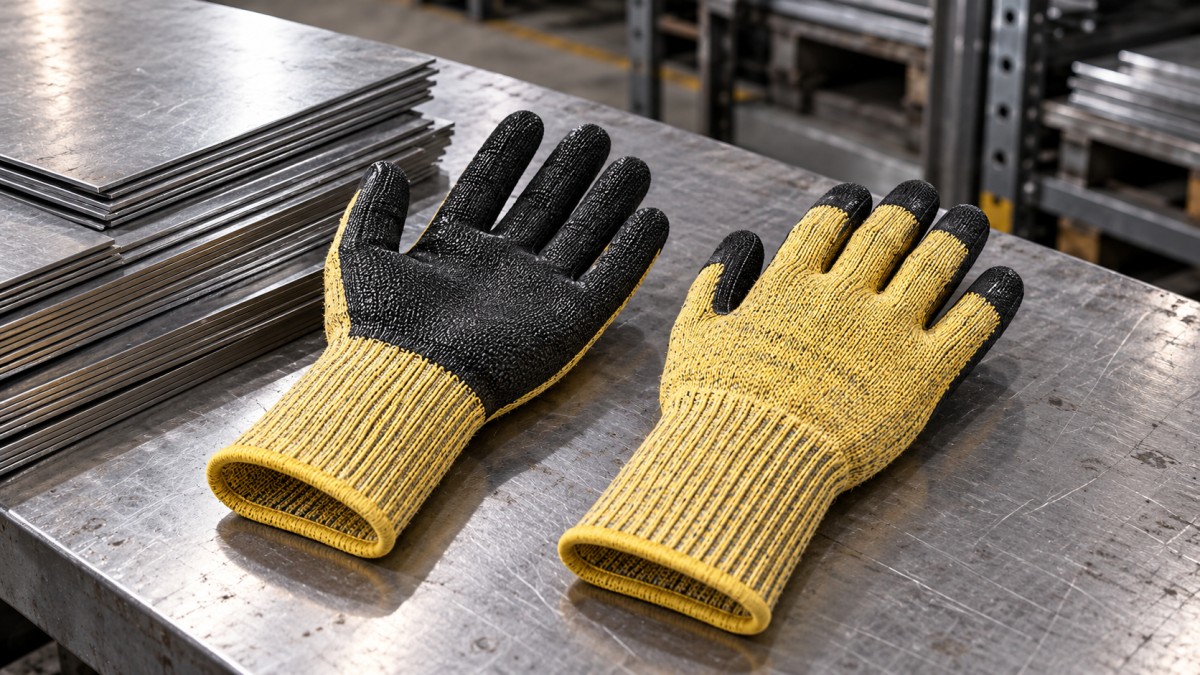
Thumb-crotch reinforcement can improve service life where edges repeatedly load that area. However, it may add stiffness, and the reinforcement’s protection should not be inferred from the palm rating. Check whether seams or transitions create vulnerable contact points.
Fit should be assessed across the required size range. Loose fingertips reduce control of thin parts and small gauges. An excessively tight glove can restrict movement, increase fatigue, or prevent full finger seating. Either condition can encourage removal during precision work.
Knitting gauge is not a protection rating. A finer-gauge glove may improve dexterity, but protection still depends on its tested construction. Compare candidates through representative movements: lifting a part from a flat surface, rotating it, positioning it in a fixture, and operating inspection tools. Reject the assumption that the thickest glove is necessarily the safest.
Separate cut, puncture, abrasion, and heat requirements
A sharp corner or projecting burr can create a puncture hazard distinct from a sliding cut. EN 388 puncture performance uses a standardized probe; it does not establish resistance to every narrow metal projection or needle-like point. Scrap with unpredictable protrusions may require a different glove construction or a handling tool rather than a higher cut rating alone.
Abrasion resistance matters because repeated rubbing can damage coatings and expose the knitted liner. However, a high abrasion classification does not prove that cut protection remains unchanged throughout service. Local wear at a fingertip or thumb crotch can be more important than the glove’s overall appearance.
Do not infer hot-metal protection from Kevlar content. The coating, liner, seams, and other components determine the finished glove’s behavior. If parts are hot, specify suitable thermal performance separately. Cut resistance also does not establish suitability for welding or electrical work.
Use a controlled trial to resolve competing requirements
Once documentary requirements are met, compare a small number of candidates under approved working conditions. The trial should evaluate usability and wear—not deliberately expose hands to sharp edges to discover a failure point. Never perform an improvised knife test on a glove being worn.
Use representative parts and normal handling aids. Include relevant sizes and surface conditions, and record observations consistently:
- Handling control: slipping, repeated regripping, and difficulty separating or positioning parts.
- Task interference: difficulty using gauges, fixtures, controls, or small fasteners.
- Fit and fatigue: fingertip slack, restricted movement, pressure points, and discomfort.
- Wear location: coating loss, broken yarns, seam damage, and thumb-crotch deterioration.
- Coverage: exposed skin during reaching, turning, and transferring parts.
Interpret results by failure mode. If two candidates meet the cut requirement but one slips on the production oil, address grip rather than merely increasing the cut level. If repeated damage concentrates at the wrist, review coverage and handling geometry. A single glove need not serve inspection, unloading, and scrap sorting when their hazards differ.
Make purchasing and replacement criteria auditable
An effective application selection guide must translate into a reproducible specification. Identify the approved model, required cut classification and standard edition, coating, coverage, sizes, and any necessary abrasion, puncture, or thermal performance. Require notification before changes to yarns, reinforcement, coating, or construction.
For EU supply, check the applicable conformity documentation, including the EU declaration of conformity and relevant examination documentation under the PPE framework. An ANSI performance claim is not, by itself, third-party certification. In either case, confirm that the evidence identifies the supplied product rather than relying solely on packaging symbols.
Incoming checks should confirm model identity, markings, size distribution, construction consistency, and visible defects. Retain approved samples and link deliveries to supplier or batch records where available. Appearance cannot verify a cut rating, but it can reveal an unapproved substitution or construction change.
Set removal criteria before issue: holes, cut yarns, open seams, damaged reinforcement, significant coating loss, persistent contamination, or a change in fit or grip. Follow validated cleaning instructions; do not assume laundering preserves performance or that washing restores an oil-saturated glove.
The sound selection is the glove that meets the assessed protection requirement and maintains reliable handling under the actual surface conditions. Keep that decision tied to the task: reassess it when edge quality, lubricant, component geometry, handling method, or glove construction changes—not only when an injury occurs.
Recommended News