
Search News
Industry Portal
Hot Articles
What drives Kevlar protective clothing price differences?
Time
Click Count
A purchasing comparison can look straightforward until two Kevlar garments with similar descriptions arrive with very different quotations. One may be a light cut-resistant sleeve or shirt for dry handling; another may be a layered, fully constructed garment intended to manage cut, abrasion, heat, or flash-fire exposure. Both may contain aramid fiber, yet they do not provide the same protection, fit, durability, documentation, or replacement cycle.
That is why Kevlar protective clothing price differences are driven mainly by the required hazard protection and the way that protection is built into a usable garment—not by the fiber name alone. Procurement teams should first define the exposure, required test standard, garment coverage, and expected wear conditions. Only then does a unit-price comparison become meaningful. The lowest quote can become the more expensive option if the clothing wears out early, restricts work, lacks traceable compliance records, or is unsuitable for the actual hazard.
Start with the hazard, not the material label
Kevlar is an aramid fiber valued for high tensile strength, cut resistance, and thermal stability. However, “Kevlar clothing” can describe a broad range of products: cut-resistant gloves and sleeves, protective shirts, welding-adjacent workwear, ballistic-related components, multi-layer industrial suits, and blends designed for specific workplace risks. The intended hazard changes the fabric construction and, therefore, the cost.
Before asking suppliers to quote, separate the risk into practical categories. A worker handling stamped metal edges has a different need from a maintenance technician exposed to hot surfaces, a glass-processing operator facing slash hazards, or a crew working where arc or flash-fire protection is specified. A garment selected only because it contains Kevlar may fail to address the actual risk.
A useful quote request states the work activity rather than simply saying “high-strength Kevlar suit.” For example, describe whether workers lift sharp parts repeatedly, work near intermittent heat, kneel against abrasive surfaces, wear the clothing over uniforms, or need high visibility. These conditions influence fabric weight, reinforcements, seam design, ergonomic panels, and accessory choices.
Fiber grade, fabric weight, and construction change the base cost
Not all aramid-containing fabrics are equivalent. Price varies with the fiber type, percentage of aramid content, yarn quality, fabric structure, and whether the material is blended with other fibers. A protective fabric may be knitted for flexibility, woven for structure, layered for higher resistance, or combined with coatings and linings. Each approach creates a different balance of mobility, comfort, durability, and protection.
Heavier fabric often costs more because it uses more material, but weight alone is not a reliable purchasing shortcut. A well-engineered lighter construction may provide the needed protection for a narrow task, while a heavier garment may be required where abrasion, repeated contact, or thermal exposure shortens service life. Buyers should compare verified performance and intended use rather than treating grams per square meter as a standalone measure of value.
Garment construction is another major variable. Flat seams, reinforced high-wear zones, double-layer forearms, protected closures, adjustable cuffs, elastic panels, and shaped knees all add labor and components. They can also improve fit and reduce premature damage. A low-cost garment with weak seams may be acceptable for occasional, low-demand work, but it can be a poor fit for continuous handling or environments where snagging is common.
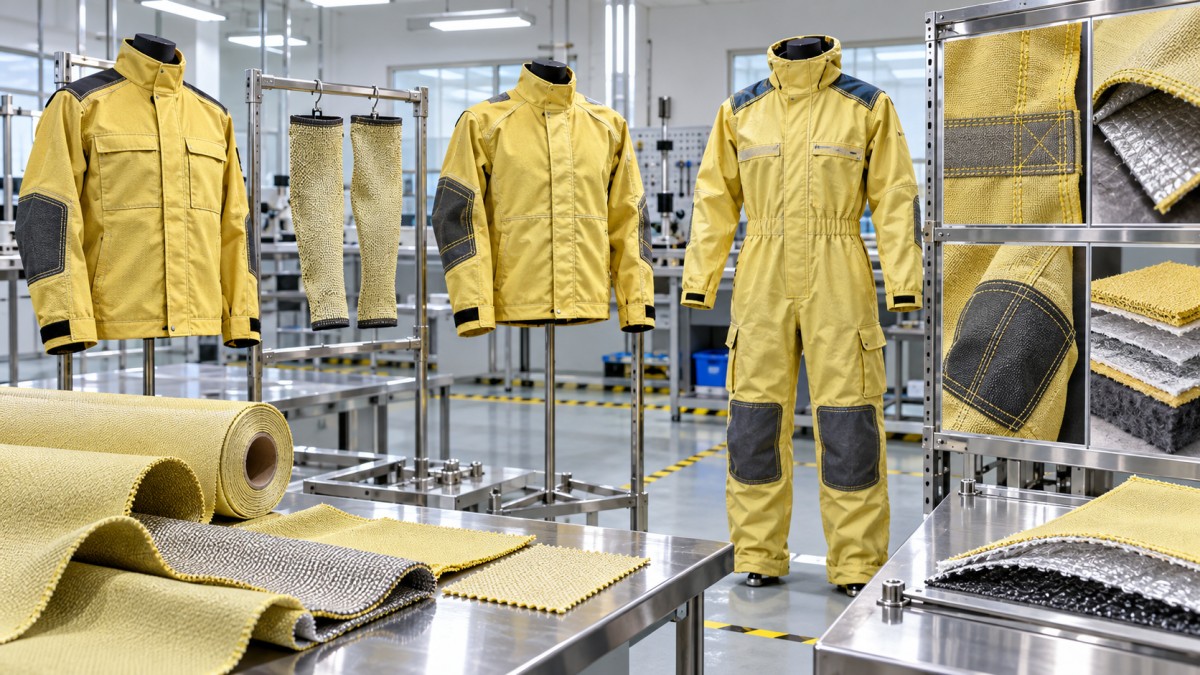
Look closely at seams because protective performance does not end at the fabric edge. A garment can use a strong cut-resistant textile but still fail operationally if stitching tears, cuffs stretch out, closures catch on machinery, or the fit leaves exposed gaps during normal movement. Request photos of inside seams, stress points, closures, and reinforcement zones along with the fabric specification.
Protection ratings and certification evidence are not interchangeable
A large share of price variation comes from the evidence behind a protection claim. Depending on the product category and market, clothing may need to meet specific requirements for cut resistance, heat and flame performance, mechanical hazards, visibility, chemical exposure, or other workplace risks. A supplier’s statement that a garment is “Kevlar reinforced” is not the same as documented testing for the protection level required by the buyer’s safety program.
Ask which test method applies to the quoted product, not merely to the raw fabric. The final garment may perform differently after cutting, sewing, adding trims, or incorporating other materials. If protection depends on a particular configuration, such as an added liner or detachable sleeve, make sure the quotation identifies that configuration clearly.
Documentation questions that expose false comparisons
- Is the stated rating for the finished garment, a fabric swatch, or a different product model?
- Which size range and garment configuration does the documentation cover?
- Are labels, lot numbers, and care instructions consistent with the quoted item?
- Does the product require a specific underlayer, outer layer, or companion PPE to achieve the stated protection?
- Can the supplier provide controlled specifications when substitutions of fabric, thread, fasteners, or trims are proposed?
Documentation raises the initial purchase price in some cases, yet it often lowers procurement risk. It gives safety, operations, and quality teams a common reference point when inspecting incoming goods or investigating field complaints. It also prevents an apparently similar alternative from entering the supply chain without equivalent protection evidence.
Design complexity is often hidden inside a quote
Two garments can have the same fabric composition but differ substantially in manufacturing complexity. A simple pullover protective shirt uses fewer panels and less assembly time than a tailored jacket with a collar, front closure, pockets, shoulder reinforcements, adjustable cuffs, reflective elements, and multiple size-specific patterns. Coveralls add even more complexity through leg construction, closures, and movement allowances.
Customization has a similar effect. Logo application, non-standard colors, special pocket layouts, custom sizing, altered sleeve lengths, reinforced tool-contact areas, and customer-specific labeling may all be valid requirements. They should be separated from the core garment price so buyers can see which features are necessary for safety and which are operational preferences.
Fit should not be treated as cosmetic. Clothing that is too loose can snag, interfere with controls, or create exposed openings at cuffs and waistlines. Clothing that is too restrictive may discourage use or cause workers to modify the garment in ways that reduce protection. A supplier with a broad, consistent size range and stable pattern control may quote higher than a basic supplier, but the difference may reduce sizing failures and avoidable returns.
Order quantity affects more than the visible unit price
Volume pricing is real, but buyers should understand why it changes. Larger orders spread pattern setup, production planning, inspection, packaging design, and freight consolidation across more units. Standard colors and common sizes are generally easier to produce and replenish than customized or unusually sized garments. Small orders may carry higher costs because materials must be purchased in less efficient quantities and production lines require changeovers.
Still, committing to a large order simply to secure a lower unit price can create a different problem: obsolete inventory, mismatched sizes, storage degradation, or stock that does not suit a revised hazard assessment. A staged purchase may be more sensible when a new garment is being introduced. The first order can validate sizing, worker acceptance, laundering behavior, and actual consumption before a long-term volume commitment is made.
When comparing supplier quotations, calculate the extended cost for the realistic mix of sizes, not only the advertised price for a medium-sized standard item. Ask whether the same price applies across the full range, whether minimum quantities apply per size or color, and whether replacement units can be purchased without triggering a new custom-production threshold.
Service life is where a low quote can lose its advantage
Protective clothing should be evaluated as a cost-per-usable-wear item, not only as a purchase order line. The relevant question is how long the garment remains fit for its intended task while retaining its required protective condition. Frequent abrasion, contact with sharp edges, industrial laundering, contamination, UV exposure, chemical contact, and improper storage can all shorten life.
Do not assume that a more expensive garment will automatically last longer. Instead, ask suppliers to define inspection criteria, permitted care methods, known limitations, and reasons for removal from service. A garment that cannot be safely washed after routine contamination may have a different replacement profile from one designed for repeated controlled laundering. Likewise, a highly protective garment that is uncomfortable in a hot work area may be worn inconsistently, undermining the value of its higher rating.
Include the operational costs around the garment: issue and tracking, storage, laundering, inspection, disposal, emergency replacement stock, and the downtime caused when the correct size is unavailable. These costs are especially relevant for reusable protective apparel. A lower purchase price may not offset a supply arrangement that causes shortages or requires frequent unplanned reorders.
Regional supply and compliance requirements alter landed cost
The factory price is only one part of the purchasing decision. Freight method, import duties, customs documentation, origin rules, local labeling requirements, lead time, currency exposure, and local inventory availability can change the final landed cost. A supplier with a lower ex-works quotation may become less competitive after transportation, inspection, and border-related costs are included.
Lead time also has a financial impact. If replenishment is uncertain, organizations often carry extra safety stock. That ties up capital and increases the chance that stock becomes unusable through changing requirements, damage, or aging. Conversely, dependable local stock may justify a higher item price if it allows a lower inventory buffer and faster replacement of damaged garments.
For cross-border purchases, clarify responsibility for product documentation, packing lists, country-of-origin information, labeling, and any required declarations before the order is issued. Problems discovered after goods arrive can delay deployment, even when the garment itself is physically sound.
A practical way to compare quotes on an equal basis
Create one controlled specification sheet and send it to every potential supplier. It should define the intended task, hazard type, protection requirement, garment style, coverage areas, color or visibility needs, size distribution, expected care method, documentation requirements, order volume, and delivery location. Without this common brief, suppliers may quote fundamentally different products, making price comparisons misleading.
- Screen for suitability first. Remove garments that do not match the required hazard protection or lack evidence needed for internal approval.
- Normalize the configuration. Confirm that all quotes include the same layers, closures, reinforcements, labels, packaging, and accessories.
- Compare landed and operating cost. Add freight, duties where applicable, inspection needs, expected replacement frequency, and inventory implications.
- Review sample garments under controlled use. Check range of motion, sizing consistency, seam quality, cuff coverage, and compatibility with gloves, helmets, harnesses, or other required PPE.
- Set substitution controls. Require written approval before changes to protective fabric, thread, trims, pattern, or manufacturing location that could affect performance or conformity.
The right purchasing decision is rarely the garment with the lowest listed price or the most elaborate specification. It is the option whose verified protection, practical wearability, supply reliability, and usable life fit the actual work exposure. Once those factors are aligned, Kevlar protective clothing price becomes a transparent commercial comparison rather than a guess based on fabric names alone.
- Last One:No more articles
- Next Article:How smart LED lighting app control can reduce after-hours energy wasteSep 23, 2026
Recommended News