
Search News
Industry Portal
Hot Articles
When does iris recognition make sense for data center access control?
Time
Click Count
Iris recognition for data centers makes sense when conventional credentials, cards, and fingerprints cannot deliver the assurance required for high-value infrastructure.
For technical evaluators, the decision depends on threat level, user throughput, environmental conditions, integration readiness, and biometric privacy obligations.
This guide examines where iris-based access control delivers measurable value, and where its cost or operational complexity may outweigh the security benefits.
Start With the Security Problem, Not the Biometric Technology
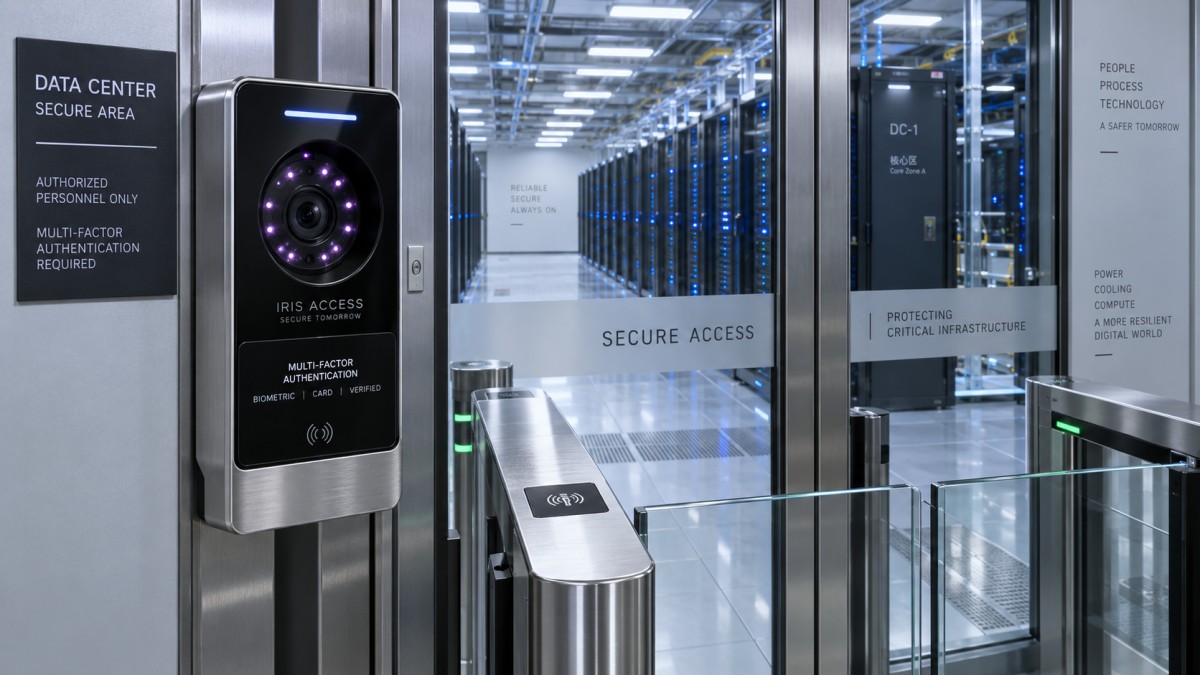
Iris recognition should not be treated as a premium replacement for every badge reader at a data center entrance.
It is most valuable where an organization needs strong evidence that the person entering is the authorized individual.
Access cards establish possession, but they do not reliably establish identity because cards can be borrowed, copied, stolen, or mishandled.
PINs add a knowledge factor, yet they remain vulnerable to observation, sharing, phishing, and poor password discipline.
Fingerprint readers offer stronger identity assurance, but they may perform inconsistently with damaged skin, gloves, moisture, dirt, or occupational wear.
Iris recognition analyzes detailed patterns in the colored ring surrounding the pupil, using near-infrared imaging to capture biometric templates.
These patterns are highly distinctive, stable over time, and generally difficult to replicate using ordinary photographs, screens, or printed artifacts.
For data center access control, the practical question is whether identity fraud would create an unacceptable operational, financial, regulatory, or safety consequence.
If unauthorized entry could expose customer equipment, network cores, backup media, cryptographic keys, or industrial control systems, stronger verification may be justified.
Conversely, a low-risk office lobby or supervised visitor reception area may gain little from deploying iris recognition at every door.
High-Assurance Zones Are the Strongest Use Case
The strongest case for iris recognition for data centers is usually limited to clearly defined high-assurance zones.
These areas include main data halls, meet-me rooms, network operations centers, cage corridors, security control rooms, and media storage areas.
They may also include loading zones where equipment can be removed, decommissioning rooms, and spaces containing privileged administration terminals.
In these environments, physical access is often directly connected to digital security, availability commitments, and customer trust.
A malicious or unverified entrant may connect unauthorized hardware, tamper with cabling, remove drives, photograph infrastructure, or disrupt cooling systems.
Biometric verification is particularly useful when a facility houses multiple tenants with different authorization levels and strict separation requirements.
Colocation providers often need reliable proof that a contractor entered only the approved cage, cabinet area, or restricted operational zone.
Iris recognition can reinforce this control when paired with role-based permissions, anti-passback rules, door alarms, and video verification.
It is less compelling for shared circulation areas where access is already monitored and the risk of a single unauthorized presence remains limited.
A zone-based deployment usually produces a better security-to-cost ratio than installing biometric readers throughout the entire campus.
Use Iris Recognition When Credential Sharing Is a Credible Threat
Credential sharing is a common weakness in facilities that depend heavily on proximity cards, mobile credentials, and contractor badges.
Even mature organizations encounter convenience-driven behavior when staff lend access cards to colleagues during urgent maintenance activities.
Temporary workers may also receive broad permissions because administrators need to support fast onboarding, shift changes, and emergency access.
These practices weaken audit trails because a system records the credential presented rather than the person who physically entered.
Iris recognition improves accountability by linking an access event to a biometric identity instead of a transferable token alone.
This distinction matters after an incident, especially when security teams must investigate equipment tampering, service disruption, or policy violations.
A biometric event log can support forensic reconstruction when combined with camera footage, door position data, visitor records, and ticketing information.
However, iris recognition should not be presented as infallible proof without considering enrollment quality, liveness detection, and system configuration.
Technical evaluators should ask vendors how the platform handles failed matches, duplicate enrollment attempts, degraded images, and manual overrides.
The objective is not simply stronger authentication, but a more trustworthy record of who accessed a sensitive physical environment.
Throughput and User Experience Can Determine Project Success
Security controls that create bottlenecks at shift changes can quickly become operational problems, regardless of their authentication strength.
Data centers frequently depend on technicians, facilities engineers, electricians, contractors, and security personnel arriving within narrow maintenance windows.
An iris recognition system must therefore be assessed for real-world throughput, not just vendor claims made under ideal laboratory conditions.
Evaluate the complete transaction: approach, positioning, image capture, liveness check, decision time, door release, and passage through the portal.
Modern contactless iris readers can authenticate users quickly when enrollment data is high quality and user positioning guidance is clear.
But performance can degrade if users wear reflective glasses, move too quickly, approach from poor angles, or encounter bright backlighting.
Reader placement, mounting height, lighting conditions, lane design, and on-screen prompts affect adoption as much as algorithm accuracy.
A pilot should include diverse users, including people with glasses, safety eyewear, mobility limitations, varying heights, and different shift routines.
Facilities with frequent large group entry may need multiple biometric lanes, staged entry procedures, or secondary credential workflows to avoid queues.
For a small number of privileged users entering controlled rooms, a brief verification step is usually easier to justify.
Environmental Conditions Need a Practical Site Assessment
Iris recognition is often marketed as suitable for low-light security environments because near-infrared illumination supports image capture in darkness.
That capability can be useful at perimeter doors, secure vestibules, unattended night entrances, and interior areas with limited ambient lighting.
Still, darkness alone does not guarantee reliable deployment because the surrounding environment influences user behavior and image quality.
Direct sunlight, reflective surfaces, outdoor weather exposure, dust, humidity, vibration, and temperature extremes can affect reader placement and maintenance needs.
Facilities engineers should inspect each proposed location rather than assuming that a successful lobby installation will translate to a loading dock.
Consider whether users will wear hard hats, prescription glasses, face shields, respirators, or other PPE during normal entry procedures.
Iris systems generally avoid the hygiene concerns of touch-based fingerprint readers, which is useful in industrial or high-traffic environments.
However, face shields and certain protective eyewear can interfere with capture, requiring an alternative approved authentication path for affected personnel.
Door interlocks, mantraps, and turnstiles must also be physically compatible with the reader’s operating distance and user positioning requirements.
The best design treats iris recognition as part of an entrance system, rather than an isolated device mounted beside a door.
Biometric Privacy and Compliance Must Be Designed Early
Biometric information requires more careful governance than standard badge identifiers because it relates to an individual’s physical characteristics.
For many organizations, privacy obligations are the deciding factor in whether iris recognition should be deployed at all.
Technical evaluators should involve legal, privacy, human resources, security, and information governance stakeholders before selecting a vendor.
The first question is what the system stores: a protected biometric template, an encrypted image, raw imagery, or multiple associated records.
Organizations should minimize collection and retention, storing only the information needed to authenticate authorized users and investigate defined security events.
Retention rules should specify when templates are deleted after employment termination, contractor offboarding, access revocation, or account inactivity.
Consent requirements vary by jurisdiction, employment relationship, and applicable privacy law, so a generic policy statement is rarely sufficient.
For GDPR-regulated operations, biometric data used for unique identification may require a clear lawful basis and additional safeguards.
Data protection impact assessments, access controls, vendor agreements, breach procedures, and transfer restrictions may all be relevant to implementation.
A technically capable platform becomes a poor choice if its data architecture prevents the organization from meeting its legal obligations.
Integration Quality Matters More Than a Standalone Reader Demo
An iris recognition reader creates the most value when it strengthens the existing physical access control ecosystem rather than operating separately.
Integration should cover identity lifecycle management, access permissions, visitor workflows, alarm monitoring, audit reporting, and incident response procedures.
At minimum, evaluators should confirm compatibility with their access control panel, directory services, badge management platform, and security operations tools.
Enrollment should be governed by authoritative identity records, preventing duplicate profiles, orphan accounts, and unauthorized self-enrollment.
Access rights should continue to follow established role, site, tenant, schedule, and approval policies instead of being manually managed within biometric software.
Well-designed integration also ensures that an employee’s termination or contractor expiration automatically disables associated biometric access rights.
Security teams should test what happens during network outages, controller failures, reader faults, and cloud service interruptions.
The system must have documented fail-safe or fail-secure behavior that matches life-safety requirements, emergency egress rules, and operational continuity plans.
Fallback credentials may be necessary, but they must be controlled carefully or they can undermine the high-assurance purpose of biometric verification.
Ask whether fallback events are prominently logged, reviewed, and restricted to specific roles, locations, or documented exceptional circumstances.
Evaluate Accuracy, Liveness Detection, and Attack Resistance
Biometric performance claims can be misleading when they rely only on a single accuracy percentage without operational context.
Technical evaluators should examine false acceptance rates, false rejection rates, failure-to-enroll rates, and failure-to-acquire rates separately.
A low false acceptance rate matters because the system must minimize the chance that an unauthorized person gains access.
A manageable false rejection rate matters because frequent denial of legitimate users creates delays, support workload, and pressure for unsafe overrides.
Liveness detection is equally important because attackers may attempt to bypass weaker systems with photographs, displays, synthetic images, or presentation artifacts.
Ask vendors what spoofing methods their systems have been tested against and whether independent testing supports their anti-spoofing claims.
Also determine how the reader responds to uncertain matches: deny access, request another capture, require a second factor, or escalate to security staff.
For critical zones, a multi-factor design is often appropriate, combining iris recognition with a managed credential, PIN, or supervised access process.
This layered approach reduces reliance on any single control while preserving a strong identity link for audit and investigation purposes.
A pilot should measure false rejections and exceptions under actual site conditions before approving an enterprise-wide rollout.
Build the Business Case Around Risk Reduction, Not Novelty
Iris recognition systems involve costs beyond reader hardware, including installation, enrollment, integration, licenses, support, privacy controls, and training.
The investment is easier to defend when the organization can connect those costs to specific risks and measurable operational outcomes.
Relevant benefits may include reduced credential sharing, stronger tenant separation, fewer disputed access events, and faster incident investigations.
Organizations may also value reduced exposure to lost-card replacement, administrative credential resets, and audit findings related to weak identity assurance.
Yet cost savings alone rarely justify biometric deployment in a data center with limited risk, low personnel turnover, and effective existing controls.
The strongest business case usually combines high asset value, meaningful insider-threat exposure, demanding customer commitments, and strict audit requirements.
Evaluate total cost of ownership over several years, including reader replacement cycles, software upgrades, template migration, and vendor support obligations.
Procurement teams should avoid comparing only acquisition price because inexpensive systems can create expensive integration, reliability, and compliance problems later.
Use a weighted evaluation model that scores security assurance, privacy controls, interoperability, environmental fit, usability, resilience, and lifecycle cost.
This approach gives stakeholders a transparent basis for deciding whether iris recognition addresses a real control gap.
When Iris Recognition Is Probably Not the Right Choice
Iris recognition is not automatically the best solution simply because a data center contains valuable digital infrastructure.
It may be excessive where access is already restricted to a small, continuously supervised team and existing controls provide strong accountability.
Facilities with low visitor volume, minimal contractor access, and limited high-security zones may obtain better value from improved badge governance.
Upgrading door hardware, camera coverage, security staffing, visitor escort procedures, and access review processes can sometimes reduce risk more effectively.
It may also be unsuitable where privacy law, labor agreements, customer requirements, or local culture make biometric collection difficult to justify.
Operational fit matters as well, especially when the workforce regularly uses eyewear or PPE that prevents consistent iris capture.
If expected exception rates are high, security staff may spend too much time handling overrides, reducing the system’s intended assurance.
Organizations should also avoid rushed deployment when their access control platform lacks reliable identity lifecycle integration or incident logging capabilities.
In those situations, foundational access governance should be improved before adding an advanced biometric authentication layer.
Choosing not to deploy iris recognition can be the correct technical decision when the control does not materially improve the risk posture.
Conclusion: Deploy Iris Recognition Where Identity Certainty Changes the Risk
Iris recognition for data centers makes the most sense where knowing exactly who entered materially changes security, compliance, or incident-response outcomes.
Its best role is usually at controlled boundaries protecting high-value infrastructure, privileged operational spaces, and tenant-separated environments.
Technical evaluators should validate real-world throughput, environmental performance, anti-spoofing capabilities, integration quality, and biometric data governance before procurement.
A focused pilot in one high-assurance zone can reveal whether the technology improves security without creating unacceptable friction for legitimate users.
When deployed as part of a layered access strategy, iris recognition can provide strong accountability that cards and PINs cannot deliver alone.
When the underlying risk is modest or governance is immature, improving conventional access controls may be the more effective investment.
- Last One:No more articles
- Next Article:How to assess an OEM hardware solutions manufacturer’s quality controlsOct 04, 2026
Recommended News