
Search News
Industry Portal
Hot Articles
DALI Protocol vs 0-10V for Smart Lighting Projects
Time
Click Count
DALI Protocol vs 0-10V for Smart Lighting Projects
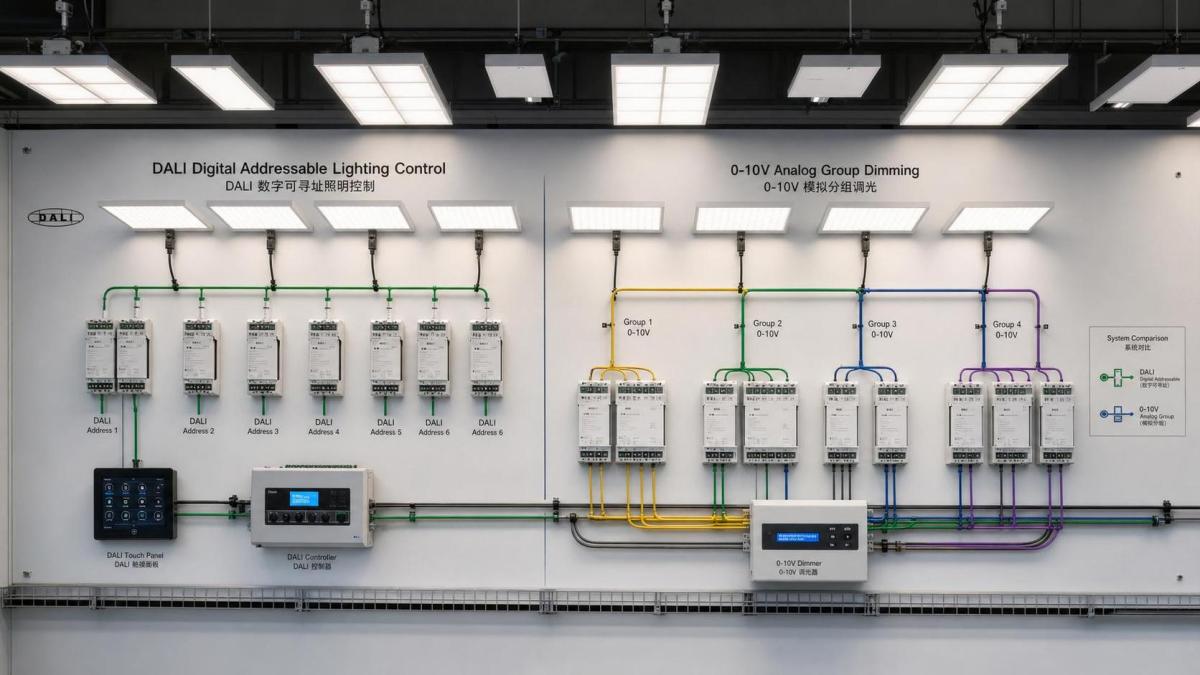
When planning a smart lighting project, the control method shapes far more than dimming performance.
It affects wiring strategy, commissioning time, maintenance visibility, and upgrade flexibility.
That is why the DALI protocol often enters the conversation early.
Many teams still compare the DALI protocol with 0-10V because both are proven options.
Yet they serve very different project goals.
In commercial buildings, logistics hubs, factories, hospitals, and smart city sites, that difference becomes practical very quickly.
If the priority is simple analog dimming, 0-10V may still work well.
If the priority is addressable control, diagnostics, zoning, and future integration, the DALI protocol usually has the edge.
The real decision is not which system is newer.
The better question is which one reduces operational friction over the full project lifecycle.
What the DALI Protocol and 0-10V Actually Do
0-10V is an analog dimming method.
It changes light output by varying voltage between 0 and 10 volts.
The concept is straightforward, widely understood, and relatively easy to deploy.
However, 0-10V usually controls fixtures by group, not as individual devices.
The DALI protocol is different.
It is a digital communication standard built for lighting control and device-level management.
Each luminaire or driver can receive its own address.
That allows individual dimming, scene setting, feedback, and fault reporting.
In simple terms, 0-10V tells lights how much to dim.
The DALI protocol tells each light what to do, and also reports what is happening.
Core Differences That Influence Project Decisions
From a selection perspective, several differences matter immediately.
- Control logic: 0-10V is analog, while the DALI protocol is digital.
- Device management: 0-10V is group-oriented, while the DALI protocol supports addressable fixtures.
- Feedback: 0-10V usually offers no return data, while the DALI protocol supports status and diagnostics.
- Scene control: 0-10V needs extra logic, while the DALI protocol handles scenes natively.
- Scalability: 0-10V becomes harder to manage as complexity rises.
- Integration: the DALI protocol fits better with sensors, BMS platforms, and smart building strategies.
These differences may look technical on paper.
In practice, they affect budget certainty, change order risk, and operating efficiency.
Where 0-10V Still Makes Sense
0-10V is not obsolete.
It remains useful in straightforward projects with stable layouts and limited automation needs.
Typical examples include small retail units, storage rooms, basic office retrofits, and low-complexity utility spaces.
It can also work when teams need familiar installation practices and a lower initial control budget.
In these conditions, simplicity has real value.
Still, the tradeoff is visibility.
Once a project demands flexible zoning or data-driven maintenance, 0-10V starts to show its limits.
Why the DALI Protocol Fits Modern Smart Lighting Better
The DALI protocol aligns well with how modern facilities actually operate.
Buildings are no longer static assets.
They are expected to adapt to occupancy, daylight, shift schedules, and energy targets.
This is where the DALI protocol stands out.
- It supports individual fixture addressing for precise control.
- It simplifies scene setting for meeting rooms, corridors, warehouses, and public zones.
- It improves commissioning because groups can be reconfigured without major rewiring.
- It enables maintenance teams to identify failures faster.
- It supports sensors and intelligent controls that improve energy performance.
More importantly, the DALI protocol supports future-ready decision making.
That matters when a project may later connect to broader smart building or smart city systems.
Cost, Maintenance, and ROI: Looking Beyond First Price
Initial cost often pushes teams toward 0-10V.
That is understandable, especially under tight capex pressure.
But control selection should not stop at material cost.
A more useful comparison includes commissioning labor, troubleshooting time, reconfiguration costs, and energy savings potential.
The DALI protocol often costs more upfront.
However, it can lower total ownership cost in medium and large projects.
That happens because reprogramming is easier than rewiring.
Fault isolation is faster, and control precision can improve energy performance.
In offices and education buildings, changing room usage is common.
In warehouses and industrial sites, shift patterns and task zones often change.
In those cases, the DALI protocol protects the project from expensive rigidity.
A Quick Comparison Table for Selection
Best-Fit Scenarios by Project Type
Selection gets easier when tied to real project conditions.
For a compact retrofit with fixed zones, 0-10V may be enough.
For a multi-floor office, hospital, airport, campus, or industrial facility, the DALI protocol is often the safer long-term choice.
For street lighting or public infrastructure, the DALI protocol supports better asset visibility and smarter maintenance planning.
For warehouses with occupancy sensors and daylight harvesting, digital control creates more measurable value.
The larger and more dynamic the project becomes, the stronger the case for the DALI protocol.
Common Risks When Choosing the Wrong Control Strategy
A poor control choice rarely fails on day one.
The pain usually appears later.
- Spaces change, but the lighting zones cannot adapt without rewiring.
- Maintenance teams lose time locating failed drivers or fixtures.
- Energy targets are missed because control granularity is too limited.
- The building management strategy evolves, but the lighting layer cannot keep up.
This is why the DALI protocol is often selected not only for features, but for risk control.
It gives projects room to change without losing control of cost or performance.
How to Make the Final Choice
A practical selection process starts with five questions.
- Will the layout, tenancy, or usage pattern change over time?
- Do you need fixture-level control or only zone dimming?
- Are fault reporting and maintenance visibility important?
- Will sensors, automation, or BMS integration expand later?
- Is long-term operational efficiency more valuable than lower first cost?
If most answers are yes, the DALI protocol is usually the stronger decision.
If most answers are no, 0-10V may still be the right fit.
The key is aligning the control layer with business reality, not just specification habit.
For many current smart lighting projects, the DALI protocol delivers the better balance of intelligence, flexibility, and lifecycle value.
It supports smarter commissioning today and fewer constraints tomorrow.
Before locking the lighting specification, map expected control needs over five years, not just handover day. That step usually makes the right answer clear.
Recommended News