
Search News
Industry Portal
Hot Articles
EU Requires EN 62443-4-1 for Smart Street Lighting IoT Imports
Time
Click Count
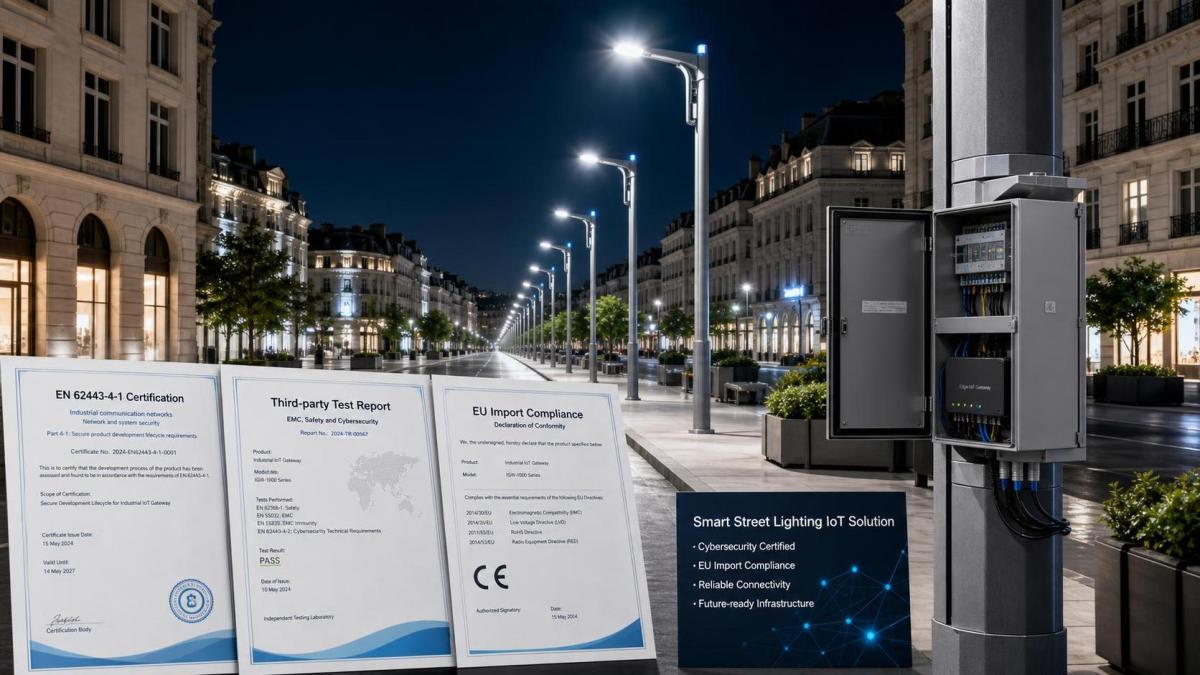
Effective August 4, 2026, the European Union has put into force an implementing measure under the Cyber Resilience Act that directly affects Smart Street Lighting IoT products entering the EU market. For smart street lighting devices, including products with embedded gateways, customs clearance now depends on IEC/EN 62443-4-1 certification together with a declaration of conformity and third-party test reports. This is a development that exporters, lighting control equipment makers, gateway suppliers, integrators, procurement teams, and cross-border delivery partners need to watch closely because the rule is tied not only to technical compliance, but also to whether products can physically enter the market.
What the New Requirement Now Covers
According to the information provided, from August 4, 2026, the EU formally began enforcing an implementing directive linked to the Cyber Resilience Act. The measure states that all Smart Street Lighting IoT equipment entering the EU market, including devices with built-in gateways, must pass IEC/EN 62443-4-1 certification for industrial cybersecurity development processes.
The same requirement also calls for a declaration of conformity and third-party test reports. The stated impact falls directly on Chinese exporters shipping smart street lighting controllers, edge gateways, and integrated IoT lighting systems to the EU. Products that do not hold the required certification may be detained by customs or returned.
Where the Immediate Pressure Will Be Felt
Export shipments now face a compliance gate at the border
For companies directly exporting into the EU, the main impact is at the customs and delivery stage. The issue is no longer limited to product positioning or customer acceptance; it now affects whether goods can clear import procedures at all. What deserves closer attention is the linkage between product eligibility and documentation readiness, especially for shipments already planned around fixed delivery windows.
Equipment manufacturers need to align product release with certification status
Manufacturers of smart street lighting controllers, edge gateways, and integrated systems may be affected at the product release and order-fulfillment stages. From an industry perspective, the practical pressure point is whether product models intended for EU delivery are backed by the required certification path and supporting documents, rather than only meeting functional or commercial specifications.
System integrators and solution providers may see project execution risks
For integrators delivering combined lighting and IoT systems, the requirement may affect project handover, installation schedules, and customer coordination. Even where the end product is sold as a complete solution, the embedded gateway element remains within the stated scope of the rule, which means compliance risk can sit inside a broader package offering.
Supply chain and logistics teams will need tighter document control
Supply chain service providers, customs-facing teams, and delivery coordinators may be affected through documentation review, shipment preparation, and exception handling. Observably, the business risk here is not only product non-compliance but also incomplete proof materials at the time of shipment or import processing.
What Companies Should Check First
Confirm which EU-bound product categories are in scope
Companies should first map whether their EU-bound portfolio includes smart street lighting controllers, edge gateways, or integrated IoT lighting systems covered by the requirement. The key practical point is product classification within actual export business, especially where gateway functions are embedded rather than sold as standalone hardware.
Review certification and supporting file readiness together
The information provided makes clear that certification alone is not the only issue; a declaration of conformity and third-party test reports are also required. In operational terms, businesses should pay attention to whether these materials are complete, internally consistent, and ready to be presented in the contexts where customers, customs, or logistics partners may request them.
Separate policy wording from delivery execution
Analysis shows that the commercial risk lies in the gap between knowing the rule and being able to ship under it. A product line may appear commercially ready, but if the required certification status and supporting documents are not aligned with a specific shipment, the problem will surface at the delivery stage rather than during sales discussions.
Prepare customer and supplier communication around lead times
For exporters and project teams, another practical focus is communication with EU customers, contract counterparts, and upstream suppliers. Where orders involve fixed milestones, companies should watch for possible friction around documentation timing, shipment planning, and acceptance expectations tied to certification status.
Why This Reads as More Than a One-Off Border Notice
From an industry perspective, this update is better understood as an enforceable market-access condition rather than a routine administrative reminder. The confirmed fact is narrow and clear: specified smart street lighting IoT products entering the EU now require IEC/EN 62443-4-1 certification and supporting compliance materials. Analysis shows that the broader signal lies in how cybersecurity development-process requirements are being tied directly to customs outcomes for connected infrastructure-related devices.
It is more appropriate to understand this as an immediate compliance change with longer-term signaling value. The immediate result is already explicit in the provided information, since uncertified products may be detained or returned. The longer-term meaning still needs continued observation, particularly in how companies adjust product planning, documentation workflows, and customer commitments for EU-facing business.
How the Market Should Read This Development Now
At this stage, the most grounded conclusion is that the rule creates a concrete import threshold for Smart Street Lighting IoT devices sold into the EU. It should not be treated as a general industry talking point or only as a regulatory headline. For affected businesses, the issue sits at the intersection of product qualification, shipment execution, and contract delivery. Current observation suggests this is best read as an active compliance requirement with direct operational consequences, while its wider market effects still deserve continued tracking.
Basis of This Article and What Still Needs Verification
This article is based on the user-provided news title, event date, and event summary. For this type of industry update, source categories typically relevant to verification may include official regulatory notices, company statements, industry association releases, authoritative media reporting, and standards-related documents. No specific official source link was provided in the input, so the precise official publication path still requires ongoing verification. Follow-up attention should remain on any further official wording, implementation clarifications, and practical documentation expectations affecting EU-bound shipments.
Recommended News