
Search News
Industry Portal
Hot Articles
What Drives Smart Streetlights Costs in North America Projects?
Time
Click Count
Start with total installed cost, not fixture price
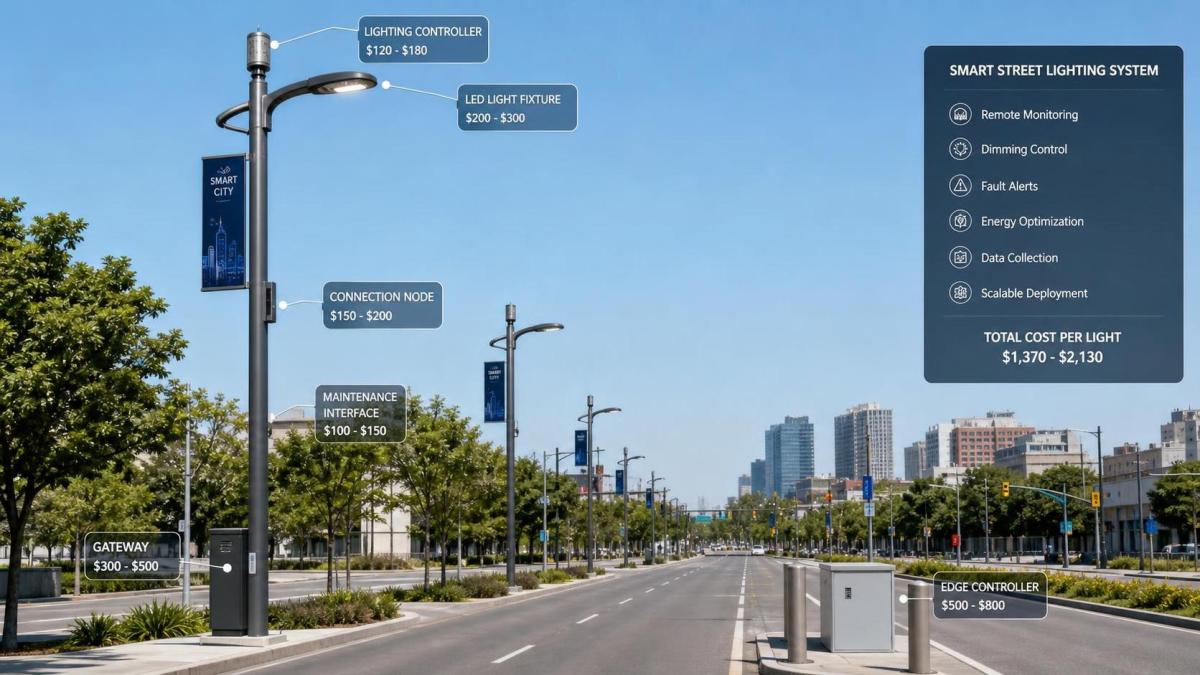
When procurement teams price smart streetlights North America projects, the fastest way to make a bad comparison is to line up luminaire quotes and stop there. In practice, the fixture is only one layer of the budget. Controls, poles, mounting hardware, network access, commissioning, traffic control, utility coordination, and long-term maintenance often move the real number more than a small difference in unit price.
A useful buying checklist starts with one question: what exactly is included in the installed system price? If one supplier prices the luminaire only, another includes node controllers, and a third bundles software plus commissioning, the spreadsheet may look clean while the procurement decision is already distorted.
Before comparing bids, break the project into cost buckets and force every vendor to map its offer to the same structure.
Check what “smart” actually means in the quote
“Smart streetlight” can mean very different things. For one vendor it may mean remote on/off and dimming. For another it includes metering, fault alerts, scheduling, asset mapping, and open API integration. That difference has a direct cost impact, but it also changes staffing, data ownership, and future upgrade options.
Ask suppliers to identify, line by line, whether the quoted system includes:
- individual node control or group control only
- energy monitoring at fixture level or cabinet level
- fault detection and alert routing
- adaptive dimming schedules
- integration with existing city management platforms
- future sensor attachment capability
This matters because buyers often pay for expandability they never use, or they buy a low-cost control layer that later blocks interoperability. A cheaper closed system can become expensive the moment the municipality wants parking, traffic, air quality, or public safety sensors on the same network.
Separate retrofit economics from full replacement economics
North America projects are rarely all the same. Some are simple LED and controls retrofits on healthy poles with stable wiring. Others involve corroded poles, outdated arms, inaccessible handholes, or utility-owned assets that create extra approval steps. The cost gap between these two situations is not minor.
Before bid evaluation, classify the inventory:
- Fixtures that can be replaced one-for-one.
- Poles or brackets likely needing structural replacement.
- Locations needing trenching, new conductors, or service upgrades.
- Sites with utility ownership or shared jurisdiction.
If suppliers are pricing from incomplete asset data, they will either load contingency into every unit or submit an attractive number that later expands through change orders. Neither outcome helps procurement.
Poles, foundations, and wind loads can change the budget fast
Lighting teams sometimes focus so heavily on optics and controls that they miss the structural side. In many projects, poles are the hidden cost driver. Taller mounting heights, different arm lengths, added control boxes, banners, cameras, or future sensor loads can trigger a different pole specification. Once that happens, foundation work and civil labor may follow.
A practical check is to compare the proposed smart streetlight package against the current pole loading assumptions. If the project includes anything beyond the luminaire itself, ask whether the vendor has accounted for the full mounted configuration. The procurement file should clearly show who carries responsibility for structural compatibility: luminaire supplier, pole supplier, EPC contractor, or owner’s engineer.
This is also where “future-ready” language needs discipline. A pole designed for future devices may cost more today. That premium is reasonable only if the owner has a real expansion roadmap.
Connectivity is not just a hardware line item
Smart lighting networks carry recurring costs, and those costs vary by architecture. Cellular designs may reduce local infrastructure work but introduce ongoing carrier fees. Mesh networks may lower recurring telecom costs but need gateways, network planning, and enough node density to perform well. Wired control approaches can reduce radio concerns but may increase installation complexity.
When comparing options, buyers should ask for a five-year cost view covering:
- device hardware
- commissioning labor
- software license or subscription
- connectivity fees
- firmware and cybersecurity support
- replacement process if a node fails
A low hardware bid can hide a high software tail. That is common in procurement rounds where one department buys the equipment but another inherits the operating expense.
Installation labor in North America is rarely a minor variable
Labor conditions can swing the project total more than buyers expect, especially in urban corridors, winter schedules, union environments, or roads requiring strict traffic management. Night work, police detail, flagging, bucket truck access, lane closure windows, and disposal rules all add cost before a single light is energized.
This is where procurement teams should challenge overly clean installation assumptions. Ask bidders how many fixtures per crew per day they used in their pricing model, whether commissioning is included in the same rate, and how they treated inaccessible or damaged poles. If the answer is vague, the cost model is probably thin.
Do not treat energy savings as automatic payback
Energy reduction is one of the strongest economic arguments for smart streetlighting, but procurement should still test the assumptions behind the savings case. The baseline wattage, burn hours, dimming schedule, utility tariff structure, and maintenance savings methodology all matter. A system with aggressive dimming potential may look excellent on paper, yet the owner’s public safety policy may limit actual dimming depth.
A reliable comparison asks vendors to calculate savings from the same baseline conditions. Keep three things aligned: existing inventory wattage, annual operating profile, and target light levels. If each bidder chooses its own baseline, the payback comparisons stop being useful.
Watch the photometric scope before it becomes a cost issue
Procurement decisions often get pushed by energy and software features, but light distribution still drives the field outcome. If the proposed optics do not fit roadway width, pole spacing, setback, or pedestrian conflict areas, the project can end up with additional fixtures, re-aiming, resident complaints, or redesign work.
The right check is simple: require the photometric package to match the actual application category being bought. Main roads, collector roads, intersections, parking areas, and pedestrian-heavy districts should not all be priced with a single generic optic assumption. Cheap uniformity on paper can become expensive remediation later.
Warranty language matters more than the headline term
A ten-year warranty sounds strong until you read what is excluded. For smart streetlights North America buyers, the real questions are operational. Does the warranty cover the driver, control node, surge protection device, and communications hardware? Who pays for lift trucks and labor? Is replacement advanced-shipped, repaired, or pooled by batch? What triggers a valid claim?
Procurement should also distinguish between component warranty and software support commitment. Hardware can remain under warranty while the control platform moves into a paid support tier. That separation needs to be visible in the total cost model.
Software ownership, cybersecurity, and data access belong in the cost review
This is where many lighting procurements quietly become IT procurements. If the system depends on cloud dashboards, user roles, remote firmware updates, and API access, buyers need to know what happens after handover. Can the owner export asset and energy data without penalties? Are admin accounts included? What support is bundled for security updates? How are failed devices re-provisioned in the field?
These questions do not always increase the bid price, but they absolutely affect operating cost and vendor lock-in risk. A lower entry price with restrictive platform terms can be the more expensive choice over the life of the system.
Look for procurement distortions caused by allowances and alternates
Experienced buyers read the exceptions page before they read the total. Allowances for commissioning, assumptions about existing poles, exclusions for traffic control, and alternates for controls can all make one proposal appear cheaper than another. The issue is not that allowances are wrong. The issue is that they hide where the price is still unresolved.
A clean bid review usually includes a normalization pass. Strip out non-comparable assumptions, restate them in a common matrix, and only then compare totals. This takes extra work up front, but it is still easier than managing disputed scope after award.
A practical buying sequence that keeps cost surprises down
For most procurement teams, the best order is not to start with brand preference or software demos. Start with asset condition, application scope, and operating model. Then price the project in the same shape you expect to own it.
- Verify existing inventory by fixture type, pole condition, controls status, and ownership.
- Define what “smart” must include for this project, and what can wait.
- Require bidders to separate hardware, controls, software, labor, and recurring charges.
- Normalize installation assumptions, especially traffic control and commissioning.
- Compare lifecycle support terms before final award, not after negotiation.
That sequence usually leads to a better decision than chasing the lowest fixture number. In North America streetlighting work, the projects that stay on budget are usually the ones where procurement forces clarity early: what is being bought, who will maintain it, what the network will cost to live with, and which field conditions are likely to turn a neat quote into an expensive reality.
Recommended News